Tajikistan’s modern statehood is inseparable from water. Positioned at the upstream core of the Amu Darya basin, the country’s mountainous terrain functions as a vast natural reservoir, storing snow and ice through winter and releasing meltwater in spring and summer. This geography gives Tajikistan one of Central Asia’s most valuable assets: the capacity to generate large volumes of low-carbon electricity through hydropower. At the same time, it binds the country to a set of enduring structural constraints-constraints that are inherently political, because the same rivers that power Tajikistan’s grid also underpin downstream agriculture, shape regional diplomacy, and influence fiscal and legitimacy choices at home.
By 2025-2026, these pressures are intensifying. Climate volatility is testing the reliability of hydropower, winter electricity shortages remain a lived reality for many households, and the government is doubling down on mega-projects and power-sector reforms in an effort to resolve energy insecurity while positioning Tajikistan as a future electricity exporter. The familiar cycle is becoming sharper: unstable water flows lead to power shortages-especially in winter-which in turn generate political pressure and require active legitimacy management by the state.
Renewable Riches, Seasonal Scarcity
On paper, Tajikistan’s electricity system looks enviable. Hydropower accounts for as much as 95 percent of generation, placing the country among the most renewable-heavy power systems in the world. In practice, that concentration creates vulnerability. The system is highly exposed to hydrology and temperature shifts, and it relies heavily on a small number of assets. The Nurek hydropower plant alone typically produces around 70 percent of national electricity output in normal years. This centralization delivers efficiency when reservoirs are well supplied-but it becomes a systemic risk when inflows fall short or storage timing shifts.
That risk materialized again in late 2025. An unusually warm and dry autumn pushed reservoir levels to critically low levels, forcing authorities to impose electricity-saving restrictions that hit major industrial users-companies responsible for roughly one-fifth of GDP. Water levels at the Nurek reservoir fell several meters below the previous year’s benchmark, and Tajikistan turned to electricity imports from neighboring states, underlining a paradox that has become increasingly visible: even a hydropower-dominant system can become import-dependent under stress.
For households, the political stakes are even higher. Winter rationing remains the most tangible indicator of state capacity for many citizens. By the end of 2025, the national utility acknowledged that rationing introduced in autumn would extend into early 2026, with rural areas reporting access to electricity for as little as six or seven hours per day. The brief restoration of full supply over the New Year holidays-followed by an immediate return to restrictions-illustrated how electricity provision functions not just as infrastructure management, but as a tool of public reassurance.
This is the core contradiction of Tajikistan’s energy model: abundant renewable potential coexisting with administrative scarcity. The problem is not annual generation capacity alone, but seasonality, limited storage, grid inefficiencies, and financing constraints that prevent water abundance from translating into year-round reliability.
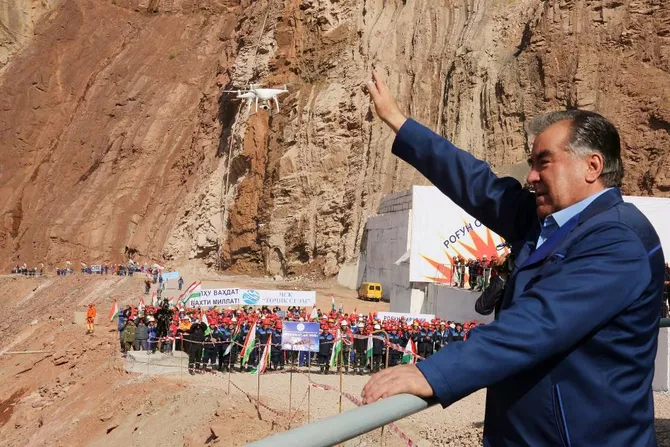
Photo: Tajikistan President's press service
Climate Volatility and the Erosion of Predictability
Climate change is no longer a distant risk for Tajikistan-it is already reshaping the operating environment. Recent environmental assessments show that average temperatures have risen significantly faster than the global mean, accelerating glacier retreat across the country. More than a thousand glaciers have already disappeared, and projections suggest substantial future shrinkage in key river basins that feed the hydropower system. In some scenarios, runoff in the Amu Darya basin could fall sharply compared to recent averages.
For electricity generation, the challenge is timing rather than volume alone. Hydropower depends on predictable seasonal flows. As glaciers retreat and snowmelt peaks earlier in the year, water availability increasingly mismatches winter demand, when heating needs drive electricity consumption to its highest levels. At the same time, more frequent floods, landslides, and avalanches damage transmission infrastructure, raise maintenance costs, and disrupt supply.
These dynamics turn technical energy management into a governance stress test. When reservoirs drop, the state must decide which users bear the burden-households, small enterprises, or large industrial consumers. Such decisions are never purely economic. They shape perceptions of fairness, competence, and state legitimacy, particularly in a country where winter power shortages have long been politically sensitive.
Rogun as Infrastructure, Symbol, and Fiscal Strategy
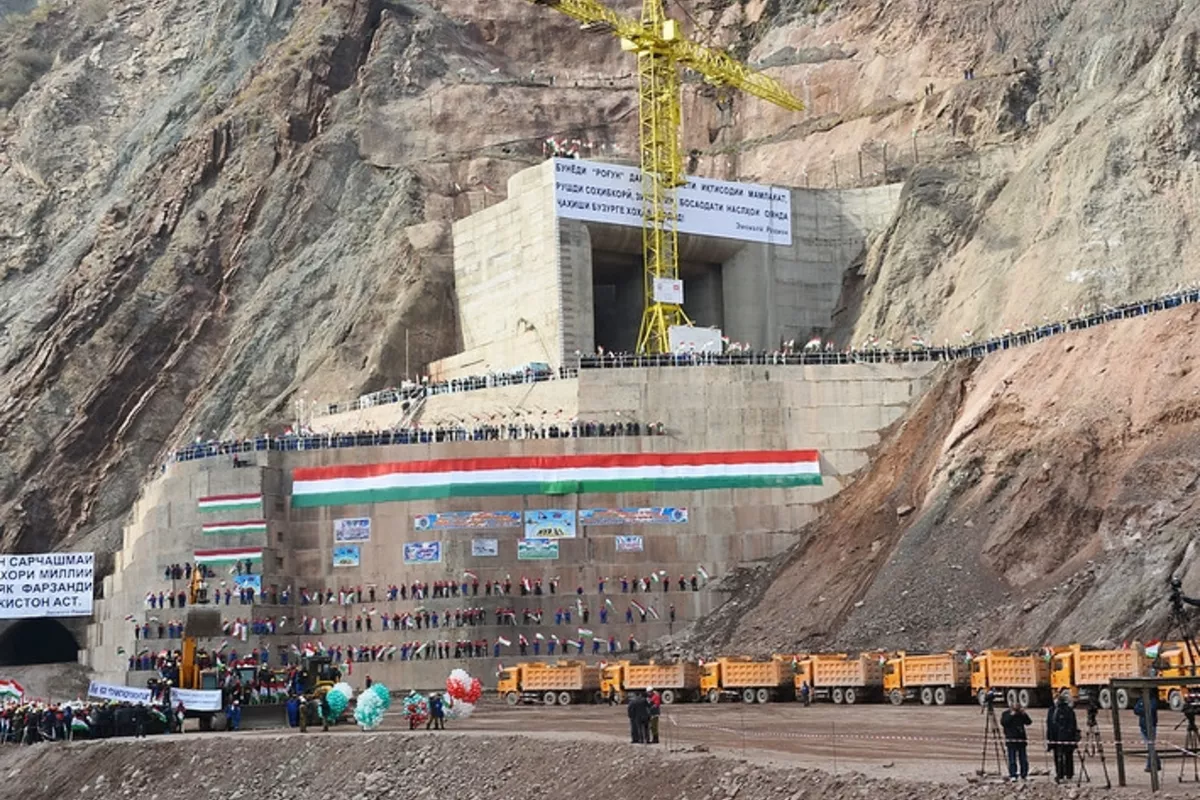
Against this backdrop, the government’s central response remains unchanged: Rogun. Designed with an installed capacity of 3,780 megawatts and a large regulating reservoir, the Rogun hydropower plant is intended to solve the winter deficit by reshaping the seasonal profile of electricity availability. Its value lies not only in additional capacity, but in storage-allowing water captured during high-flow periods to be released when demand peaks.
Yet Rogun is more than an energy project. It is a fiscal strategy and a nation-building instrument. Completion is expected to require over six billion dollars, with a significant share mobilized through grants and concessional finance from a wide array of international partners. To manage the domestic politics of such a massive investment, authorities have tied the project to a nationwide benefit-sharing mechanism, earmarking a portion of electricity revenues for social support during and after construction.
The political narrative around Rogun is explicit. Commissioning milestones are publicly linked to promises of ending rationing, reinforcing the message that current hardships are temporary and solvable. At the same time, this megaproject logic carries risks that cannot be engineered away. Larger reservoirs mitigate variability but do not eliminate drought years. Even concessional debt constrains fiscal space, potentially crowding out spending on maintenance, health, and education. And procurement, tariffs, and cost recovery can become flashpoints if citizens perceive that the burden is unevenly distributed.
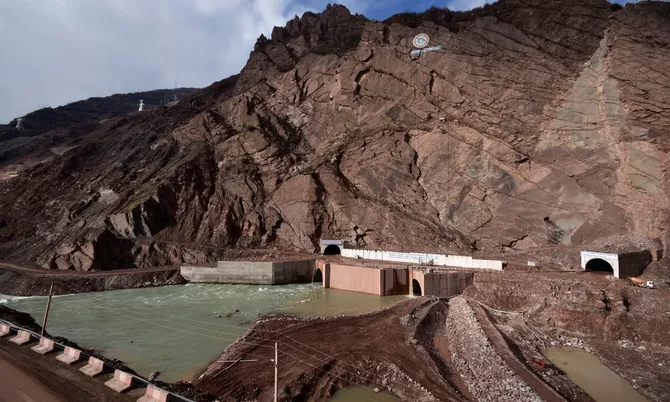
Photo: AFP
Export Ambitions and the Geography of Dependence
If Rogun represents the supply-side bet, cross-border transmission represents the revenue bet. The flagship project is CASA-1000, a regional electricity corridor designed to export surplus summer hydropower from Tajikistan and Kyrgyzstan to Afghanistan and Pakistan. The logic is straightforward: monetize excess summer generation to improve power-sector finances and indirectly support winter energy security.
The constraint is equally clear. While much of the infrastructure in Central and South Asia is largely complete, the project depends on a transit route through Afghanistan. Construction there was suspended after 2021 and only resumed later under special safeguards. Even now, full operation hinges on progress in a country facing profound political and security uncertainty.
This creates a structural vulnerability that no domestic reform can fully offset. Tajikistan’s export revenues-and the political promise that exports will stabilize the energy system-are contingent on factors beyond its control. As a result, export infrastructure is framed domestically not just as trade policy, but as social stability infrastructure, expected to underwrite reliability at home.
From Capacity Expansion to System Reform
Recognizing that generation alone cannot resolve shortages, the government has begun to articulate a broader reform agenda. A new power-sector development program for 2026-2030 emphasizes market development, loss reduction, grid rehabilitation, and improved energy security alongside export growth. This reflects a growing acknowledgment that winter rationing is not solely a supply problem.
Transmission bottlenecks, technical losses, weak metering, and payment discipline all erode effective capacity. Without addressing these institutional and operational gaps, even large new plants will struggle to deliver uninterrupted power. In this sense, the reform agenda represents an implicit admission that Tajikistan’s energy constraint is as much institutional as it is hydrological.
Water Policy as Foreign Policy
Energy policy cannot be separated from water diplomacy. Tajikistan has increasingly emphasized integrated water management, basin-level planning, and improved data systems in its national strategies. Long-term planning documents stress the need for institutional reform, better hydrological information, and stronger transboundary cooperation.
The country has also elevated glacier preservation and cryosphere research as diplomatic themes, positioning itself as an agenda-setter in international water and climate forums. This strategy serves both environmental and geopolitical purposes, reinforcing Tajikistan’s upstream role while seeking legitimacy for large storage projects.
Still, the fundamental tension remains: upstream regulation creates downstream anxiety. Even as regional cooperation improves, every major reservoir raises questions about seasonal releases and agricultural planning in neighboring states. Durable solutions depend less on declarations than on transparent data-sharing, agreed operating rules, and credible dispute-resolution mechanisms-forms of institutional cooperation that often lag behind dam construction.
Strong Growth, Persistent Fragility
Macroeconomic indicators in 2025 painted a positive picture. Growth remained robust, inflation was contained, foreign exchange reserves were healthy, and public debt ratios declined. Remittances continued to underpin domestic demand, accounting for nearly half of GDP.
Yet these strengths coexist with deep vulnerabilities. Heavy reliance on remittances exposes the economy to external shocks. Hydrological stress can simultaneously hit households and industry through rationing. And large infrastructure commitments can strain governance capacity if multiple projects compete for limited administrative and financial resources.
Photo: AKIpress news agency
What Will Matter Most in 2026
The real test for Tajikistan in 2026 will not be new capacity announcements, but constraint management. Several indicators will be especially revealing.
First, the handling of rationing: not whether it disappears entirely, but whether schedules are predictable, transparent, and perceived as fair, particularly in rural areas. Second, progress on grid losses and utility reform-tariffs, metering, collections, and maintenance funding will show whether institutional weaknesses are being addressed. Third, financing discipline and visible delivery of Rogun’s benefit-sharing commitments will shape public trust. Fourth, progress on the Afghanistan segment of CASA-1000 will determine whether export revenues move from promise to reality. Finally, advances in basin-level planning and data transparency will indicate whether water diplomacy is becoming operational rather than rhetorical.
A Constraint, Not a Puzzle
Tajikistan’s challenges are not mysterious. They are the predictable result of hydropower dependence under climate volatility, a winter-heavy demand profile, limited fiscal space, and deep regional interdependence. The politics arise because every technical solution carries distributional consequences-who pays today, who benefits tomorrow, and who absorbs the risk when water behaves differently than models predict. Managing those trade-offs, rather than simply building capacity, will determine whether Tajikistan can turn its water advantage into durable energy security and political resilience.