From Munich to Belgrade: mapping Baku’s strategic shift
In February 2026, Azerbaijan’s foreign policy doctrine entered a new phase marked by proactive, results-driven diplomacy. President Ilham Aliyev’s participation in the Munich Security Conference on 13-15 February, followed immediately by official engagements in Belgrade on 15 February, forms a single strategic trajectory that consolidates Baku’s position on the Eurasian geopolitical map as a middle power.
This diplomatic sequence signals that Azerbaijan has moved beyond the role of a purely regional actor. It is increasingly positioning itself as a key broker of stability, energy security, and emerging transport corridors across a broad arc stretching from Eastern Europe to the Balkans.
Against the backdrop of global uncertainty in 2026, the Munich Security Conference emerged as the principal intellectual and political arena where Azerbaijan forcefully articulated its national interests before the world’s leading decision-makers. Within the framework of the conference, the meeting between the head of state and Ukrainian President Volodymyr Zelensky created space not only to address regional security issues but also to raise, in a principled manner, sensitive diplomatic incidents such as the shelling of Azerbaijan’s embassy in Kyiv.
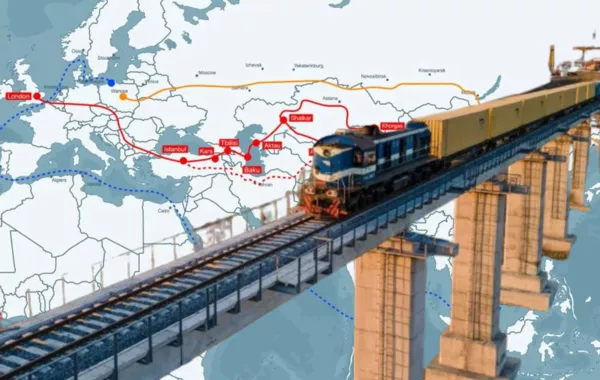
While maintaining its independent stance, Baku also used meetings with the President of Bulgaria and representatives of the Bundestag to place the Middle Corridor and Green Energy initiatives-projects reshaping Europe’s energy and transport landscape-at the center of discussions. In parallel, talks with global financial heavyweights such as The Goldman Sachs Group underscored the growing appeal of Azerbaijan’s economic diversification strategy to international capital.
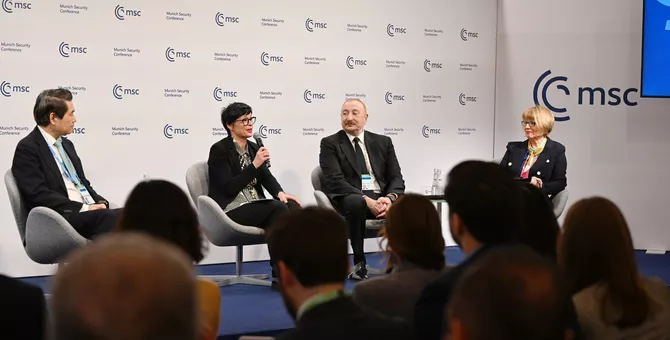
Photo credit: think-tanks.az
As a logical and more practical extension of the Munich discussions, the visit to Belgrade elevated Azerbaijan’s Balkan policy from strategic intent to an institutional framework. On 15 February-symbolically marked as Serbia’s Statehood Day-the first meeting of the Azerbaijan-Serbia Strategic Partnership Council was held in Belgrade, signaling that bilateral ties have progressed beyond cordial relations to a level of structured strategic interdependence.
In his joint press statement with Serbian President Aleksandar Vučić, President Ilham Aliyev’s declaration that “Azerbaijan is ready to invest substantial funds in Serbia” amounted to a formal acknowledgment of the country’s transition from an exporting state to an active regional investor. Plans to expand natural gas supplies to Serbia and deepen cooperation in the electricity sector further indicate that Azerbaijan is positioning itself as a foundational element of the emerging energy framework in the Balkans.
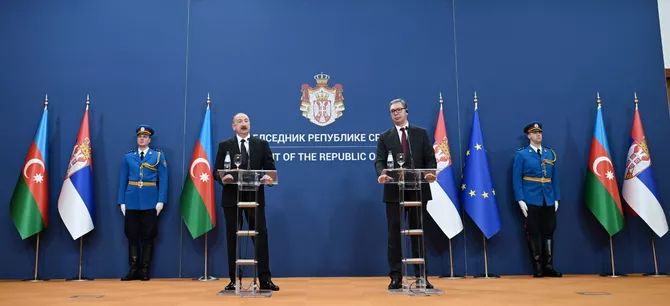
Photo credit: think-tanks.az
The analytical link between these two tracks lies in a consistent guiding principle: whether on global security platforms or within bilateral strategic partnerships, Azerbaijan acts on the premise that sovereignty must translate into tangible economic returns for national interests.
The diplomatic line extending from Munich to Belgrade also strengthens Baku’s position in the peace process with Armenia. As international attention increasingly focuses on Azerbaijan’s proposed logistics initiatives, including the Zangezur corridor, and its energy projects, the peace agenda is framed less in abstract political terms and more around pragmatism and economic benefit.
Taken together, the diplomacy of February 2026 can be seen as a practical demonstration of Azerbaijan’s “strong state, independent policy” doctrine in action. Baku is no longer merely observing international developments; it is actively shaping them, redesigning energy and transport configurations and positioning itself as a central actor in that process.
This assertive engagement consolidates Azerbaijan’s dual role: a reliable partner sought in the West and, at the same time, a decisive power center within its own region, capable of setting the terms of interaction.
Find the original article here