In the vast interior of Eurasia, the idea of a “corridor” is undergoing a quiet but consequential transformation. For decades, corridors in Central Asia and the South Caucasus were imagined primarily as physical arteries-railways threading across steppe and mountain, pipelines binding producers to markets, highways stitching post-Soviet economies into global trade. Today, a parallel architecture is taking shape beneath and alongside these routes. It is composed not of steel and asphalt, but of fiber-optic cables, data centers, satellite gateways, and the legal regimes that govern digital traffic.
These emerging digital corridors are redefining how power, sovereignty, and economic value are distributed across the region. They determine not only how fast data moves between Europe and Asia, but also where it is stored, who can access it, which platforms dominate national markets, and how easily states can monitor, filter, or interrupt digital flows. In Central Asia and the Caucasus, digital connectivity is no longer a technical subfield of telecommunications policy; it has become a core element of state capacity and geopolitical positioning.
Three structural forces are driving this shift toward corridor thinking in the digital domain.
First, the geopolitics of routing has fundamentally changed since 2022. The disruption of established transit geographies and the growing politicization of infrastructure have made routing choices explicitly strategic. Governments and major carriers increasingly seek to bypass politically sensitive territories, conflict-adjacent waters, and single-country chokepoints. Redundancy and diversification-once engineering preferences-are now matters of national strategy.
Second, the region’s digital economy has matured. Cloud services, fintech ecosystems, digital public services, and early-stage artificial intelligence ambitions are now embedded in national development strategies. As a result, latency, resilience, and cybersecurity are no longer minor performance metrics; they shape economic competitiveness, public-sector effectiveness, and even political legitimacy.
Third, cyber sovereignty has shifted from rhetoric to regulation. Data localization requirements, critical information infrastructure laws, and surveillance-enabled governance have become central pillars of state policy across much of the region. Governments are no longer content to rely on foreign platforms operating beyond their jurisdiction; they increasingly demand that data, infrastructure, and control points reside within national borders or under domestic authority.
Together, these dynamics have produced a new kind of competition. It is not a simplistic ideological contest between China and the West, but a pragmatic struggle over standards, vendors, financing models, and the governance assumptions embedded in technology stacks. Digital corridors have become the arena where competing ecosystems intersect-and where regional states attempt to extract investment, reduce dependency, and preserve regime stability at the same time.
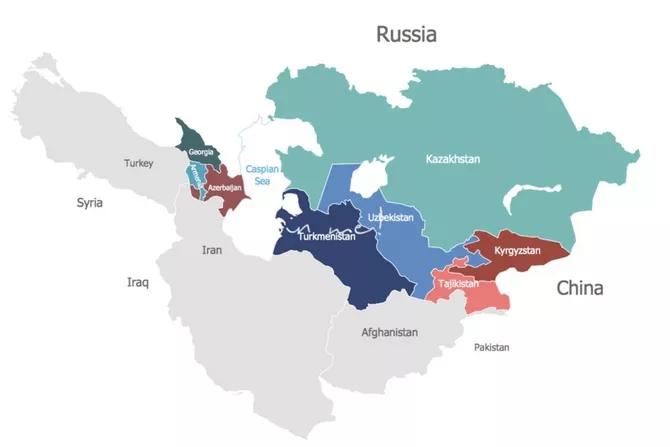
Photo: avim.org.tr
When Geography Turns into Code
Data flows are governed by a combination of physics and policy. Fiber-optic cables follow the shortest and most efficient physical routes, but they are also shaped by legal regimes, political risk, and market incentives. In this context, the Caucasus-Caspian-Central Asia space occupies a position of growing importance for three interconnected reasons.
First, it offers a credible opportunity to shorten and diversify Europe-Asia digital routes. Much like the so-called Middle Corridor for freight, digital pathways through the South Caucasus and Central Asia reduce dependence on a narrow set of transit geographies. For carriers and states alike, this diversification improves resilience and strengthens bargaining power with upstream providers.
Second, digital corridors open the possibility of a new “transit economy.” Hosting cross-border fiber does not merely generate transit fees. It creates opportunities to capture higher-value services such as wholesale capacity sales, internet exchange points, carrier-neutral colocation, and regional data center hosting. States that position themselves effectively can move beyond being passive conduits and become active nodes in the global digital economy.
Third, digital infrastructure embeds sovereignty in tangible ways. Fiber routes, data centers, and national internet exchange points enable governments to enforce data localization, promote domestic cloud services, and exert greater oversight over traffic flows. In an era where political authority is increasingly exercised through digital means, infrastructure becomes a tool of governance.
At the same time, these advantages carry new risks. Fiber networks and data centers become critical infrastructure, vulnerable to physical disruption, cyberattack, or political pressure. Foreign vendors that design, maintain, or operate networks assume quasi-security roles, because they control the software-defined layers that increasingly determine how networks function. These conditions are precisely those in which cyber sovereignty politics flourish.

Photo: Shutterstock
Caspian and Black Sea Data Bridges
The physical backbone of the emerging digital corridor is being built across two bodies of water that have long served as geopolitical fault lines: the Caspian Sea and the Black Sea.
One of the most significant projects is the Trans-Caspian Fiber-Optic Communication Line linking Azerbaijan and Kazakhstan. Framed as part of a broader ambition to establish a Europe-Asia digital telecommunications corridor, the project represents a strategic attempt to create a direct, non-Russian data route across the Caspian basin. Reporting in early 2026 indicated that the project had entered active implementation, with completion targeted for the end of the year.
The importance of this cable extends beyond its technical specifications. It offers routing diversification at a time when dependence on a limited number of transit paths is increasingly viewed as a vulnerability. More importantly, it enables the construction of a broader digital ecosystem along its route: internet exchange points, carrier hotels, cybersecurity services, and regional cloud infrastructure. In this sense, the cable is not an endpoint but a catalyst.
Parallel efforts are unfolding in the Black Sea. The concept of a Black Sea submarine cable linking Georgia and Romania-often discussed in tandem with electricity interconnector projects-has increasingly been framed as a digital resilience initiative. The objective is to provide the South Caucasus with a more direct, Europe-facing digital route that bypasses congested or politically sensitive paths.
The European Union has explicitly supported the idea of a Black Sea submarine digital cable as part of its broader connectivity agenda, presenting it as a contribution to digital transformation and resilience. At the same time, private-sector interest in Black Sea cable projects has intensified, driven by demand for redundancy and geopolitical risk mitigation.
Taken together, Caspian and Black Sea initiatives point toward a multi-route, multi-sea architecture. Rather than relying on a single “golden path,” the region is moving toward layered redundancy-a defining feature of mature digital corridors.
From Transit to Hosting
Fiber alone does not create digital power. The real economic and political gains accrue to those who capture higher layers of the value chain, particularly data hosting and cloud services.
Several states in the region are actively pursuing this shift. Azerbaijan, for example, has emphasized the development of modern data center capacity as part of its ambition to become a regional digital hub. Announcements of new facilities highlight green technology, Tier III standards, and enterprise-grade reliability-signals aimed at attracting international workloads rather than merely supporting domestic e-government services.
Kazakhstan has similarly linked its West-East transit aspirations to investments in data processing centers. The logic is clear: if data is already passing through national territory, hosting a portion of it locally increases economic value, strengthens regulatory leverage, and supports domestic digital innovation.
These strategies redefine sovereignty in practical terms. A state capable of hosting data at scale can more easily enforce localization rules, negotiate with global platforms, and build AI and high-performance computing capabilities on top of domestic infrastructure. At the same time, hosting raises the stakes. Data centers become strategic assets, cloud governance becomes a security issue, and outages or breaches take on political significance.

Photo: iStock
Competing Technology Ecosystems
The struggle over digital corridors is also a struggle between different technology ecosystems, each with distinct political and economic logics.
The Chinese approach is characterized by depth and integration. Chinese firms often operate across multiple layers of the digital stack, supplying network hardware, providing managed services, offering financing, and increasingly delivering training, AI laboratories, and cloud-adjacent compute capacity. Analysts observing China’s engagement with Central Asia note a clear progression: from basic connectivity to data centers and AI infrastructure, and from infrastructure provision to shaping demand through capacity-building.
This integrated model is attractive to governments seeking rapid deployment and clear lines of control. Surveillance-ready smart city solutions, tightly coupled with telecom networks and analytics platforms, align well with governance systems that prioritize stability and centralized authority. Bundled delivery reduces coordination costs and accelerates implementation.
Western approaches differ in structure and emphasis. The European Union’s Global Gateway initiative, which explicitly includes Central Asia in its digital connectivity ambitions, represents a portfolio strategy rather than a single vendor stack. Announcements at the first EU-Central Asia summit in 2025 highlighted substantial investment commitments spanning connectivity, digital networks, and resilience.
Rather than turnkey solutions, Western actors tend to emphasize standards, regulatory alignment, route diversification, and blended finance. The appeal lies in flexibility and interoperability, particularly for states seeking closer integration with European markets and compliance frameworks. The United States, for its part, has focused more on policy dialogue, digital transformation partnerships, and targeted initiatives than on large-scale infrastructure branding.
In practice, most regional governments do not choose exclusively between these models. Instead, they assemble hybrid stacks: Chinese equipment in parts of the network, Western financing or standards in others, and domestic institutions attempting to arbitrate between competing interests. This hybridity reflects both strategic caution and the region’s long-standing tradition of multi-vector foreign policy.
Data Localization as a Policy Instrument
Among the tools of cyber sovereignty, data localization stands out for its directness. By requiring certain categories of data to be stored and processed domestically, states convert infrastructure into regulation.
Kazakhstan has long maintained localization requirements for personal data, and recent regulatory developments suggest a tightening of enforcement. From a political perspective, localization increases state leverage over platforms and facilitates law enforcement and surveillance access. Economically, however, it can raise costs and deter investment from firms reliant on regionalized or global cloud architectures.
Uzbekistan’s regulatory framework also includes localization expectations, which have attracted attention from international investors and policy analysts. At the same time, domestic debate has intensified around the economic costs of these rules. Estimates of opportunity costs vary, but the underlying issue is clear: localization has become a contested policy choice rather than an uncontested assertion of sovereignty.
Across Central Asia more broadly, data protection and localization debates intersect with questions of governance quality, privacy safeguards, and regulatory capacity. External assessments and civil society critiques often focus on oversight mechanisms and the balance between state authority and individual rights.
In corridor politics, localization has a specific function. It signals that the value generated by digital transit and hosting will be captured locally, and that access to networks will be governed on national terms.
Surveillance as Corridor Politics
Digital corridors are not only about economic flows; they are also about political control. “Safe City” and smart city programs have expanded rapidly across the region, justified by goals such as traffic safety, crime prevention, and urban management.
These initiatives are deeply data-intensive. They generate vast streams of video, biometric, and behavioral data that require local storage, analytics platforms, and centralized command centers. As a result, surveillance expansion reinforces localization, domestic hosting, and vendor lock-in.
In several cases, surveillance infrastructure relies heavily on Chinese hardware and analytics, a trend often interpreted as part of a broader move toward high-tech governance models that emphasize monitoring and predictive control. In other contexts, smart city partnerships are framed as modernization projects, even as debates over facial recognition, privacy, and oversight intensify.
Once surveillance systems are integrated into urban governance, switching vendors becomes extremely costly, both financially and politically. Cybersecurity incidents are treated not merely as technical failures but as challenges to regime legitimacy. In this way, surveillance stacks embed governance models just as surely as constitutions do.
Cyber Sovereignty as Governance Practice
Beyond localization and surveillance, cyber sovereignty encompasses the broader management of digital networks as strategic assets. Many states in the region have adopted formal cybersecurity strategies that define critical information infrastructure, expand state authority over operators, and integrate cyber defense with national security planning.
These policies converge around a common set of tools: designation of critical infrastructure, mandatory security standards, domestic routing requirements for sensitive data, and enhanced state oversight. For digital corridors, the implication is clear. Physical connectivity alone does not guarantee openness or commercial viability. Regulatory predictability, interception risk, and shutdown potential all shape whether a corridor attracts sustained investment.

Photo: CABAR.asia
Possible Trajectories
Looking ahead, three broad scenarios appear plausible.
The most likely is corridor pluralism. States maintain mixed technology stacks, balance Chinese and Western partnerships, and tighten control over sensitive data while keeping selected routes open. This approach mirrors the region’s traditional multi-vector diplomacy, applied to digital infrastructure.
A second scenario is sovereignty maximalism. Localization expands, cross-border routing is filtered, and surveillance integration deepens. While this maximizes domestic control, it risks slowing innovation and fragmenting the region into isolated digital spaces.
A third, more demanding scenario is resilience-led integration. Caspian and Black Sea links mature into a genuinely competitive Europe-Asia alternative, supported by neutral exchange points, transparent regulation, and predictable governance. Achieving this outcome would require institutional trust-building as much as physical infrastructure.
What to Watch Next
Key indicators in 2026 will include the execution of major cable projects, the translation of announced investment packages into bankable digital infrastructure, the evolution of localization regimes, procurement choices in surveillance systems, and the pace of private-sector investment in redundancy routes.
The Corridor as Constitution
Central Asia and the Caucasus are entering a phase in which digital infrastructure functions as a constitutional layer of politics. Fiber routes reshape dependence, data centers redefine economic strategy, localization laws redraw jurisdiction, and surveillance platforms reorganize relations between state and society.
The region is not merely adopting new technologies; it is negotiating how sovereignty itself will be exercised through them. The critical question is no longer whether connectivity will expand-it will-but whether digital corridors will remain open and interoperable, or become gated and fragmented. In that choice lies the future balance between growth, resilience, and control.