Georgia’s debate over snap parliamentary elections is often framed as a procedural disagreement about calendars and constitutional schedules. In reality, it is far deeper and more consequential. At its core, the dispute reflects an unresolved struggle over political legitimacy following the October 26, 2024 parliamentary elections and the political crisis that unfolded in their aftermath. The question facing Georgia is not simply when the next elections should be held, but whether the current political system can command public trust under existing conditions.
Since the disputed vote, opposition parties, civil society groups, and a significant segment of the public have argued that the credibility of Georgia’s democratic institutions has been fundamentally damaged. According to this view, early elections are not a tactical demand or an attempt to gain short-term advantage, but the only realistic mechanism for restoring confidence in the political system and preventing deeper democratic regression. Street protests, boycotts, and sustained mobilization since late 2024 have all revolved around this central claim: that the existing parliament lacks a legitimate mandate.
The ruling Georgian Dream (GD) party rejects this narrative outright. Its leadership insists that the election was constitutionally valid, that the state cannot be governed under pressure from protests, and that political competition must proceed strictly within the timelines set by law. Prime Minister Irakli Kobakhidze reiterated this position forcefully on January 23 during an interview with Imedi TV, dismissing the snap-election debate as largely exhausted. He argued that if any political actors fear early elections, it is the opposition itself, and reaffirmed that the next parliamentary vote should take place in October 2028, in line with constitutional requirements.
This clash of interpretations-between legitimacy derived from constitutional procedure and legitimacy derived from public consent-has become the defining fault line in Georgian politics. As long as that divide remains unresolved, the snap-election question is unlikely to disappear, regardless of official declarations that the issue is settled.
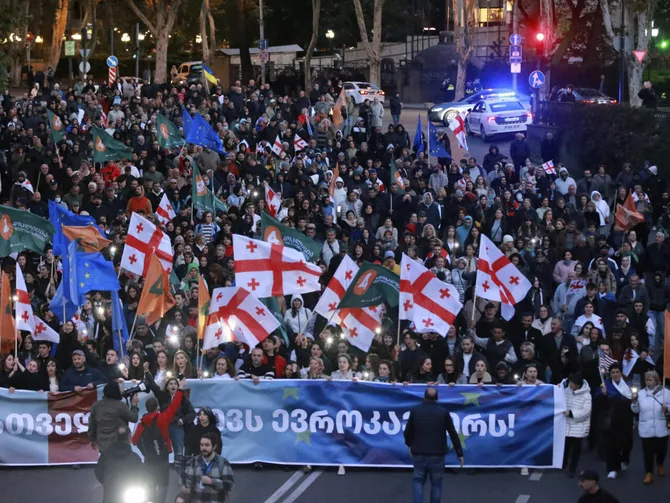
Photo: AFP
Why the Opposition Sees Snap Elections as a Democratic Reset
For Georgia’s opposition forces, the demand for early elections rests on a broader indictment of the 2024 parliamentary process and its political consequences. Opposition leaders and civil activists argue that the election was marred by irregularities, intimidation, and systemic bias that tilted the playing field in favor of the ruling party. While Georgian Dream secured formal victory, critics contend that the conditions under which that victory was achieved fatally undermined its legitimacy.
From this perspective, the problem did not end on election day. Instead, the aftermath of the vote has deepened polarization and reinforced the perception that political power is becoming increasingly centralized. Opposition parties argue that parliament, as currently constituted, no longer functions as a credible arena for pluralistic politics. Legislative processes are viewed as dominated by a single political force, while dissenting voices are marginalized or treated as threats to stability.
Snap elections, in this framing, are not about punishing Georgian Dream or rewarding protest movements. They are presented as an institutional “reset”-a chance to restore trust through a new vote conducted under stricter oversight, improved electoral administration, and stronger guarantees for media freedom and civil society participation. Opposition figures emphasize that without such a reset, Georgia risks drifting toward de facto one-party dominance, even if formal democratic structures remain intact.
The snap-election demand is also closely tied to Georgia’s stalled European integration trajectory. The government’s decision to effectively postpone EU accession negotiations until 2028 became a powerful catalyst for mass protests in late 2024 and early 2025. For many demonstrators, the issue symbolized not only a geopolitical shift but a deeper retreat from democratic norms associated with the European project. Early elections, in this context, are seen as a way to realign Georgia’s political course with its pro-European public sentiment.
However, the opposition’s position is not without internal challenges. Georgia’s opposition landscape is fragmented, ideologically diverse, and often divided over strategy. While there is broad agreement on the need for early elections, there is less consensus on a unified political program or leadership alternative. This weakness complicates the opposition’s ability to sustain pressure and allows the ruling party to question whether snap elections would truly resolve the crisis or simply reproduce it under new circumstances.
Georgian Dream’s Case: Constitutional Order Over Street Pressure
Georgian Dream’s rejection of snap elections is grounded in a fundamentally different conception of political legitimacy. For the ruling party, legitimacy flows from adherence to constitutional rules, not from the intensity or duration of protests. Accepting early elections under pressure, GD argues, would establish a dangerous precedent in which any organized mobilization could force governments to abandon electoral timetables and undermine institutional stability.
Prime Minister Kobakhidze’s January 23 remarks reflect this logic clearly. By asserting that the opposition is the actor most afraid of snap elections, he sought to invert the dominant protest narrative. Rather than portraying Georgian Dream as clinging to power, the government positions itself as confident in its electoral strength and committed to constitutional continuity. In this telling, it is the opposition-divided, unpopular, and lacking a coherent alternative-that benefits from prolonged crisis rather than from facing voters again.
Georgian Dream has also framed protests and opposition activity in increasingly securitized terms. Officials have described mass demonstrations as attempts to destabilize or even overthrow the government, rather than as legitimate expressions of political dissent. International reporting has documented a tougher official response to protests, including arrests, legal pressure on activists, and rhetoric warning of severe consequences for those challenging state authority.
From GD’s perspective, conceding snap elections would reward what it sees as extra-parliamentary pressure tactics and weaken the very institutions the opposition claims to defend. The party argues that political competition must occur through regular elections, not through cycles of mobilization that paralyze governance. This argument carries particular weight among voters concerned about stability, economic predictability, and the risks of permanent political confrontation.
At the same time, Georgian Dream’s strategy depends on maintaining control over key institutions and managing international perceptions. While the government insists that Georgia remains a democratic state governed by law, growing concerns from external observers about shrinking space for media freedom and civil society have increased scrutiny of its actions. The longer the legitimacy dispute persists, the harder it becomes for GD to rely solely on constitutional arguments without addressing broader questions about democratic credibility.
Photo: Civil Georgia
Does Georgia Actually Need Snap Elections?
Whether Georgia “needs” snap elections ultimately depends on how one defines the country’s most urgent political problem. The debate is less about legal permissibility than about political necessity.
If the primary challenge is restoring public trust and preventing long-term democratic erosion, the case for early elections becomes stronger. When a significant portion of society rejects the legitimacy of parliament and political confrontation becomes a permanent feature of public life, governance itself suffers. Under such conditions, a new election-paired with meaningful reforms to electoral administration, observation mechanisms, and media access-can function as a pressure valve. It offers a structured, institutional way to reset political competition and reduce the risk of escalation.
This is the opposition’s most compelling argument. Snap elections, they insist, would not be a concession to street politics but a reaffirmation of democratic accountability. Without them, Georgia risks normalizing a situation in which large segments of the population feel permanently excluded from meaningful political influence.
Conversely, if the overriding priority is institutional continuity and constitutional predictability, Georgian Dream’s position carries its own logic. Frequent early elections can weaken the authority of electoral outcomes and encourage a cycle in which governments are constantly challenged before they can govern. From this viewpoint, the solution to polarization lies not in resetting the calendar but in strengthening existing institutions and encouraging political actors to operate within them.
This argument gains credibility if early elections are unlikely to resolve underlying disputes. If the opposition remains fragmented and the conditions surrounding a snap vote fail to address structural concerns, a new election could simply reproduce the same legitimacy crisis in a shorter timeframe. In that scenario, Georgia would emerge with renewed instability rather than renewed trust.
Looking ahead, several factors will determine whether the snap-election debate regains momentum or fades into the background. One is the opposition’s ability to maintain a unified message and sustained mobilization beyond episodic protests. Another is the government’s approach to political competition-particularly any legal or administrative measures that further constrain parties, media outlets, or civil society organizations. Such steps would almost certainly intensify calls for an electoral reset.
International dynamics also matter. Signals from European institutions and key partners influence the political cost of refusing compromise. While external actors are unlikely to dictate Georgia’s internal decisions, their recognition-or questioning-of institutional legitimacy can shape domestic calculations.
For now, Prime Minister Kobakhidze is projecting certainty: the next parliamentary elections will be held in 2028, and the debate over snap polls is over. Yet Georgia’s recent history suggests that unresolved legitimacy disputes have a way of resurfacing, especially when combined with social mobilization and external pressure. As long as trust in political institutions remains fractured, the question of early elections is less dormant than merely postponed-waiting for the next shock to bring it back to the center of Georgian politics.