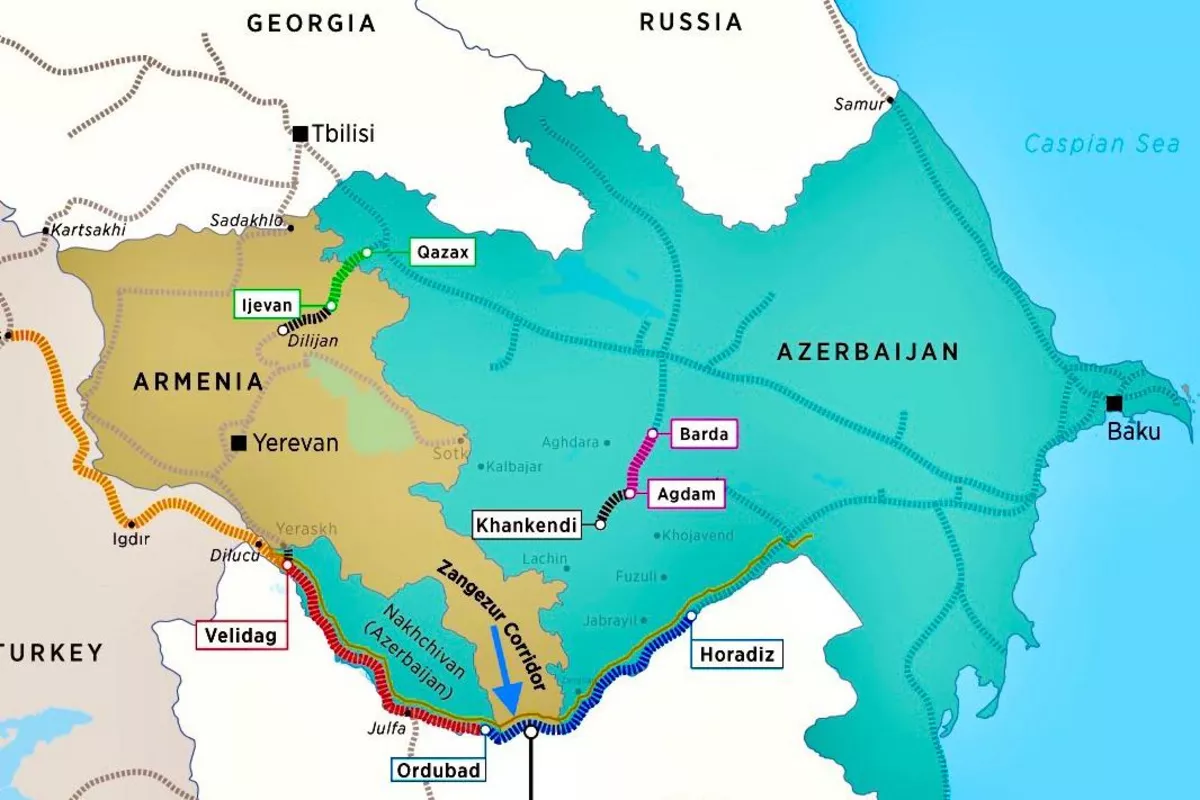
The reopening of the Zangezur Corridor constitutes a decisive moment in the evolution of Azerbaijan’s economic geography and its role within Eurasian trade systems. Rather than functioning merely as a transport route, the corridor embodies a deeper transformation in how Azerbaijan integrates into regional and global supply chains. By re-establishing uninterrupted land connectivity between mainland Azerbaijan and its mainland Nakhchivan-and, more broadly, by linking Central Asia, the South Caucasus, and Europe-the Zangezur Corridor fills a long-standing structural gap in Eurasian logistics. It serves as a vital missing component of the Middle Corridor, strengthening east-west connectivity across the continent.
The corridor’s economic importance extends well beyond anticipated freight volumes or shortened delivery times. Its true value lies in its capacity to reshape Azerbaijan’s economic role from that of a predominantly energy-exporting country into a key connectivity hub within an increasingly fragmented and competitive global trade environment. In a world where supply chain resilience, route diversification, and speed have become paramount, the Zangezur Corridor enhances Azerbaijan’s ability to capture value from transit, logistics, and trade facilitation, anchoring the country more firmly within Eurasia’s evolving economic architecture.
The Zangezur Corridor in the Context of Eurasian Trade Architecture
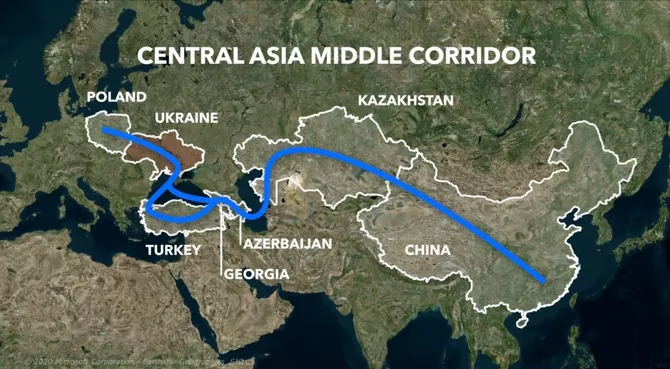
At its foundation, the Zangezur Corridor must be understood as an integral element of a broader transcontinental connectivity framework. It is embedded within the Middle Corridor, an increasingly prominent trade route that links China to Europe via Central Asia, the Caspian Sea, and the South Caucasus. This corridor offers an alternative to traditional maritime routes and northern land passages, reflecting a wider reorientation of global trade patterns in response to geopolitical tensions, supply chain disruptions, and congestion at key maritime chokepoints.
The growing relevance of the Middle Corridor underscores a shift toward diversification in global logistics. As states and corporations seek to reduce dependence on single routes, overland corridors across Eurasia have gained strategic importance. In this context, the Zangezur Corridor enhances the coherence and efficiency of the South Caucasus segment of the Middle Corridor, addressing long-standing fragmentation and bottlenecks in regional connectivity.
The analytical framework proposed by Clyde Kenderdine and Péter Bucsky-who describe the Middle Corridor as a form of “multilateral institutional development”-is particularly useful in understanding the Zangezur Corridor’s economic logic. The corridor does not operate as a standalone infrastructure project; rather, it integrates multiple national transport systems into a unified, containerized rail and multimodal network spanning Eurasia. This system connects Chinese railways with Central Asian infrastructure, Caspian Sea ports, South Caucasus rail lines, and European logistics hubs through a complex chain of ports, border crossings, and intermodal terminals.
By reinforcing institutional and physical connectivity within this system, the Zangezur Corridor reduces friction in cross-border trade. Shorter routes, harmonized procedures, and more predictable transit schedules lower transaction costs and enhance reliability-two factors that increasingly shape route selection by logistics providers and multinational firms. As a result, Azerbaijan’s role evolves from that of a passive transit territory to that of an active participant in the design and governance of Eurasian connectivity. Economically, this shift enhances the country’s capacity to generate value from integration rather than mere passage.
Dual Integration into East-West and North-South Trade Corridors
The economic significance of the Zangezur Corridor is further amplified by Azerbaijan’s unique position at the intersection of two major transcontinental transport systems: the Middle Corridor and the North-South Transport Corridor (NSTC). While the Middle Corridor facilitates east-west trade between China and Europe, the NSTC connects Russia with South Asia, particularly India, via the South Caucasus and Iran. Azerbaijan’s participation in both corridors elevates its importance as a multimodal junction within Eurasian trade networks.
This dual integration has profound implications for economic resilience. Transit economies that rely on a single trade axis are vulnerable to fluctuations in demand, geopolitical disruptions, or policy changes along that route. In contrast, Azerbaijan’s role as a convergence point for multiple corridors allows it to diversify transit flows and revenue sources. Goods moving from Central Asia to Europe, from Russia to South Asia, or from East Asia to the Middle East can all be routed through Azerbaijani infrastructure, enhancing throughput and stability.
The Zangezur Corridor strengthens this nodal function by offering an additional land-based route that is both shorter and more direct. It complements existing infrastructure rather than replacing it, increasing overall network redundancy and flexibility. From an economic perspective, this configuration enables Azerbaijan to transition from sectoral dependence toward a platform-based growth model. Instead of deriving value primarily from hydrocarbon extraction, the country increasingly benefits from facilitating flows-of goods, services, and logistics.
This transformation aligns with the concept of a connectivity hub, where economic returns stem from efficiency, scale, and integration rather than from resource endowments alone. The Zangezur Corridor contributes directly to this structural shift by expanding the range of services Azerbaijan can offer, from transit and warehousing to customs facilitation and digital logistics coordination. Over time, these capabilities strengthen Azerbaijan’s position within regional and global value chains.
Freight Expansion, Revenue Generation, and Economic Multipliers
One of the most concrete measures of the Zangezur Corridor’s economic impact lies in projected freight volumes. Current assessments of the Middle Corridor indicate that annual trade flows could increase threefold, reaching approximately eleven million tons by 2030. Such growth would represent a significant expansion of regional transport capacity, with Azerbaijan emerging as a central beneficiary due to its geographic position and sustained infrastructure investments.
Even under conservative scenarios, transit cargo volumes passing through Azerbaijan are expected to increase by five to eight million tons annually. This expansion carries direct revenue implications. Transit fees, rail tariffs, port charges, and associated logistics services generate stable and recurring income streams. Key infrastructure assets-most notably the Port of Baku-stand to benefit from increased throughput, particularly as Caspian Sea crossings and multimodal transfers intensify.
Beyond direct revenues, rising freight volumes produce broader economic multiplier effects. Higher demand for transport services stimulates employment across logistics-related sectors, including rail operations, port management, freight forwarding, and customs services. Supporting industries such as equipment maintenance, insurance, information technology, and digital logistics platforms also expand in response to increased traffic. These spillover effects contribute to the development of a more diversified and resilient non-oil economy.
In the longer term, the accumulation of logistics expertise and infrastructure capacity can attract foreign direct investment and encourage the establishment of value-added activities, such as light manufacturing, assembly, and regional distribution centers. In this sense, the Zangezur Corridor functions not only as a conduit for trade but also as a catalyst for broader economic development within Azerbaijan.
Time Distance Compression, Multimodal Synergies, and Strategic Leverage
Perhaps the most transformative economic effect of the Zangezur Corridor lies in its contribution to reducing transit times across Eurasia. In recent years, shipping durations between China and the South Caucasus have fallen dramatically-from approximately fifty days to between nineteen and twenty-three days. Further reductions to fourteen to eighteen days are widely considered achievable in the near future, reflecting both infrastructure upgrades and improved coordination among participating states.
This phenomenon, often described by transport economists as “time distance compression,” effectively shortens the economic distance between markets. While Azerbaijan’s physical location remains constant, faster and more reliable transit brings it functionally closer to major production and consumption centers. For businesses, shorter delivery times reduce inventory costs, lower capital tied up in transit, and enhance responsiveness to market demand.
In contemporary logistics, reliability and speed increasingly outweigh cost considerations. Time-sensitive goods such as electronics, automotive components, and intermediate industrial inputs depend on predictable delivery schedules. By enabling such efficiencies, the Zangezur Corridor strengthens the competitiveness of the Middle Corridor relative to alternative routes. Azerbaijan’s role in facilitating these gains enhances its strategic importance to global logistics operators and multinational firms.
The corridor’s multimodal character further reinforces its economic value. By linking rail, road, and maritime infrastructure, the Zangezur Corridor allows for flexible routing and reduces dependence on any single transport mode. This flexibility is critical in an era marked by frequent disruptions-whether geopolitical, environmental, or operational. Azerbaijan’s infrastructure, particularly the Port of Baku and its rail connections, serves as a linchpin within this multimodal system, generating economies of scale and lowering average transport costs over time.
Finally, the economic implications of the Zangezur Corridor cannot be fully separated from its geopolitical economy. Connectivity infrastructure reshapes patterns of interdependence and redistributes economic opportunities. By emerging as a critical node in Eurasian trade networks, Azerbaijan gains strategic leverage that extends beyond immediate financial returns. This leverage enhances the country’s bargaining power in regional economic arrangements, increases its visibility in international connectivity initiatives, and supports broader objectives such as attracting investment and securing long-term transit agreements.
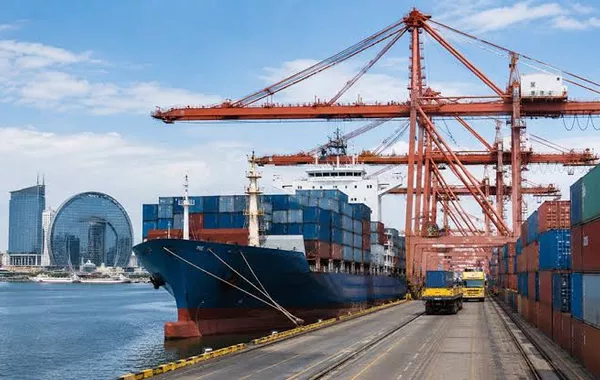
Source: Flickr
Conclusion: Connectivity as a Driver of Structural Transformation
The reopening of the Zangezur Corridor represents far more than the restoration of a transport link between two territories. It marks a structural shift in Azerbaijan’s economic orientation and strategic positioning. Integrated into both the Middle Corridor and the North-South Transport Corridor, the Zangezur Corridor elevates Azerbaijan from a peripheral transit space to a central node in Eurasian connectivity.
Projected increases in freight volumes, substantial reductions in transit times, and the resulting compression of economic distance highlight the corridor’s capacity to enhance trade efficiency and competitiveness. Expanded throughput at major logistics hubs-particularly the Port of Baku-promises not only direct revenue gains but also powerful multiplier effects across the broader economy. At a deeper level, the corridor supports Azerbaijan’s transition toward a connectivity-based economic model, diversifying its sources of growth and embedding it more firmly within global supply chains.
In an era characterized by shifting trade geographies and heightened demand for resilient logistics networks, the Zangezur Corridor positions Azerbaijan at the forefront of Eurasian connectivity. Its economic significance lies not simply in the movement of goods, but in the reconfiguration of space, time, and value across the continent-an enduring transformation whose implications extend well beyond transport itself.