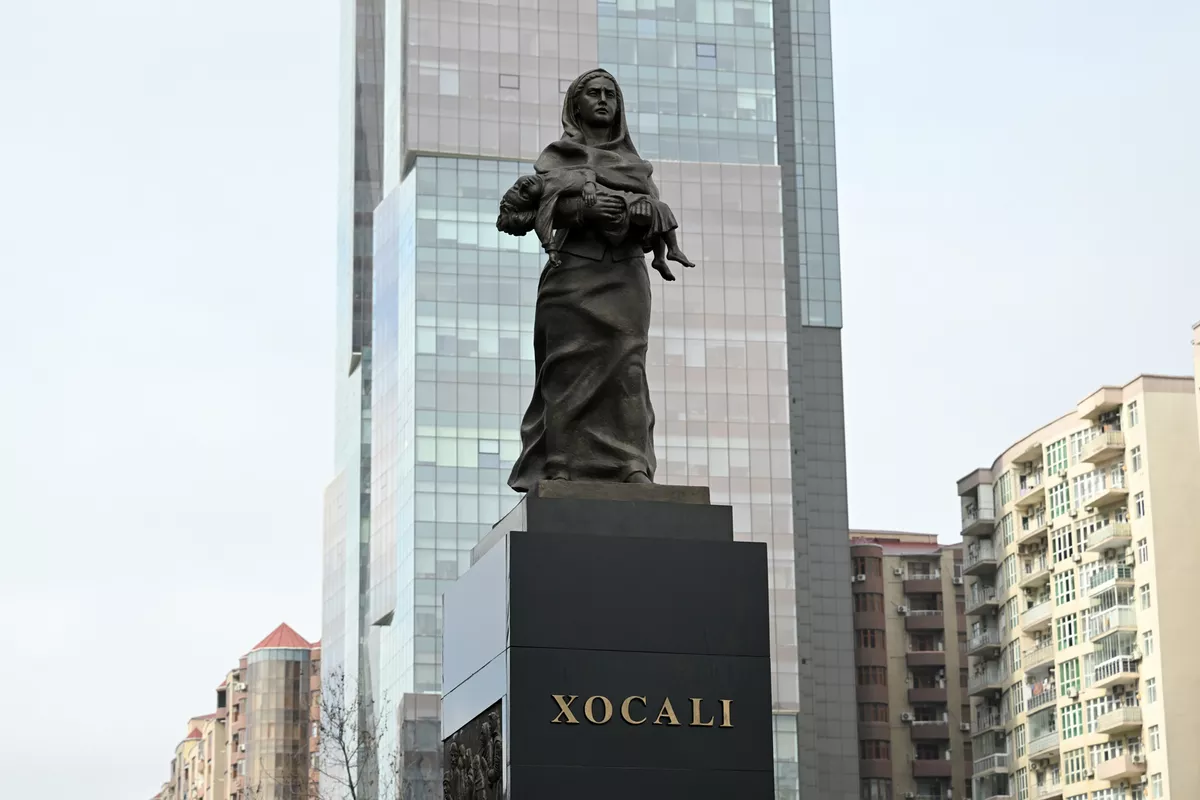
In February 1992, one of the most horrific tragedies in the history of Azerbaijan occurred: an assault carried out by Armenian armed forces against the civilian population of Khojaly, accompanied by mass violence, killings, and hostage-taking. This event was not merely an episode of war; it became emblematic of the deliberate targeting of civilians-that is, a grave and manifest violation of international humanitarian law.
The gravity of the issue lies in the fact that, although certain political circles have attempted to frame the Khojaly genocide as an “ordinary battle” within broader conflict narratives, independent human rights monitoring and investigations grounded in eyewitness testimony demonstrate both the scale and the systematic character of violence directed against civilians.
Geographically, Khojaly is located in a strategically significant part of Karabakh, near Khankendi. During the initial phase of the former conflict, the town’s logistical and military importance increased substantially. Official descriptions identify Khojaly as the site of the region’s only airport at the time-an element that intensified the struggle for control under siege conditions. Independent sources likewise note that beginning in the autumn of 1991, Khojaly was effectively blockaded; from January 1992, electricity supply was cut off, and no full evacuation of civilians was organized. This circumstance-the confinement of civilians within a conflict zone without viable exit-sharpened the social-psychological and humanitarian dimensions of the ensuing tragedy. In this context, the attack should not be interpreted as an accidental confrontation, but rather as the sequential outcome of the logic of war-siege, territorial control, disruption of communication lines, and the mass displacement (deportation/expulsion) of the population. Fact-finding missions conducted after the events, medical records, documentation concerning hostages, and on-site inspections substantiate this reading.
One of the most detailed accounts of the assault is found in reports prepared by observers who conducted fact-finding operations in the conflict zone in March-April 1992, working on both sides of the affected territory. According to these reports, artillery shelling began around 11:00 p.m. on February 25; infantry units entered the town between 1:00 and 4:00 a.m. on February 26; and the final pocket of resistance was suppressed at approximately 7:00 a.m. The same sources, along with other independent assessments, confirm witness claims and information received through various channels regarding the involvement of the former Soviet Army’s 366th Motor Rifle Regiment stationed in Khankendi. Refugees reported that personnel of the regiment participated directly in the assault, whereas the Armenian side maintained that the regiment provided fire support with military equipment but did not enter the town itself. In either scenario, the deployment of heavy weaponry and military equipment in a civilian-populated area predictably resulted in increased civilian casualties. The position of Human Rights Watch is particularly noteworthy: in the context of attacks against those fleeing Khojaly, the organization attributed direct responsibility for civilian deaths to Armenian forces in Karabakh and also mentioned the involvement of troops from the 366th Regiment. This constitutes a significant reference point undermining manipulative narratives suggesting that civilians were harmed by their own side.
Official casualty statistics indicate that 613 individuals were killed (including 106 women, 63 children, and 70 elderly persons); 487 were wounded; 1,275 were taken hostage; and the fate of 150 remains unknown. Eight families were completely annihilated; 25 children lost both parents; and 130 children lost one parent. These figures are not merely statistical data. They represent the social anatomy of violence that cannot be obscured under the pretext of “military necessity”: the destruction of the family institution, children left orphaned, hostage-taking, enforced disappearance, and the embedding of long-term trauma into collective memory. Independent observations concerning the detention conditions of hostages, allegations of abuse, and the inhumane aspects of exchange processes indicate that the event transcended the framework of a “one-night massacre,” evolving into a continuing human rights crisis.
Explaining the causes of the Khojaly tragedy solely as a manifestation of “front-line tensions” is academically insufficient and logically untenable. The events occurred against a broader backdrop of strategic objectives: to intimidate Azerbaijanis in Karabakh, subject them to ethnic cleansing, and consolidate territorial control by emptying Azerbaijani settlements. Traces of this intent are evident both in official statements and in the language of independent reports: violence against civilians, the opening of fire resulting in mass casualties despite claims of a “corridor,” followed by hostage-taking and deportation.
Observers’ reports specifically examined claims regarding the existence of a “free corridor,” noting testimony that information about such a corridor did not reach a substantial portion of the population. Moreover, they emphasized that the mass killing of civilians in or near the alleged corridor could not be justified under any circumstances. This reinforces the principal thesis: Khojaly was to be seized as a strategic transport and communications hub, while the removal (cleansing) of the Azerbaijani civilian population was intended to facilitate the establishment of a future military-political status quo.
Subsequent international documents, including relevant resolutions of the United Nations Security Council, emphasized principles such as occupation, territorial integrity, and the inadmissibility of acquiring territory by force. These principles underscore that the core of the conflict lay in attempts to alter territorial control through violent means.
Legal Responsibility and Impunity
It should be emphasized that the term “genocide” is not merely emotive, but a legal category. The 1948 Convention on the Prevention and Punishment of the Crime of Genocide defines genocide as certain acts committed with the intent to destroy, in whole or in part, a national, ethnic, racial, or religious group. The key element is specific intent: it is not sufficient to demonstrate mass killing; it must be shown that there was an intent to destroy the group as such.
In the case of Khojaly, international consensus has not been reached regarding proof of specific genocidal intent. Nevertheless, independent observations affirm that the mass violence committed against civilians constituted grave breaches of the Geneva Conventions and that hostage-taking, detention conditions, and allegations of abuse give rise to distinct legal responsibility.
Within the broader jurisprudential context of the European Court of Human Rights, discussions related to Khojaly have approached the threshold of “war crimes or crimes against humanity,” indicating that the legal gravity of the event extends beyond ordinary political or informational disputes-even if a direct legal determination of genocide has not been issued.
With regard to responsibility, incontrovertible facts demonstrate that the leadership of the former self-proclaimed regime-claiming “full control” over the situation-bears legal responsibility for the planning and execution of the operation to seize Khojaly and for subsequent related actions. This constitutes, at minimum, a serious claim under the doctrine of command responsibility requiring thorough legal investigation. Official criminal proceedings were initiated on February 27, 1992, and investigative actions reportedly continued thereafter.
However, the major unresolved issue has been impunity. As early as the 2000s, Azerbaijan reportedly appealed through Interpol channels to seek the prosecution of individuals accused in connection with Khojaly. By the mid-2020s, official statements continued to emphasize that many perpetrators remained unpunished in various countries.
Following the shift in the region’s political-military reality after 2023, judicial proceedings were initiated against certain figures of the former self-proclaimed regime. Some high-ranking officials were sentenced by courts in Baku to long-term imprisonment. While this development suggests that the problem of impunity has begun to be partially addressed, a comprehensive and finalized international legal assessment, along with the full attribution of individual responsibility for the Khojaly episode at the international level, remains unresolved.
The Khojaly tragedy has been commemorated and discussed internationally in various formats: human rights reports, journalistic investigations, parliamentary statements, and documents of international organizations. In this regard, reports by Memorial Human Rights Center and statements by Human Rights Watch constitute significant reference frameworks.
However, the principal issue has arisen at the stage of legal qualification and consequence: the event did not culminate in an adequate and objective final legal judgment within international enforcement mechanisms-whether in the form of an international tribunal, sanctions regime, extradition process, or binding international conviction establishing individual responsibility. This gap effectively reflects a broader pattern of selectivity, wherein geopolitical interests have constrained the realization of legal truth.
One of the most paradoxical examples of such selectivity emerged in U.S. policy in 1992. Under Section 907 of the Freedom Support Act adopted by the U.S. Congress, U.S. assistance to the Government of Azerbaijan (with humanitarian exceptions) was restricted and conditioned upon Azerbaijan ceasing “blockade and use of force.” The paradox is evident: on one side stood territorial losses, ethnic cleansing, and the reality of refugees and internally displaced persons; on the other, sanction-like restrictions were imposed not upon the occupying party, but upon the state subjected to occupation and ethnic cleansing.
Following the war of autumn 2020 and Azerbaijan’s “local anti-terror measures” in September 2023, Azerbaijan restored its internationally recognized territorial integrity. Thereafter, the war agenda gradually gave way to a diplomatic peace agenda.
In August 2025, as a result of a meeting held in Washington, the leaders of the two countries signed a joint declaration, while the text of the peace agreement was initialed at the level of foreign ministers. Additionally, the activities of the OSCE Minsk Group-once established for the settlement of the conflict-were legally terminated.
Thus, the conflict has formally ended, and peace in the region has been established at Azerbaijan’s initiative: there is no military-political escalation along the conditional border; economic relations between the two states have begun to develop; concrete steps toward reopening communications (including projects such as TRIPP) are being undertaken; diplomatic platforms are functioning; and the peace treaty has been agreed upon, with a high probability of formal signature in the near future.
At the same time, peace has a psychological and ethical precondition: Azerbaijanis do not forget the Khojaly genocide. It is remembered as one of the gravest crimes against humanity, and its perpetrators, organizers, and sponsors continue to be condemned in accordance with the principle of individual responsibility.
Find the original article here.