The news portal bne IntelliNews has published an article highlighting Armenian PM Pashinyan’s ongoing struggle against Church leaders.
The Caspian Post republishes the article.
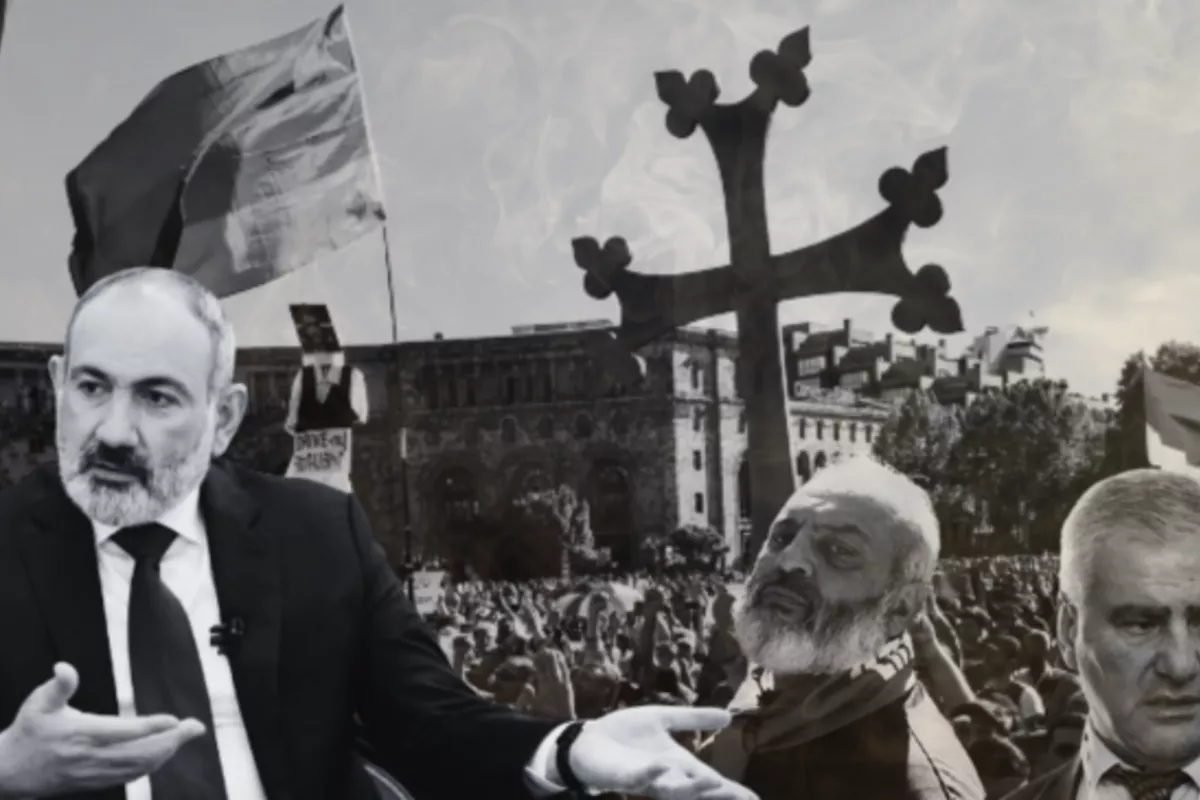
Prime Minister Nikol Pashinyan is demanding the removal of Catholicos Garegin II as head of the Armenian Apostolic Church. Ostensibly concerning accusations that the Catholicos of All Armenians violated his vow of celibacy, the struggle has a pronounced geopolitical dimension.
Pashinyan is attempting to bring about a change in the Church’s top leadership ahead of the general election in June. His team assesses that the Church’s hierarchy, which they say is pro-Russian and opposition-minded, will be used by Russia to support the political opposition and to work toward Pashinyan’s removal from power.
Pashinyan has signed, together with ten bishops from the Armenian Apostolic Church, an agenda titled “Church Reform” that demands Catholicos Garegin II’s removal, a rare occurrence on the European continent.
His team is firmly convinced that the current top leadership of the Armenian Apostolic Church, headed by Garegin II, serves Russia’s interests and consists of many agents of the Russian special services. The prime minister has stated that he does not want to see on the throne of the Catholicos of All Armenians a person who “reports to a senior lieutenant of the KGB”. This is not merely a political accusation. Armenia’s National Security Service has published a document claiming that the Catholicos’ brother, Archbishop Ezras Nersisyan, head of the Russian Diocese of the Church, was recruited by the Soviet KGB and continues to cooperate with foreign special services today.
Archbishop Ezras Nersisyan has described the document as a fabrication. However, there are academically substantiated data indicating that after occupying Armenia in the 1920s, the Soviet Union decided not to shut down the Armenian Apostolic Church, but instead placed it under KGB control. During the Great Patriotic War, Stalin realised that religion and patriotism could unite the people. In September 1943, he met with church leaders, marking the beginning of a “reconciliation".
Despite this softening of policy, it was not true religious freedom; the Church became a strictly controlled institution. In 1945, the election of the Catholicos of All Armenians, Gevorg VI Cheorekchyan, was permitted. Clergy were appointed exclusively from among those who demonstrated a willingness to cooperate with the KGB.
Putin’s support
At the most intense stage of the confrontation between Pashinyan and the church hierarchy - when the prime minister directly accused the Nersisyans of being agents - Russian President Vladimir Putin awarded the head of the Russian-Armenian Diocese one of Russia’s most prestigious decorations, the Order of Alexander Nevsky, “for strengthening ties between the Armenian and Russian peoples”.
Sources close to Armenia’s authorities recount that in 2018, when the “New Armenia, New Catholicos” movement was unfolding on the streets of Yerevan against Garegin II, Putin urged Pashinyan, who was visiting Moscow at the time, to “leave the elder alone”. The movement against Garegin II did not receive Pashinyan’s support in 2018 and eventually faded. Garegin II has also received the Order of Honour from Putin.
These awards have been viewed as a political message from the Kremlin in support of Archbishop Ezras and the current leadership of the Mother See, and as a protest against Pashinyan’s actions. Notably, according to media reports, it was Archbishop Ezras Nersisyan who blessed members of the Arbat battalion departing for the war against Ukraine. The unit was composed of ethnic Armenians residing in Russia, who fought as part of the Russian army.
Claims about the influence of Russian special services over the church hierarchy have also been voiced by some bishops who demanded Garegin II’s resignation. The Mother See has denied all accusations. Months earlier, Pashinyan attempted to justify his interference in the internal affairs of the Armenian Apostolic Church by stating that he was acting as an ordinary believer. He sounded the alarm that Garegin II and members of the hierarchy had violated the vow of celibacy. By signing off the Church Reform agenda as prime minister, he has now formalised his intervention.
Separation of Church and state
Pashinyan is taking tough steps that some lawyers and constitutional scholars describe as unconstitutional. Armenia’s constitution establishes the principle of separation of religious organisations from the state.
According to some experts, when the head of state interferes in the internal governance of the Church - deciding who should be removed or who should serve as its leader - he grossly violates this constitutional separation. The state has no legal authority to determine the appropriateness of a religious institution’s leadership tenure.
Pashinyan is now justifying his actions by citing the need to ensure Armenia’s security. According to members of the ruling Civil Contract party, the leadership of the Armenian Apostolic Church has not only become an instrument of Russian influence, but also one of the branches of Armenia’s opposition. They substantiate this view by pointing to the oppositional stance adopted by a significant portion of the clergy.
In the spring of 2024, at least 30,000 demonstrators gathered in Yerevan’s main square. On the stage was Archbishop Bagrat Galstanyan, head of the Tavush Diocese of the Church, who today, along with more than a dozen of his supporters, is in prison on charges of preparing acts of terrorism. The opposition movement led by Galstanyan lasted only two to three months and quickly faded. He openly stated that the movement had the blessing of Catholicos Garegin II. The latter not only did not deny this, but numerous clergymen have also taken part in opposition rallies known as the “Sacred Movement”. Government officials also recall Archbishop Galstanyan’s public claim that representatives of a foreign special service had contacted him and warned that if he failed to bring about a change of power in Armenia, traditional values would be endangered.
The head of the Shirak Diocese, Archbishop Mikayel Ajapahyan, has also been imprisoned for calling for a military coup. He is the author of sharp political accusations against Pashinyan, sometimes even more radical than those voiced by opposition figures. On several occasions, he publicly stated that he had called on the former presidents who currently lead Armenia’s opposition to carry out a military coup. The head of the Aragatsotn Diocese is also in prison. There are public claims by some clergymen that, at the level of the Catholicos, they were instructed to participate in opposition rallies.
Archbishop Arshak Khachatryan, the chancellor of the Mother See, a member of Garegin II’s inner circle and a sharp critic of Pashinyan, has been accused of “cohabiting with his own aunt by marriage”. He has denied the accusation, but video footage has been published. He is also in prison. According to the official accusation, in 2018 Archbishop Arshak instructed someone to plant drugs in the backpack of one of the participants in a protest demanding the Catholicos’ resignation, with the aim of discrediting the protestor.
Meanwhile, one of the Church’s fundamental rules for high-ranking clergy is the mandatory observance of the vow of celibacy. Catholicos Garegin II has not denied that he violated the vow of celibacy and has a daughter.
Opposition links
It is evident, however, that the accusation of violating the vow of celibacy is merely a tool in the prime minister’s hands to neutralise the current leadership of the Armenian Apostolic Church and strip it of its political potential. Ahead of the 2026 elections, Pashinyan is weakening the field of the opposition’s allies. The Church has an extensive network in Armenia, and Pashinyan’s government is concerned that those clerics are conducting counter-propaganda against it. Russia-based businessman Samvel Karapetyan, who is also close to Garegin II, has likewise been imprisoned on charges of calling for the seizure of power.
Garegin II maintains close relations with former presidents Robert Kocharyan and Serzh Sargsyan, who today lead the opposition. One of the main reasons for the harsh confrontation between Pashinyan and Garegin II is that the opposition has drawn the Church hierarchy into the political struggle, positioning it as an anti-government institution. Clergy loyal to Garegin II largely adopt oppositional positions and, in their public rhetoric, are anti-Pashinyan, accusing him of “acting against national and traditional values”, making concessions to Turkey and Azerbaijan, failing to adequately protect the rights of Armenians of Karabakh, and other alleged offences.
Meanwhile, investigative journalists in Armenia have documented evidence of how Russia generates hybrid threats against Armenia. These are accompanied by the dissemination of disinformation and AI-generated fake videos aimed at manipulating Armenian public opinion and provoking domestic political instability.
Armenia’s Foreign Intelligence Service, in a report published recently, also listed representatives of the Church among the sources of hybrid threats. The report notes the activation of agent networks and influence agents, including individuals engaged in politics under the guise of business, as well as religious and cultural institutions and their publicly recognisable representatives.
According to the Intelligence Service, “these actors may be involved during the pre-election and post-election periods, as well as on the day of voting itself, in organising acts of sabotage under the cover of civil disobedience actions.” It is not coincidental that opposition forces particularly aligned with Russia have sharply criticised the European Union’s decision to provide Armenia with financial assistance aimed at countering hybrid threats.
Thus, Armenia’s Intelligence Service - working closely with US and European intelligence agencies - has gathered information indicating that church figures may assume an active role in domestic political processes. Although the service does not explicitly name Russia in its report (out of a desire to avoid provoking a new round of political tension between Yerevan and Moscow), it is evident that the Armenian authorities perceive the most serious hybrid threats as coming specifically from Russia. They view the Church as one of the instruments of that influence.
Pashinyan appears to believe that by removing Garegin II and his close circle, he will be able to neutralise yet another channel of Russian influence. However, the opposition aligned with former presidents has consolidated around Garegin II and is preparing to resist Pashinyan’s agenda. The Russian side, at the level of Foreign Minister Sergey Lavrov, was compelled to express concern over developments surrounding the Armenian Apostolic Church. Both Pashinyan and Garegin II are in a “battle-ready” stance, and neither is willing to retreat.
A resolution may come on June 7. If Pashinyan’s political team wins the parliamentary elections, Catholicos Garegin II’s resignation is highly likely. Conversely, an opposition victory would allow Garegin II to continue serving unimpeded as Catholicos of All Armenians. No one knows how this Armenian series will end - not even the screenwriters themselves.