Russia is preparing for another major electoral exercise. Voting for the ninth State Duma will take place over three days, from September 18 to 20, 2026, with 450 seats at stake - 225 elected through party lists and another 225 in single-member constituencies. According to the Central Election Commission, 4,436 candidates have been registered, including 2,816 on the federal lists of 10 political parties and 1,620 in single-member districts.
On paper, these numbers suggest competition.
The more important question, however, is not how many names appear on the ballot but which political alternatives have been prevented from appearing there at all.
Weeks before voting begins, the campaign has already produced a series of controversies over candidate registration, court decisions, restrictions on opposition figures and the absence of independent international monitoring. Taken together, they raise a broader question about the nature of electoral politics in contemporary Russia: why does a political system that appears confident of victory devote so much energy to eliminating opponents who have little realistic chance of defeating it?
Boris Nadezhdin: Why Fear a Candidate With 3%?
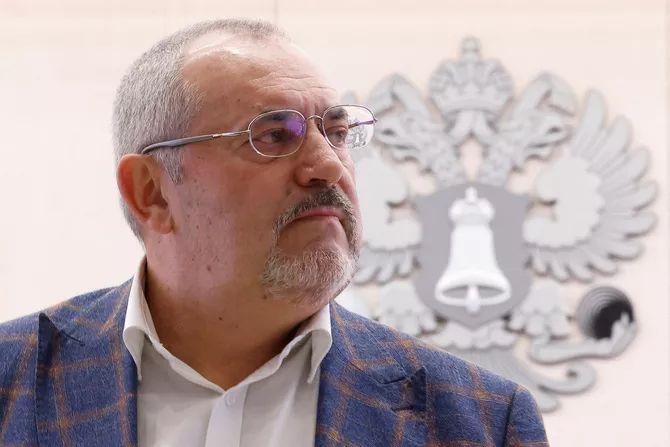
Boris Nadezhdin offers perhaps the clearest example.
Maxim Shemetov | Reuters
When he attempted to challenge Vladimir Putin in the 2024 presidential election, Nadezhdin was hardly a serious threat to the Kremlin. A Levada Center survey found that only about 3% of respondents were firmly prepared to vote for him if he had appeared on the ballot, although around 9% said they might consider supporting him.
Putin, by contrast, enjoyed overwhelming support in the same electoral environment.
Nadezhdin nevertheless became politically significant for another reason. He openly opposed the war in Ukraine and briefly turned the collection of signatures required for his candidacy into an unusual public political event. Russians queued to sign in support of his nomination, making his campaign a legal focal point for people who wanted an alternative position represented in the election.
The Central Election Commission eventually rejected his presidential candidacy over allegedly invalid signatures.
Two years later, the pattern repeated itself.
Nadezhdin announced in June 2026 that he intended to run for the State Duma. On July 10, the Justice Ministry designated him a “foreign agent,” a status that prevents individuals from participating as candidates under Russian electoral legislation. Three days later, police detained him. On July 17, a court also found him guilty of displaying “extremist symbols” in connection with an old social-media post containing footage in which an image of the late opposition leader Alexei Navalny appeared briefly. He was fined 1,000 rubles, but the administrative conviction created an additional prohibition on running for office. Nadezhdin subsequently ended his campaign and later left Russia.
This is where the political paradox becomes difficult to ignore.
A politician commanding only a few percent of the vote was unlikely to defeat Putin in 2024 and even less likely, as an individual parliamentary candidate, to destabilize the Russian state in 2026.
So why remove him?
One interpretation is that the Kremlin is not primarily afraid that people such as Nadezhdin can win. It is afraid that they can become a legal rallying point for dissatisfaction.
In a tightly managed system, even a weak candidate can create something dangerous: an uncontrolled political process.
Yabloko: From the Ballot to the Supreme Court
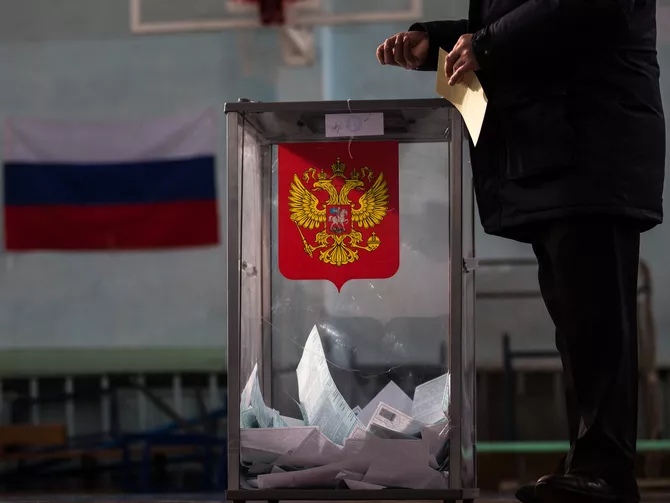
The case of the liberal Yabloko party strengthens that argument.
Credit: Igor Russak / SOPA Images / LightRocket / Getty
Yabloko has not been a major parliamentary force for many years. According to official results, it received only 1.34% in the 2021 State Duma election and won no seats through the federal party list.
Yet in 2026 it occupied a politically unusual position: it was the only registered party contesting the national election on an openly pro-peace, anti-war platform.
Initially, the Central Election Commission approved more than 400 Yabloko candidates for participation in the parliamentary campaign. On August 5, the party was even assigned the No. 2 position on the federal ballot, directly after United Russia.
Five days later, everything changed.
On August 10, Russia’s Supreme Court canceled the registration of Yabloko’s federal list following a lawsuit brought by the Rodina party. The accusations included improper campaign financing and copyright violations. According to the court’s reasoned ruling as described by Yabloko, the disputed material included donations from Russian citizens who had previously received funds from abroad, publications supporting the party on restricted social media platforms and alleged unauthorized use of intellectual property.
Yabloko rejected the accusations as politically motivated.
On August 17, the Supreme Court’s appeals panel upheld the decision. The following day, the Central Election Commission formally removed Yabloko from the federal ballot. The No. 2 line was simply deleted, leaving the numbering of the remaining parties unchanged.
Once again, the issue goes beyond the electoral strength of the organization involved.
Yabloko had no realistic prospect of forming a government. Its previous national performance had been marginal. Yet it offered voters something increasingly rare inside the legal Russian political system: an explicitly different position on one of the defining political issues of the era.
Eliminating such a party therefore does not merely eliminate a potential winner. It eliminates a choice.
Problems Begin Before Election Day
The controversies have not been confined to Moscow.
In St. Petersburg, election authorities barred Yabloko’s entire slate from the regional parliamentary election over problems with a notarized power of attorney. Earlier, 11 of 25 Yabloko nominees had been told that required documents were missing. Party lawyers claimed some of those documents had actually been submitted and officially logged.
Similar complaints were reported by a candidate associated with A Just Russia, whose representatives also disputed claims that documents were missing.
These incidents do not prove that votes will be falsified in September. Voting has not yet taken place.
But they illustrate why the quality of an election cannot be judged only by what happens when ballots are counted. An election can be politically constrained long before a voter enters a polling station - through registration rules, court proceedings, restrictions on campaigning, access to media and decisions about who is legally permitted to compete.
Who Will Watch the Vote?
There is another major problem: independent observation.
On August 6, the OSCE Office for Democratic Institutions and Human Rights and the OSCE Parliamentary Assembly announced that Russia had not invited them to observe the 2026 parliamentary election.
According to the OSCE, this will be the third consecutive nationwide Russian electoral process that it has been unable to observe. The organization was unable to deploy a mission for the 2021 parliamentary election after Russia imposed limits on observer numbers, while it received no invitation for the 2024 presidential election.
Domestic independent monitoring has also been weakened.
Golos, Russia’s best-known independent election-monitoring organization, announced in July 2025 that it was ceasing operations. The decision followed the sentencing of its co-chairman Grigory Melkonyants to five years in prison for alleged involvement with an organization designated “undesirable.” Melkonyants denied wrongdoing. Russian authorities have rejected Golos’s previous allegations of large-scale electoral fraud.
This matters because transparency becomes particularly important when voting is spread over several days and increasingly involves digital technology.
The Central Election Commission has authorized voting on September 18, 19 and 20 and says the three-day format makes participation more convenient while improving security. Remote electronic voting will be available to voters in 33 regions. By August 19, approximately 1.57 million applications for remote electronic voting had already been submitted.
The CEC insists that the Russian electoral system remains transparent and open. Its own statistics also provide an important counterargument to claims that there is no competition at all: thousands of candidates have been registered and 10 parties remain on the federal ballot.
Yet quantity is not the same as political pluralism.
The Kremlin’s Real Fear May Not Be Defeat
This is ultimately the central issue surrounding Russia’s 2026 election.
It would be simplistic to claim that the Kremlin fears Boris Nadezhdin because it believes he could defeat Vladimir Putin. Available polling provides little basis for such an argument.
Nor was Yabloko likely to take control of the State Duma.
The vulnerability of a highly controlled political system lies elsewhere.
Such systems depend not merely on winning elections but on ensuring that the entire political process remains predictable. They can tolerate parties that criticize individual policies while accepting the basic boundaries established by the authorities. What becomes more problematic is a candidate, party or movement capable of transforming an election into a public demonstration that another political position exists.
That helps explain why a politician with 3% support can still matter.
It explains why a small party can matter.
It explains why queues to sign nomination papers can matter.
And it explains why the distinction between defeating an opponent and preventing that opponent from participating is so important.
Russia’s parliamentary election is still almost a month away. It would therefore be premature to describe election day violations that have not yet occurred.
But one conclusion can already be drawn from the campaign: the decisive struggle over the 2026 Russian election is taking place before the ballots are cast.
The defining question may not be who Russians are allowed to vote for on September 18-20.
It may be who they are not allowed to vote for - and why a political system that presents itself as overwhelmingly popular still appears so uncomfortable with even weak, peaceful and electorally marginal alternatives.