The war in Iran has disrupted global trade routes, but it has also thrust the Trans-Caspian Corridor into the spotlight, turning the South Caucasus-and especially Azerbaijan-into a key player in international trade and transit.
In the hours following the joint strikes on Iran by the US and Israel on February 28, air traffic along the usually busy east-west routes was forced to shift into a narrow corridor over the South Caucasus, The Caspian Post reports via foreign media.
While this development in the skies was sudden, on the ground it had been brewing for years. The region has increasingly drawn attention as a critical link in the Trans-Caspian International Transport Corridor, also known as the Middle Route, which connects Europe and China while bypassing Iran and Russia via Central Asia and the South Caucasus.
The outbreak of war in Iran has made the corridor’s significance even more pronounced. By blocking the Strait of Hormuz-through which roughly one-fifth of global oil and liquefied natural gas shipments pass-Iran has disrupted the established global energy transport system.
Director of the Yerevan Center for Regional Studies Richard Giragosian said that the war in Iran has opened new opportunities for the South Caucasus amid the crisis: the Middle Route remains the only fully operational transport corridor for trade and cargo movement.
Its importance is further underscored by the instability of another major trade route through the Bab-el-Mandeb Strait and the Red Sea, which handles roughly 12% of global trade but has recently faced threats and actual attacks by Iran-backed Houthi forces in Yemen. The alternative detour around the Cape of Good Hope in South Africa adds more than ten days to the transit time from Asia to Europe.
The Trans-Caspian Corridor, as the shortest overland route between Europe and China, is designed for transporting Chinese goods as well as critical minerals and energy resources from Central Asia to Europe. Both the European Union and China have already pledged multi-billion-dollar investments to modernize ports, railways, and highways along this corridor.
Freight volumes along the route have quadrupled since 2022, following Russia’s full-scale invasion of Ukraine. While the corridor’s role in Europe-Asia trade remains modest for now, it is expected to rise sharply in the coming years, regardless of the conflict in Iran. The World Bank forecasts that by 2030, the Middle Route could handle up to 11 million tons of cargo.
Kornely Kakachia, director of the Georgian Institute of Politics, said that in the medium to long term, the Trans-Caspian Corridor will become one of the main transport arteries between the EU and China alongside maritime routes. Such development would significantly boost the South Caucasus countries’ role as key transit states.
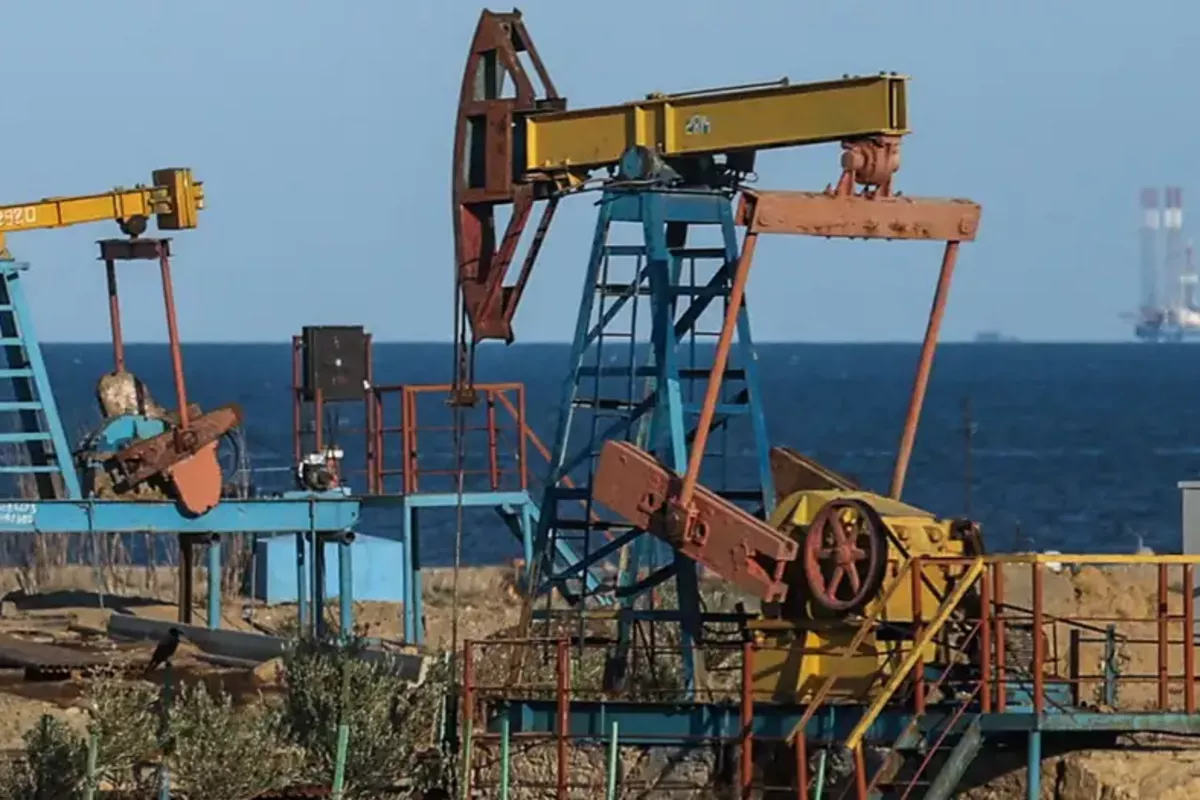
Azerbaijan could also reap short-term gains from the war in Iran: rising oil prices are projected to bring the country hundreds of millions of dollars in additional revenue each month.
Hikmet Hajiyev, Assistant to the President of the Republic of Azerbaijan, told Euronews that the country is also increasing its natural gas exports to offset the reduced energy supply from the Persian Gulf amid the conflict with Iran. Europe currently receives about 4% of its gas from Azerbaijan, totaling 12.8 billion cubic meters, with plans to increase this volume to 20 billion cubic meters by 2027.
However, the war also carries significant risks. Kakachia said that the success of the Middle Route depends on stability along the entire corridor from China to the European Union and throughout the South Caucasus. Georgia, Azerbaijan, and Armenia have all adopted neutral stances in the conflict with Iran.
However, Tehran has for a long time criticized Baku for its close economic ties with Israel. In 2025, Israel sourced 46.4% of its oil from Azerbaijan via the Baku-Tbilisi-Ceyhan pipeline, while Azerbaijan, in turn, purchased a significant portion of its military equipment from Israel.
Muhammad Mammadov representing the Topchubashov Analytical Center in Baku, which specializes in international relations and security, said that Azerbaijan’s ties with Israel have long been perceived in Tehran as a threat. In recent years, however, relations between Baku and Tehran had gradually improved, with both sides attempting to separate contentious issues from practical cooperation. Their partnership was largely built around developing a trade corridor linking Iran and Russia.
This fragile balance was shattered on March 5, when four Iranian drones struck the international airport in Azerbaijan's Nakhchivan. Azerbaijani President Ilham Aliyev condemned the attack as a terrorist act. Baku announced possible retaliatory measures and temporarily suspended cargo traffic with Iran.
Tensions eased following a direct conversation between the leaders of the two countries, but as Mammadov notes, while relations have returned to their previous level, the incident generated significant uncertainty. Azerbaijani authorities also reported foiling sabotage attempts by the Islamic Revolutionary Guard Corps (IRGC), with potential targets reportedly including the Baku-Tbilisi-Ceyhan pipeline and the Israeli embassy.
A prolonged war could jeopardize a major initiative known as TRIPP. The acronym stands for “Trump Route for International Peace and Prosperity” and refers to a 43-kilometer transit corridor for both road and rail connecting Azerbaijan with Nakhchivan-separated by a 32-kilometer stretch of Armenia-as well as linking Azerbaijan directly to Türkiye.
The opening of the long-closed Armenia-Azerbaijan border, shut for decades due to the Karabakh conflict, would create a new logistics route in the South Caucasus, complementing existing corridors through Azerbaijan and Georgia. The United States, viewing TRIPP as a critical supply chain for essential minerals, actively supports the project, which is planned to be developed and managed by a U.S.-led consortium.
However, Iran remains skeptical of U.S. involvement, as the route passes close to its border. Last summer, one of the advisors to former Supreme Leader Ali Khamenei even called the project “a grave for Donald Trump’s mercenaries.”
At the same time, Giragosian believes Tehran’s concerns are overstated, noting that there are currently no military targets along the corridor that would warrant Iranian attention. Construction of TRIPP is not expected to begin before the second half of 2026.
Ultimately, stability and security in the region are essential for the South Caucasus. Mammadov said that it is not in Azerbaijan’s interest for Iran to descend into chaos or for the war there to drag on: prolonged conflict increases risks, reduces predictability, and creates fertile ground for mistakes. A collapse in Iran could open a Pandora’s box, triggering economic turmoil and a massive refugee outflow from a country home to over 20 million ethnic Azerbaijanis.
Mammadov considers the optimal scenario for Baku to be a weakened Iran that still retains its current regime. As long as Tehran remains an international pariah, Azerbaijan maintains its geopolitical and economic significance as a stable bridge between East and West.
by Lisa Louis