Japan’s Strategic Turn Toward Central Asia
The Jamestown Foundation has posted on its website an analytical article highlighting Japan's close engagement with Central Asia.
The Caspian Post republishes the article by Vusal Guliyev, a leading advisor at the Baku-based Center of Analysis of International Relations (AIR Center).
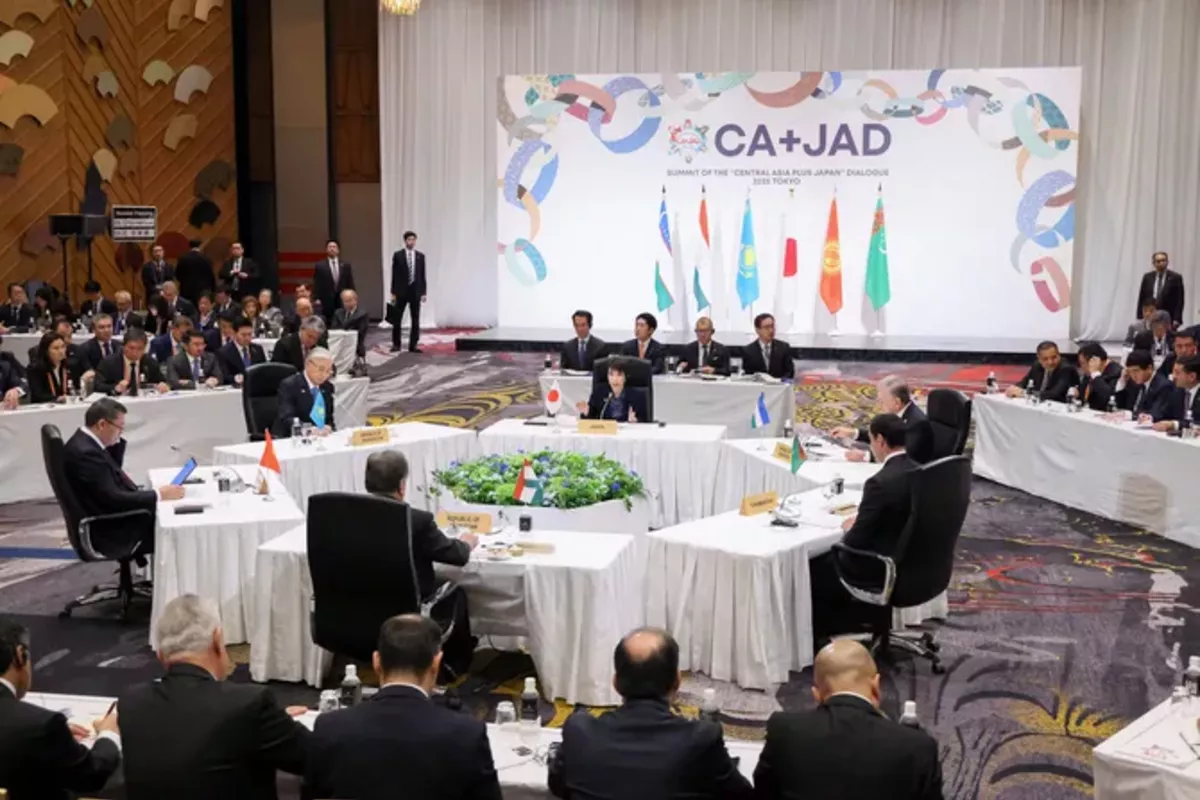
Japan’s first-ever leaders’ summit with the five Central Asian countries of Kazakhstan, Kyrgyzstan, Tajikistan, Turkmenistan, and Uzbekistan in Tokyo on December 20, 2025, marked a shift in Tokyo’s approach to the region. At the summit, Japanese Prime Minister Sanae Takaichi announced the CA+JAD Tokyo Initiative, a new framework aimed at promoting industrial and logistical integration with Central Asia. This initiative signals a move beyond Japan’s longstanding “Silk Road Diplomacy,” which traditionally emphasized official development assistance and technical cooperation, toward a more assertive geoeconomic partnership. Tokyo identified three priority areas for cooperation-green and resilience, connectivity, and human resource development-while underscoring Central Asia’s growing importance as a junction between Europe and Asia, endowed with significant energy and mineral resources. Together, these elements outline a broader strategy that links diplomacy, infrastructure, and economic security.
This strategic reorientation is not confined to diplomatic rhetoric but is backed by substantial financial and investment commitments. Under the Tokyo Initiative, Japan is moving beyond low-key development assistance toward assuming tangible economic stakes in Central Asia. Central to this effort is a proposed 3 trillion yen (approximately $19 billion) program designed to support joint business investments over the next five years through a combination of public and private capital. Takaichi framed the initiative as an effort to cultivate a self-sustaining hub of prosperity in Central Asia, positioning Japan as a reliable long-term partner rather than a peripheral donor. This shift reflects the evolving situation in the region, as supply-chain disruptions stemming from Russia’s war against Ukraine and intensifying great-power competition have compelled Japan to diversify its sources of supply and transit routes.
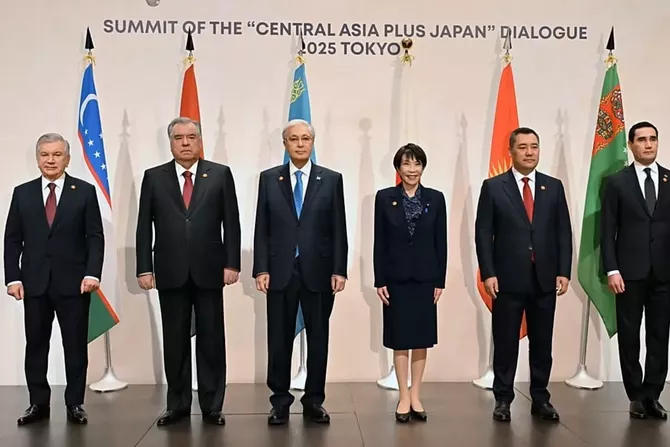
Phot: Akorda
These ambitions are operationally structured through a three-pillar framework that defines Japan’s long-term engagement with Central Asia. Under the “green and resilience” pillar, Japan committed to joint initiatives on energy transition, climate action, and the development of secure critical-mineral supply chains. The “connectivity” pillar centers on advancing the Trans-Caspian International Transport Route-commonly referred to as the Middle Corridor-and includes the launch of a Japan-Central Asia AI Cooperation Partnership to improve logistics performance and industrial efficiency. The third pillar, “human resources,” prioritizes expanded scholarships, professional training programs, and new forms of cooperation in the health and education sectors. Taken together, these pillars encompassing green energy, rail and maritime connectivity, and people-to-people exchanges are intended to deepen Central Asia’s integration into global markets while providing Japan with stable, diversified, and long-term partnerships.
Among these areas, connectivity directly addresses Japan’s growing concerns over transit security and supply-chain vulnerability. One of the central objectives of Japan’s strategy is to bypass Russia and congested maritime routes by leveraging the Middle Corridor. Traditionally, trade between East Asia and Europe has relied either on all-sea routes via the Suez Canal or on overland transit through Russia along the Trans-Siberian Railway. The appeal of the Trans-Siberian route was highlighted in 2018, when the first rail shipment of Japanese cargo transited Russia with official backing from both sides, marking an experiment in rail-based alternatives to sea and air freight. Russia’s war against Ukraine, however, transformed what was once a logistical option into a liability. Sanctions, political risk, and uncertainty have rendered reliance on Russian territory increasingly untenable.
The Middle Corridor has emerged as a compelling alternative. Under this route, goods move by rail from the People’s Republic of China (PRC) and Kazakhstan to the Caspian Sea, cross by ferry to Azerbaijan, and then continue by rail through Georgia to Türkiye and onward to European markets. Its appeal is not merely geopolitical but increasingly operational. This multimodal route already delivers a dramatic reduction in transit times. In this regard, a Japanese cargo shipment in February 2025, routed via Nagoya (Japan)-Qingdao (PRC)-Xi’an (PRC)-Altynkol (Kazakhstan)-Aktau (Kazakhstan)-Poti (Georgia)-Ambarlı (Türkiye), completed the journey in just over 20 days, compared with 45-60 days via traditional maritime routes. In effect, the Middle Corridor has emerged as a genuine east-west artery rather than merely a theoretical backup option. It bypasses Russian territory entirely.
Logistics efficiency alone does not explain Japan’s expanding interest in the region. Equally important is the region’s role in securing access to critical raw materials. The region is rich in minerals and hydrocarbons, which are crucial to Japan’s industrial base and green-energy transition. Kazakhstan alone supplies substantial uranium and rare earth elements, while also exporting oil to Japan. Uzbekistan holds significant gold reserves and other minerals. Tajikistan possesses antimony deposits. Turkmenistan has vast natural gas reserves. Tokyo has linked its green and resilience agenda to “strengthening critical minerals supply chains”. Central Asia’s critical minerals and rare metals are increasingly viewed as vital for economic security, particularly amid rising demand for semiconductors, electric vehicle batteries, and nuclear power generation.
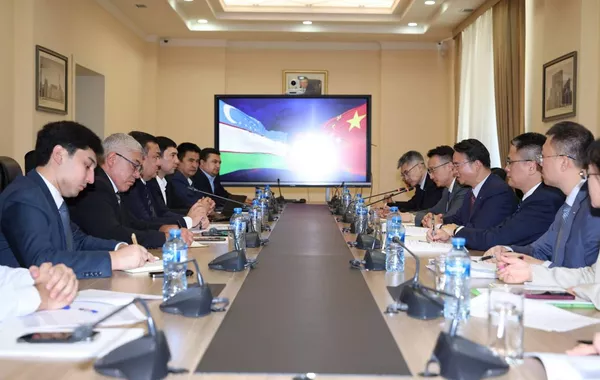
Photo: Uzdaily.uz
Securing these resource flows depends on the reliability and sophistication of the Middle Corridor itself. This pushes Japan to invest not only in physical infrastructure but also in digital and technological systems. Beyond tracks and docks, a modern logistics network relies just as heavily on its digital and technological backbone. Japan is therefore advancing a comprehensive digital agenda along the Middle Corridor. The CA+JAD Tokyo Initiative launched a Japan-Central Asia AI Cooperation Partnership, marking a shift from connectivity rhetoric to concrete technological integration. The initiative focuses on modernizing both the physical and digital foundations of the corridor. Japan is prioritizing the digitalization of customs procedures, aiming to standardize and automate clearance systems in Kazakhstan and other transit states to reduce delays and enhance the predictability of cross-border shipments. Complementing these efforts is a strong emphasis on artificial intelligence and data integration. Through the newly launched AI cooperation partnership, Japan is sharing its logistics platforms and engaging in joint technology projects to improve route planning, cargo tracking, and intermodal coordination across the corridor.
Investments in infrastructure, resources, and digital systems reveal the logic underpinning Japan’s approach to the Middle Corridor. Rather than merely adapting to shifting Eurasian dynamics, Tokyo actively seeks to reshape connectivity on its own terms. By linking supply-chain diversification with resource security, Japan is recasting Central Asia not as a landlocked periphery but as a globally connected hub for trade and investment. The CA+JAD Tokyo Initiative provides a concrete roadmap for translating this vision into practice, from digitizing customs procedures across the Caspian to deploying AI-enabled logistics systems. If Japanese and Central Asian stakeholders follow through on these commitments, Asia-Europe overland traffic through Central Asia and the Caucasus is likely to increase significantly over the coming decade.