For more than three decades after the collapse of the Soviet Union, Central Asia was defined less by its own strategic identity than by its location between others. Sandwiched between Russia, China, South Asia, the Middle East, and Europe, the region was widely perceived as a geopolitical corridor rather than a geopolitical actor. External powers projected influence inward, while Central Asian states pursued outward-facing, largely bilateral strategies designed to secure investment, security guarantees, and diplomatic backing.
The result was a fragmented regional order-politically cautious, economically under-integrated, and strategically reactive. Regional institutions remained weak, intra-regional trade was limited, and collective positioning was rare. Sovereignty was guarded, but at the cost of coordination.
By 2025-2026, that model has reached its limits.
The international environment confronting Central Asia has changed fundamentally. Great-power competition has intensified, sanctions have become structural features of global politics, supply chains are fragmenting, and climate stress is no longer a distant risk but an immediate constraint. In this context, Central Asia’s long-term security, economic resilience, and geopolitical autonomy increasingly depend not on external patrons, but on the region’s ability to act together.
Regional unity-incremental, pragmatic, and interest-driven rather than ideological-is no longer an abstract aspiration. It is becoming a strategic necessity.
A Structural Turning Point in the Mid-2020s
The years 2025-2026 represent a quiet but decisive turning point for Central Asia. Several structural shifts have converged at once.
Russia’s war-driven reorientation has weakened its economic role in the region while increasing political unpredictability. China remains Central Asia’s largest trade partner, but Beijing’s approach has become more cautious, commercially selective, and risk-sensitive. The European Union has upgraded Central Asia within its Global Gateway strategy, focusing on connectivity, energy transition, and critical raw materials. Türkiye, the Gulf states, Japan, India, and South Korea have all expanded diplomatic and economic engagement.
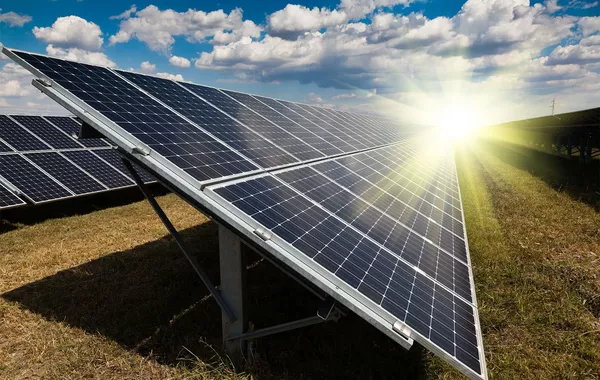
At the same time, climate change has moved from being a long-term environmental issue to a short-term policy driver. Water scarcity, energy imbalances, and extreme weather events now directly affect economic growth, social stability, and political legitimacy.
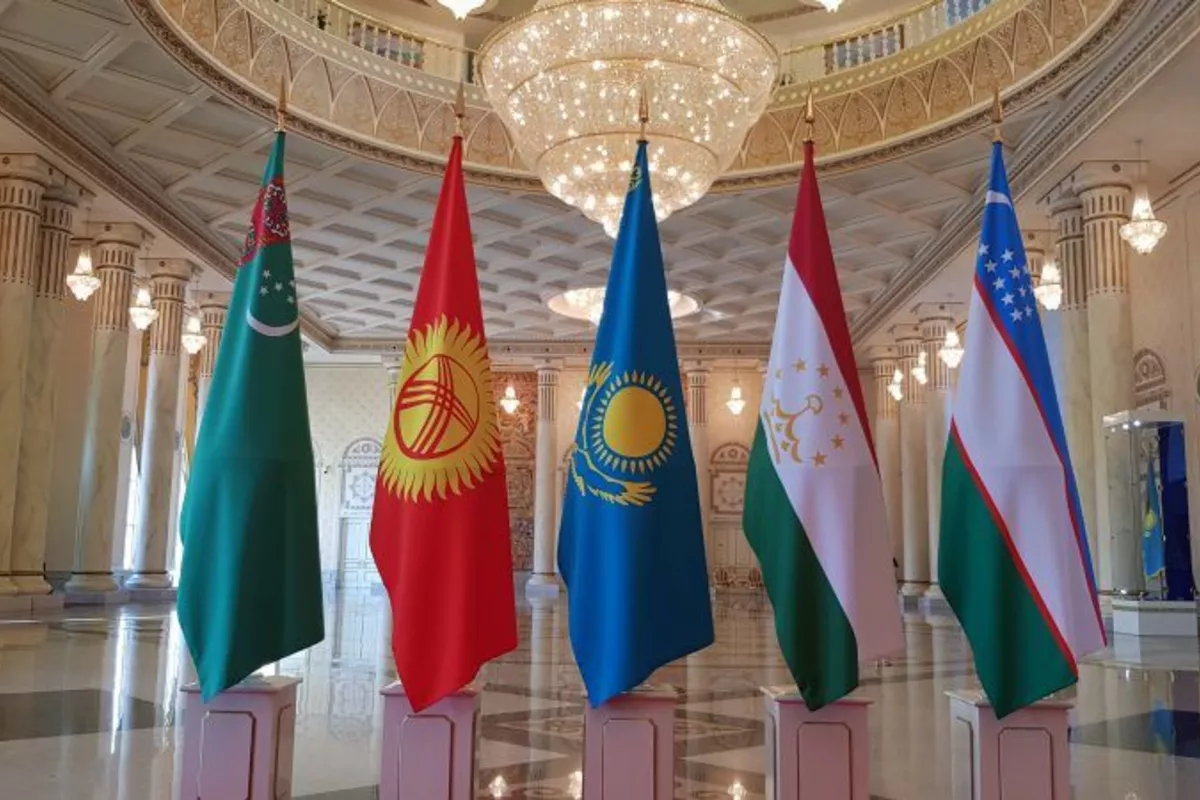
Individually, Central Asian states have limited leverage in navigating this environment. Collectively, they represent a region of nearly 80 million people, significant natural resources, and transit corridors critical to Eurasian connectivity. Whether that potential translates into strategic agency depends on the depth and durability of regional coordination.
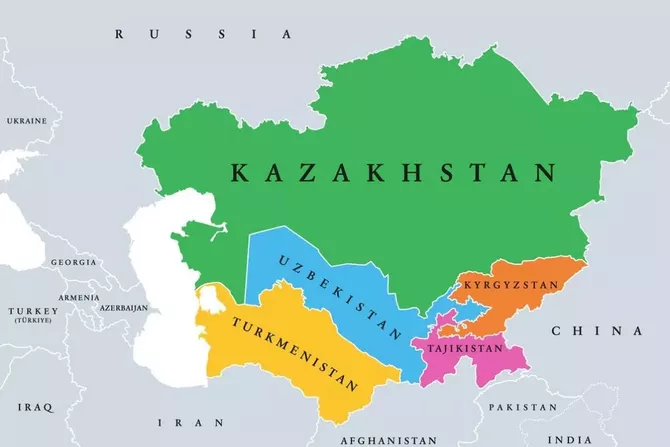
Photo: Wikimedia Commons
From Fragmentation to Functional Regionalism
The early post-independence decades were defined by defensive sovereignty. Borders hardened, regional cooperation was minimal, and diplomacy flowed primarily through Moscow, Beijing, or Western capitals. This fragmentation was not accidental; it reflected weak state capacity, unresolved border issues, water disputes, and fears of instability spillover.
Yet by the late 2010s-and more clearly by the mid-2020s-this posture began to evolve. Improved relations between Uzbekistan and its neighbors played a catalytic role. Regular Consultative Meetings of Central Asian Heads of State became institutionalized. Trade barriers eased, border crossings reopened, and regional dialogue expanded beyond symbolism.
By 2025-2026, Central Asia is no longer fragmented in the way it once was. What has emerged is not integration in a European Union sense, but functional regionalism: cooperation focused on practical problems where interests overlap. Transport, energy, trade facilitation, and diplomatic coordination have become areas of quiet convergence.
The logic behind this shift is simple. What once protected sovereignty now constrains it. Fragmentation increases vulnerability in an interconnected and volatile world.
Strategic Autonomy in an Era of Great-Power Competition
Central Asia sits at the intersection of multiple power agendas. Russia remains an important security and labor-market partner. China dominates trade, infrastructure finance, and energy demand. The European Union seeks regulatory alignment, green energy, and secure transit routes. Middle Eastern and Asian partners are expanding investment footprints.
Bilateral relationships remain necessary, but they are structurally asymmetric. Individually, Central Asian states often find themselves price-takers-on energy exports, transit fees, infrastructure contracts, and financing terms.
Regional unity mitigates this asymmetry.
By 2025-2026, coordination around connectivity projects-particularly along the east-west and north-south corridors-has begun to reduce zero-sum competition among national routes. Shared signaling on sovereignty, military non-alignment, and external basing has preserved policy space. Even loose alignment sends a message: Central Asia is not merely an arena of competition, but a region with its own strategic preferences.
Unity does not eliminate dependence on major partners, but it diversifies it-and diversification is the foundation of autonomy.
Economic Resilience Through Regional Markets
Economically, Central Asia remains rich in resources but structurally vulnerable. Hydrocarbons, metals, and agricultural commodities dominate exports, while value-added production remains limited. Global volatility in 2024-2025 exposed the risks of this model, particularly for states heavily dependent on single markets or routes.
Regional unity offers a partial but meaningful remedy.
Integrated transport networks lower logistics costs. Harmonized customs and standards facilitate cross-border trade. Coordinated industrial strategies-especially in agri-processing, light manufacturing, and energy-help retain value within the region. Shared investment frameworks attract longer-term, productivity-enhancing capital rather than extractive finance.
By 2026, policymakers increasingly recognize that national development strategies are more viable when aligned regionally. Competition among neighbors for identical investments or transit roles ultimately benefits external actors, not Central Asia itself.
Water, Energy, and Climate: Unity as Survival Strategy
Nowhere is regional unity more critical than in water and energy governance. Central Asia’s upstream-downstream dynamics are inherently regional. Climate change has intensified these interdependencies.
Accelerated glacier melt in the Pamirs and Tien Shan threatens long-term water availability. Hotter summers increase irrigation demand, while winter electricity shortages persist in upstream countries. No national solution can resolve these basin-wide challenges.
By 2025-2026, regional energy swaps, grid interconnections, and water-management dialogues have become operational necessities rather than political gestures. Shared data, forecasting, and investment planning reduce mistrust and inefficiency.
Failure to cooperate carries consequences beyond economics. Resource insecurity fuels migration, social unrest, and political pressure. Unity here is not idealism-it is risk management.
Security Without Militarization
Central Asia’s security challenges-extremism, organized crime, cyber threats, and instability linked to Afghanistan-are transnational by nature. Yet security responses have often been mediated through external frameworks.
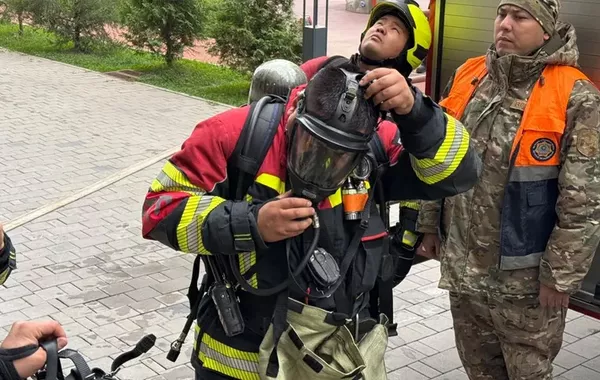
By 2025-2026, regional leaders increasingly recognize the limits of outsourcing security. While organizations like the Shanghai Cooperation Organisation remain relevant, there is growing emphasis on regional confidence-building: intelligence sharing, border coordination, crisis communication, and disaster response.
This approach enhances sovereignty rather than diluting it. Reduced intra-regional mistrust lowers escalation risks and limits the need for external military guarantees.
Diplomacy, Legitimacy, and Regional Ownership
Central Asia’s diplomatic profile has risen markedly in 2025-2026. Leaders-level summits with the EU, China, Japan, and Gulf states increasingly treat the region as a collective interlocutor. This shift enhances negotiating power and reduces external agenda-setting.
Domestically, regional cooperation also strengthens political legitimacy. When citizens experience tangible benefits-reliable energy, jobs, improved connectivity-regionalism becomes socially grounded rather than abstract.
Equally important, regionally generated norms and standards carry greater acceptance than externally imposed ones. Unity becomes political capital.
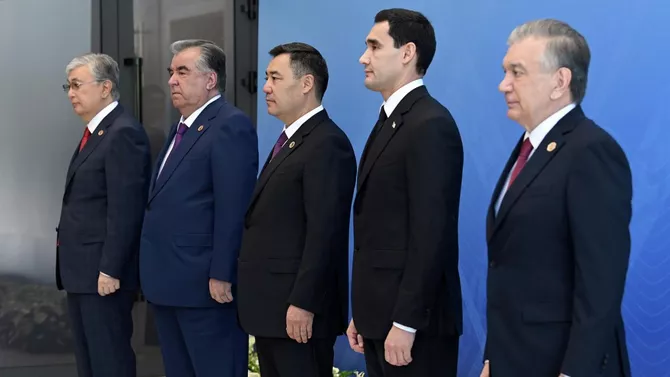
Photo: Kun.uz
The Cost of Disunity in a Fragmenting World
The alternative to unity is not independence-it is exposure. Disunity amplifies vulnerability to sanctions spillovers, supply-chain disruptions, climate shocks, and great-power rivalry. It encourages competitive undercutting among neighbors and deepens dependency.
In a fractured global order, regions that coordinate-even imperfectly-are better positioned to absorb shocks and shape outcomes.
Conclusion: Unity as Strategy, Not Sentiment
By 2025-2026, regional unity in Central Asia is no longer a theoretical debate. It is a practical strategy for resilience and relevance. It does not require supranational institutions or ideological alignment. It requires coordination, restraint, and the recognition that shared risks demand shared responses.
Central Asia’s future will be shaped not only by how others engage with it, but by whether the region continues transforming proximity into partnership-and geography into agency.
Unity, in this sense, is not an end state. It is a method. And in today’s Central Asia, it is becoming the most important one available.