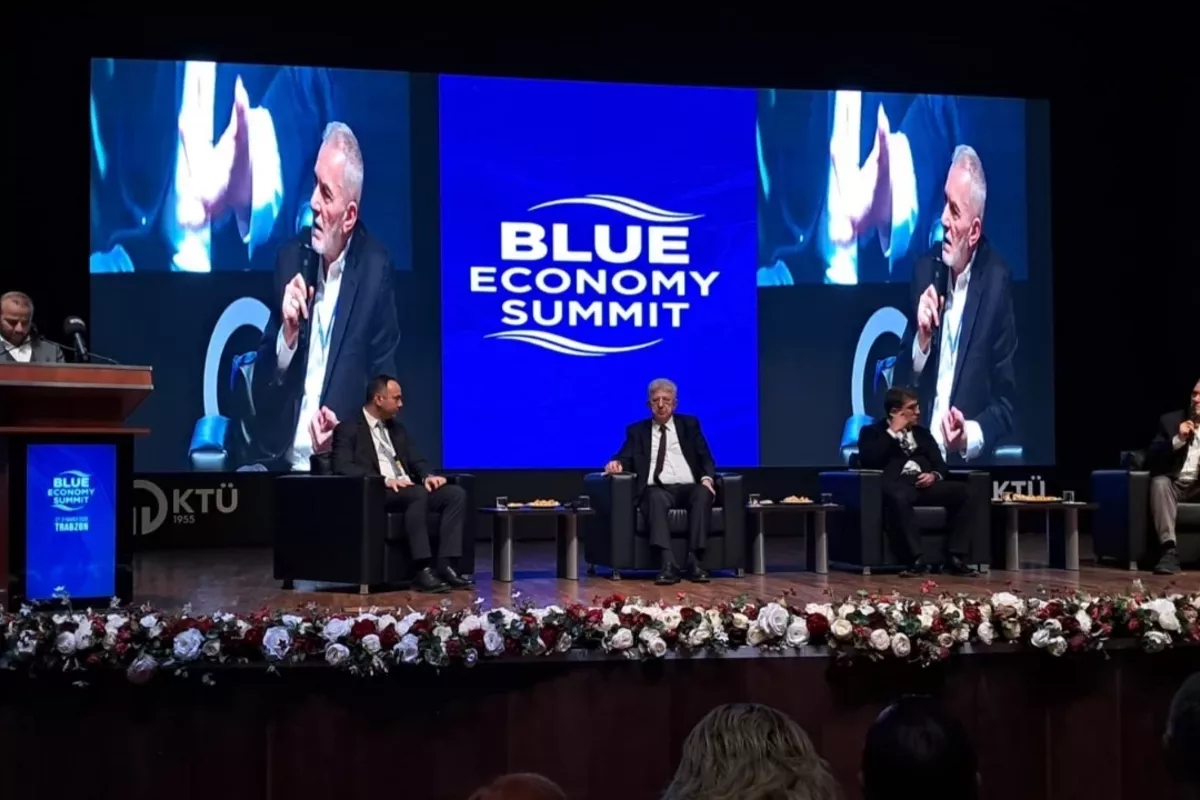
The Turkish city of Trabzon emerged as a focal point for discussions on the blue economy as it hosted the “Blue Economy Summit” at the Osman Turan Culture and Congress Center of Karadeniz Technical University.
The event brought together local and international academics, scientists, and leading representatives of the maritime sector, who delivered presentations on the economic and strategic importance of the Black Sea, The Caspian Post reports.
Opening the summit, Blue Economy Summit General Secretary Recep İlhan Yıldız emphasized that the gathering represented more than just an event, describing it as a reflection of a shared vision for the Black Sea’s economic and strategic future.
He noted that rapid global changes are reshaping energy corridors, trade routes, and geopolitical balances, placing the Black Sea at the center of strategic importance.
Yıldız stressed that the blue economy is no longer optional but essential, adding that its sustainable development depends on security, stability, and cooperation among regional actors. Despite differing national perspectives, he underlined that the sea is a shared resource requiring joint protection and development. He expressed confidence that the summit would strengthen partnerships and create new opportunities.
Trabzon Chamber of Commerce and Industry President Erkut Çelebi highlighted the need to benefit from the blue economy without harming marine ecosystems. He warned that economic gains should not come at the cost of environmental degradation, stressing the importance of sustainability and recycling across sectors that rely on the sea, including energy production. Çelebi also pointed to Trabzon’s strategic geographical position between Central Asia and Europe, calling for broader regional cooperation to maximize the benefits of the blue economy.
Karadeniz Technical University Rector Prof. Dr. Hamdullah Çuvalcı described the blue economy as a key sector for both the Black Sea region and Trabzon, noting its strong potential to drive future economic growth.
Black Sea Economic Cooperation Organization (BSEC) Deputy Secretary General and Ambassador Assoc. Prof. Dr. Merve Safa Kavakcı underscored the importance of developing maritime routes and railway connections in the region. She stated that efforts are ongoing to build a sustainable blue economy in the Black Sea, encompassing shipping, fishing, tourism, and port operations, while ensuring the protection of marine ecosystems and long-term prosperity.
Former Deputy Prime Minister of Ukraine Ivan Kyrylenko highlighted biomethane as one of the cleanest energy sources supporting the green economy. He noted that the European Union aims to increase biomethane production to 35 billion cubic meters annually by 2030. Kyrylenko pointed out Ukraine’s significant potential in this field due to its strong agricultural base, with six operational facilities already producing over 100 million cubic meters annually. He projected that fully utilizing this potential by 2050 would require approximately €40 billion in investment. Acknowledging the economic challenges caused by the ongoing war, he invited Turkish and Black Sea-based companies to invest in Ukraine’s biomethane sector and collaborate on sustainable development initiatives.
During a later session moderated by Fikret Yazıcı, Black Sea Regional Representative of Nasıl Bir Ekonomi newspaper, Salih Zeki Çakır, Chairman of the Board of Trabzon Shipyard, emphasized the dominant role of maritime transport globally. He stated that a country’s strength in maritime transportation influences its broader economic capabilities. While acknowledging Türkiye's progress in recent years, he noted that the country still has room for improvement.
Çakır also drew attention to the concentration of shipyards in Tuzla and Yalova, while highlighting state-supported infrastructure development in the Black Sea region, including Ereğli, Samsun, and Trabzon. He noted that while shipyards in Ereğli have reached significant capacity, the shipyard area in Samsun’s Tekkeköy district remains underutilized despite existing infrastructure. In Trabzon, he said efforts are underway to expand and develop shipyard investments for the benefit of both the region and the country.
He further emphasized the region’s strong educational infrastructure, including maritime faculties, vocational schools, and technical high schools, which contribute significantly to the sector. Graduates, particularly from Karadeniz Technical University’s Faculty of Marine Sciences, hold important roles in both public administration and the private sector. Çakır added that recent initiatives have enabled more students to complete internships locally, reducing the need to travel to traditional shipbuilding hubs like Tuzla and Yalova.
Salih Bostancı, a member of the Board of Directors of the Shipbuilders’ Association (GİSBİR), described the organization as one of Türkiye’s oldest civil society institutions, with 85 active shipyards as members. He outlined its mission to develop the shipbuilding sector, strengthen its global positioning, and facilitate coordination between government bodies, industry stakeholders, and international institutions.
Bostancı noted that Türkiye holds significant capacity in shipbuilding, stating that apart from China, the country is among the largest in terms of shipyard concentration. While individual shipyards may not match the size of some in countries like South Korea, he highlighted Türkiye’s unique ability to carry out diverse shipbuilding activities across multiple facilities simultaneously. He also pointed to major advancements in the defense industry over the past two to three decades, with projects such as the multi-purpose amphibious assault ship TCG Anadolu, coast guard vessels, submarine rescue ships, and Ada-class corvettes being largely designed and built by Turkish engineers.
Providing industry figures, Bostancı said Türkiye’s new shipbuilding capacity has increased from 3.6 million deadweight tons (DWT) in 2013 to 4.7 million DWT. Maintenance and repair capacity has also grown significantly, rising from 15 million DWT to 26 million DWT, with approximately 2,500 to 3,000 ships serviced annually. He added that Türkiye holds an estimated 13-15% share of the global maritime maintenance and repair market, compared to China’s 51% and Europe’s 17%. Turkish shipyards currently operate 11 dry docks and 38 floating docks.
Mustafa Çağatay Cansız, Head of the Maritime Freight Transport Department at the Ministry of Transport and Infrastructure’s General Directorate of Maritime Affairs, stated that Türkiye ranks 12th globally in terms of its maritime trade fleet. He reported a 4% year-on-year increase in cargo handling, surpassing the global growth rate of 1.1%, with global maritime trade reaching 12.8 billion tons. He noted that 86% of global trade is conducted by sea, a figure mirrored in Türkiye, where maritime transport accounts for 75% of foreign trade, underlining the country’s strong dependence on sea routes.
Mesut Cesur, Chairman of the Ro-Ro Professional Committee of the Chamber of Maritime Commerce, highlighted projections by the OECD that the global blue economy could reach $3 trillion by 2030. He noted that Türkiye economy is also expected to approach similar levels by that time. Cesur emphasized the Black Sea’s suitability for Ro-Ro transport due to its short distances, noting that routes such as Samsun to Novorossiysk can be covered overnight by sea, compared to lengthy overland journeys of around 2,000 kilometers. He concluded that resolving regulatory challenges among Black Sea Economic Cooperation members could unlock significant growth potential in regional maritime trade.