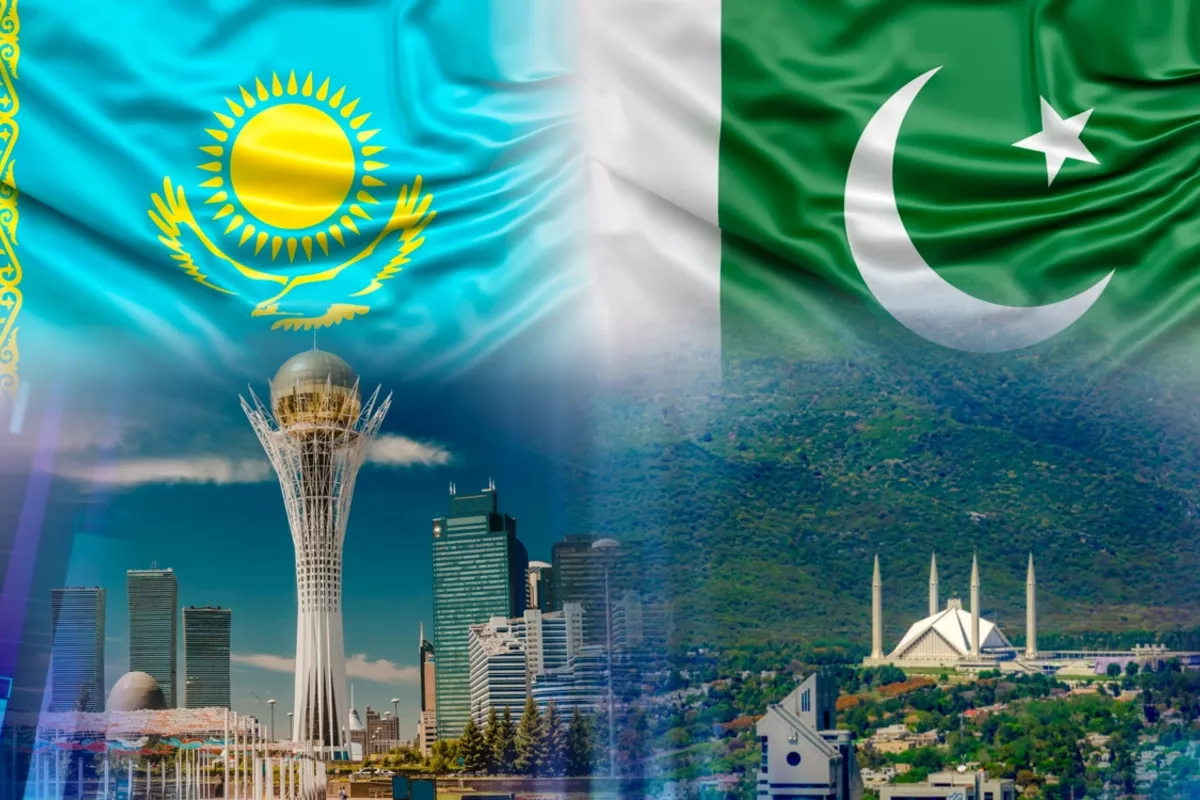
Astana-Islamabad ties are entering a new phase as cooperation between Astana and Islamabad shifts from political declarations to concrete, results-driven initiatives. Officials say the strategic dialogue is increasingly taking on a “project-oriented character,” with a focus on practical cooperation in trade, transport, energy, and investment-signaling a move toward measurable outcomes and long-term partnership.
On February 3 to 4, the President of Kazakhstan Kassym-Jomart Tokayev will pay a state visit to Pakistan. The visit of the Head of State is viewed as a step toward shifting bilateral relations into a project-oriented mode, with concrete routes, contracts, market access, logistics, and transit, The Caspian Post republishes the article.
Astana and Islamabad are Changing the Format of Cooperation
Until now, Kazakhstan and Pakistan have more often perceived each other as “distant partners.” Political contacts existed, but economic interaction for a long time did not correspond to the geography and potential of the two countries. This logic is now changing. For Kazakhstan, Pakistan is not just a market in South Asia, but also access to the ports of the Arabian Sea and, consequently, alternative export corridors at a time when it is becoming increasingly difficult for the world to rely on one or two routes.
These contours are clearly articulated by Manarbek Kabaziyev, Deputy Chairman of the Board of the Institute for Foreign Policy Studies under the Ministry of Foreign Affairs of Kazakhstan. According to him, the upcoming visit is not a one-off episode, but an element of broader regional diplomacy and economic transformation.
“The upcoming visit reflects both dimensions at once. On the one hand, it is aimed at qualitatively deepening bilateral interaction and giving it a more applied, project-oriented character. On the other hand, it fits into a broader context of regional diplomacy focused on strengthening connectivity between Central and South Asia. Kazakhstan views Pakistan as one of the key partners in South Asia, while Pakistan sees Kazakhstan as the leading economy of Central Asia and an important Eurasian connecting link, which gives the dialogue strategic depth,” the expert notes.
In other words, it is important for Kazakhstan to integrate the southern direction into its economy as pragmatically as the northern and eastern routes are already integrated. Here Pakistan has a specific competitive advantage, namely access to ports and developed infrastructure that can become part of international supply chains.
“The agenda of the visit directly corresponds to Kazakhstan’s course toward diversifying foreign economic ties and reducing dependence on a limited number of markets and routes. The emphasis is on expanding trade, attracting investment, and developing alternative transport corridors. Access to the ports of the Arabian Sea through Pakistan is seen as an important element in forming sustainable export and logistics chains and expanding Kazakhstan’s presence in the markets of South Asia, the Middle East, and Africa,” Manarbek Kabaziyev emphasizes.
Trade expands, but Project Portfolio Remains Narrow
Trade turnover has indeed shown notable growth. In January to November 2025 it amounted to $101.3 million, increasing 2.1 times compared to the same period in 2024, which stood at $48.7 million. Kazakhstan’s exports grew even more strongly, fivefold, reaching $56.4 million, while imports amounted to $44.9 million, an increase of 19.9%.
However, the qualitative picture is more important. Export growth is largely explained by the emergence of one major commodity item, crude oil. Oil supplies in 2025 amounted to $52.9 million, equivalent to 93.8% of Kazakhstan’s exports to Pakistan. This is a good start, but a risky model. When growth is driven by a single commodity, it can just as easily decline if supplies turn out to be one-time or irregular.
At the same time, it is clear that trade is not limited to oil alone. Kazakhstan supplies Pakistan with legumes, flax seeds, cereals, and oats. However, in 2025 declines were recorded for a number of items. For example, supplies of onions and garlic ceased, and volumes of oats, flax seeds, and other agricultural products decreased. This indicates that the agricultural component of trade still strongly depends on market conditions and logistics.
Imports from Pakistan, in turn, reflect real complementarity between the economies. Kazakhstan purchases potatoes, citrus fruits, pharmaceuticals, clothing, and knitwear. In the case of potatoes, statistics show a sharp increase, with imports rising to $9.28 million. In contrast, pharmaceutical products saw a decline in 2025, with supplies of packaged medicines falling to $5.51 million.
At this point, the positions of both sides converge. Trade needs to be expanded not only in volume, but also in structure. Otherwise, it will always fluctuate from one commodity item to another. The expert directly points to this when answering a question about barriers.
“Growth in trade turnover is not only possible, but is already demonstrating positive dynamics. In January to November 2025, mutual trade exceeded $100 million, showing more than double growth compared to the previous year. Further expansion of volumes requires the removal of logistical constraints, simplification of transit procedures, harmonization of standards, and reduction of administrative barriers. In this context, particular importance is attached to the preparation of a transit trade agreement,” he stressed.
In essence, this is the answer to the main question for business. Is it possible to transport goods steadily and predictably? If yes, long-term contracts will emerge, and with them an expanded product range.
Investment, Agribusiness, IT
In official documents, cooperation between Astana and Islamabad is described as comprehensive. The political component sets the framework, while the applied agenda should fill it with concrete projects. Pakistan is of interest to Kazakhstan both as a market and as a transit platform, while Kazakhstan for Pakistan is the largest economy in Central Asia and a gateway to the Eurasian space.
As the expert notes, priority areas include the agro-industrial complex, energy, logistics, pharmaceuticals, and IT. Kazakhstan is interested in expanding exports of grain and oilseeds, as well as in creating processing capacities. Pakistan, in turn, is of interest as a source of pharmaceutical products and as a partner in digital technologies and startup ecosystems.
“Special attention is paid to cooperation in the areas of digitalization, e-government, and cybersecurity,” Manarbek Kabaziyev said.
What is important here is that all these areas can be assembled into a single chain. Agribusiness does not grow without logistics, logistics does not scale without clear transit rules, and transit rules do not work without coordinated interagency decisions. Pharmaceuticals and IT represent a second level of cooperation. It is precisely these sectors that provide added value and resilience at moments when trade in raw materials or seasonal goods begins to fluctuate.
A separate block in the materials highlights documents on agriculture, specifically on quarantine and plant protection, as well as veterinary issues. At first glance, these are technical papers, but in practice they remove constraints that can cause supplies to fail or become more expensive.
The investment component of the agenda also looks substantive. A memorandum with the Fauji group of companies on the creation of a joint investment platform has been announced. Such a mechanism is capable of moving interest in projects from the level of declarations to the level of real money and procedures.
The parties are interested in increasing mutual investment, primarily in infrastructure, energy, and industrial projects. Kazakh companies are exploring opportunities to participate in projects in Pakistan in the fields of energy, logistics, and agribusiness, while Pakistani business, in turn, is showing growing interest in the Central Asian market.
From Politics to Logistics
Today, transport and logistics are becoming a key area of cooperation. Kazakhstan needs not just trade “in statistics,” but a sustainable corridor with predictable costs, timelines, and clear legal rules. Official documents explicitly record interest in the ports of Karachi and Gwadar, as well as in multimodal routes through Afghanistan and Iran. This is not a theoretical discussion. In conditions where global supply chains regularly experience disruptions, those with more alternatives gain an advantage.
The expert separately explains how this could work, through linking Kazakhstan’s transit capabilities with the infrastructure of the China-Pakistan corridor and Eurasian routes.
“The integration of the transit potential of Kazakhstan and Pakistan is possible through the development of multimodal routes linking Central Asia with the ports of Karachi and Gwadar. The use of the infrastructure of the China-Pakistan corridor in combination with the capabilities of the Middle Corridor creates prerequisites for the formation of new logistics chains ‘Eurasia-South Asia.’ This will reduce delivery times, diversify routes, and increase the resilience of regional trade amid the transformation of global supply chains,” Manarbek Kabaziyev says.
This is why the package of expected documents separately provides for memorandums on railway and maritime cooperation, as well as a transit trade agreement. The logic here is simple. As long as there are no unified transit rules and coordinated work of relevant agencies, business remains hostage to fragmented procedures and unpredictable timelines.
A Connection that Works for the Long Term
Economic cooperation is rarely sustainable without human and cultural ties. As the expert notes, there are plans to open Yasawi, Satbayev, and Al-Farabi centers in Islamabad, as well as the Dostyk sports center. A plan of events for cultural and humanitarian cooperation for 2026 to 2027 is also envisaged.
This is soft power without pathos, exchanges, education, and contacts between universities and media. In the long term, it is precisely such channels that give relations resilience, especially when economic conditions change.