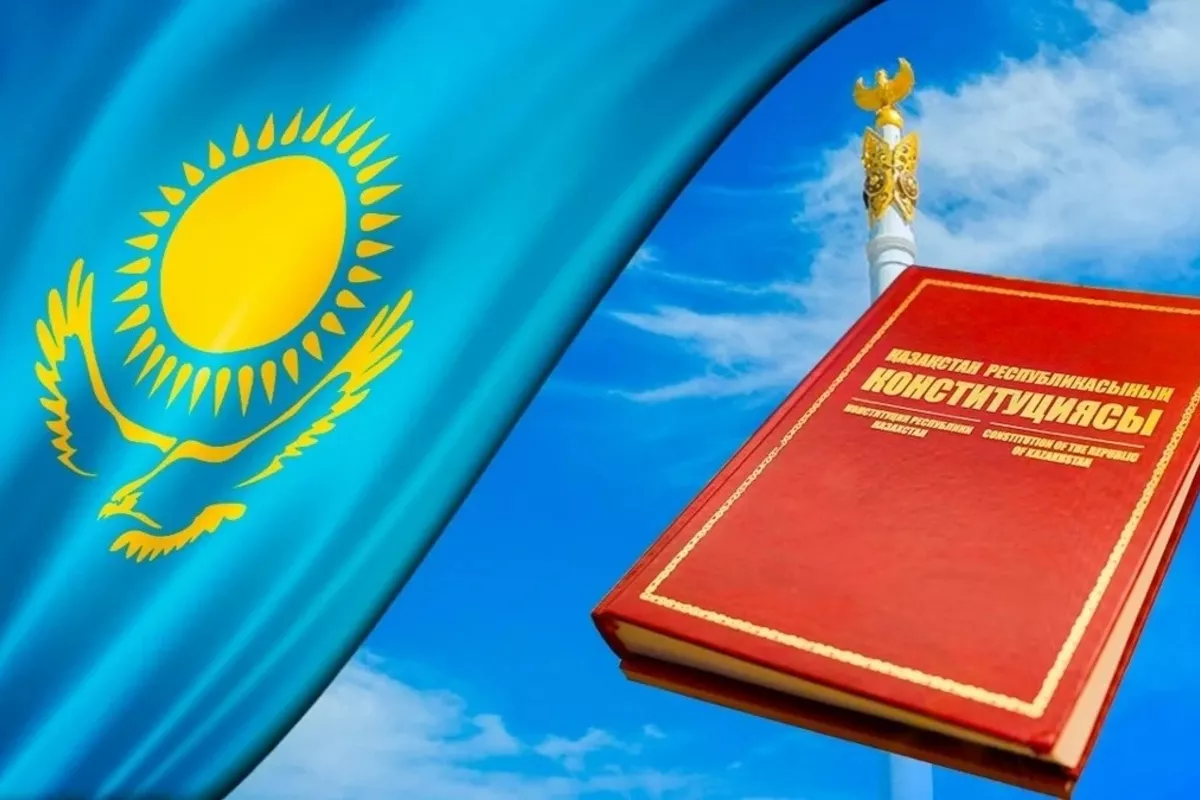
On March 15, 2026, a referendum on amendments to the republic's constitution was successfully completed in Kazakhstan.
As observers noted, this marks the seventh change to the Basic Law since the country gained state sovereignty. This fact suggests that Kazakhstan is continuing to search for its own path of development, seeking to build a system that better reflects national traditions. The changes primarily concern presidential powers and the requirements for candidates for this position.
According to the constitution, in order to run for the office of head of state, a person must be a citizen of Kazakhstan by birth, be over 40 years old, speak Kazakh, have lived in the country for the past 15 years, and possess higher education. Under the amendments, an additional requirement has been introduced: at least five years of experience in public service or in elected office, which appears reasonable. The rule that the president is elected for a single seven-year term remains unchanged.
The approved document expands the president’s powers in relation to the government. As before, the head of state proposes a candidate for prime minister and appoints the ministers of foreign affairs, defense, and internal affairs. However, if parliament twice fails to approve the prime ministerial candidate, the president may now dissolve it.
The list of state positions appointed by the president has also been expanded. These include the chairpersons of the Constitutional and Supreme Courts, the head of the National Bank, the prosecutor general, the head of the National Security Committee, the chair of the Central Election Commission, the heads of the Supreme Audit Chamber and the Supreme Judicial Council, the chief of the State Protection Service, and the ombudsman. An amendment has also been added stating that the president bears no criminal or administrative liability for actions taken while in office and can only be prosecuted in cases of documented treason. Previously, the constitution only stated that the president’s “honor and dignity are inviolable.” In other words, the president is granted extensive powers, strengthening the vertical of power and, consequently, the stability of state institutions.
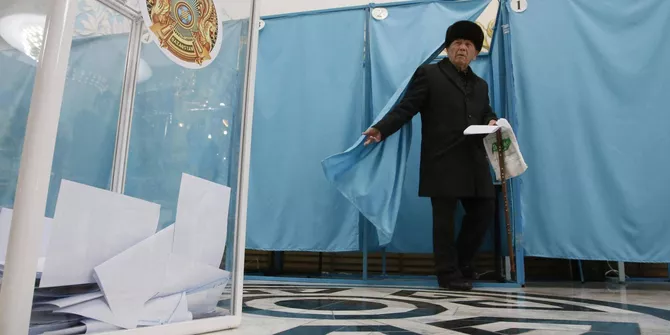
Photo credit: chathamhouse
The adopted Basic Law restores the position of vice president, eliminating the role of state adviser and thereby ensuring continuity in the event of unforeseen circumstances. It is worth noting that the vice presidency existed in Kazakhstan from 1991 to 1996. Under the new constitution, the vice president’s task is to assist the head of state in working with parliament and the government, while other powers are determined by the president. The reintroduced position also changes the order of succession: if the president leaves office prematurely, their powers pass to the vice president. If the vice president is unable to perform these duties, the role is assumed by the speaker of parliament and then by the prime minister.
The constitution also changes the system of legislative power. Instead of a bicameral parliament, which previously consisted of the Mazhilis (lower house) and the Senate (upper house), it introduces a unicameral Kurultai. It will consist of 145 deputies serving five-year terms. To become a deputy, a candidate must be over 25 years old, be a citizen of Kazakhstan, and have lived in the country for the past 10 years. Without the consent of the Kurultai, deputies cannot be detained, arrested, or held criminally liable.
The new constitution also establishes a new body, the People’s Council of Kazakhstan. Its prerogatives include advising on key domestic issues, strengthening national unity, submitting draft laws to the Kurultai, and proposing nationwide referendums.
The constitution enshrines several fundamental provisions.
It introduces a ban on dual and multiple citizenship, which was previously not formally recognized; it can now serve as grounds for revoking Kazakh citizenship. An important change concerns the status of the Russian language. As before, Kazakh remains the state language. However, the wording regarding language use in state institutions has changed: previously, Russian was used “on an equal basis with Kazakh,” while the new version states it is used “alongside Kazakh.” The Tengrinews outlet explains that the former implies equal status, whereas the latter suggests joint use without necessarily guaranteeing equal conditions.
Ahead of the referendum, President Kassym-Jomart Tokayev rejected claims that the new constitution lowers the status of the Russian language. “The very fact that the text of the new constitution has been published in Kazakh and Russian, both having equal legal force as official documents, speaks for itself and requires no further comment or justification,” he said. This clarification is important given Kazakhstan’s geography and its close ties with Russia.
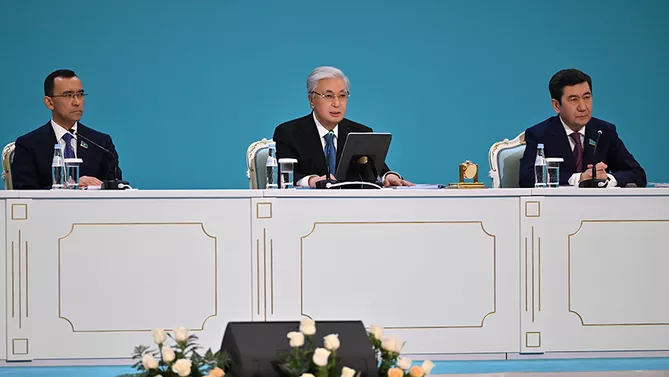
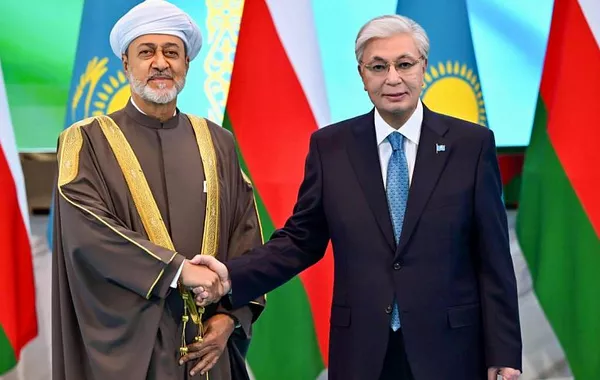
Photo credit: QazInform
The provision on citizens’ right to protest has also been revised. Previously, citizens could organize “meetings, rallies, demonstrations, marches, and pickets”; now they are guaranteed only the right to “peaceful assemblies.” Restrictions have been expanded, allowing authorities to cancel gatherings in order to protect the constitutional order, human rights and freedoms, national security, public order, public health, and public morality. The constitution also clarifies that marriage is defined as a “voluntary and equal union between a man and a woman.”
Additionally, the new constitution allows for the introduction of special legal regimes in certain regions and cities (previously limited to Astana), including in financial sectors or designated “accelerated development cities,” implying special governance and judicial arrangements.
Rules on foreign funding have been tightened. Previously, political parties receiving funds from foreign states, organizations, or individuals were banned. The updated provisions expand this to include foreign companies, enterprises with foreign participation, and stateless persons. Non-governmental organizations are now also required to disclose information about funds and property received from abroad.
The new constitution approved by referendum strengthens presidential authority and contributes to further societal consolidation. It reinforces traditional values of family and marriage while minimizing the influence of foreign actors whose activities may contribute to internal tensions. At the same time, it expands the powers of state bodies responsible for ensuring stability and public order. In proposing the new version of the Basic Law, the president took into account the experience accumulated over the years of independence.
In principle, each country must develop a system of governance that aligns with its national traditions while addressing contemporary challenges. A balance must be maintained between socio-political progress and long-standing cultural traditions. It is not possible to simply copy foreign models, especially given a country’s geography and its relations with neighboring states. Experience shows that even the United States Constitution, adopted in 1787, has been amended numerous times (27 times) to reflect societal needs and scientific and technological progress. Democracy should be understood as a process rather than a fixed and unchanging form, and it must respond to modern demands and challenges.