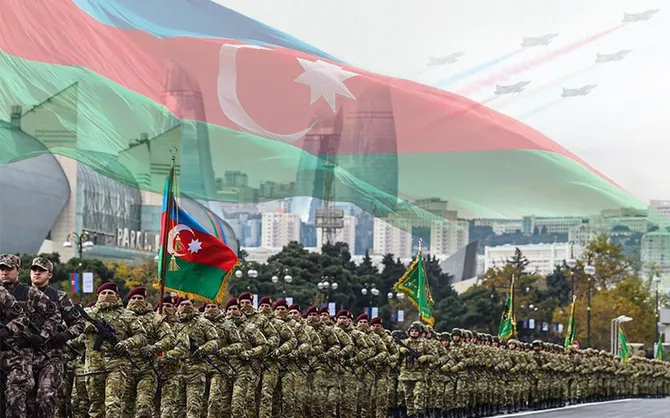
26 June - Azerbaijani Armed Forces is no longer regarded in Azerbaijan merely as the anniversary of the establishment of its military. It has also become an occasion to reflect on the changing realities of warfare and the transformation of the country's armed forces over recent years.
Over the past three decades, the Azerbaijani Armed Forces have evolved from a conventional defense institution into a military capable of adapting to the changing nature of modern warfare, combining combat experience with advanced technology and new operational concepts.
This transformation cannot be explained simply by the acquisition of new weapons. The definition of a modern army is no longer determined by the number of tanks, artillery systems or troops it possesses. On the 21st-century battlefield, superiority increasingly depends on the rapid collection and processing of information, agile decision-making, the effective use of unmanned systems, secure communications and coordination, cyber capabilities, electronic warfare, and the performance of small tactical units.
This was perhaps the most significant innovation demonstrated by the Azerbaijani Armed Forces during the 2020 Patriotic War: the integration of conventional military power with innovative methods of warfare.
The 44-day war demonstrated that technology alone does not determine victory. Its effectiveness depends on how well it is integrated into a unified operational system. Unmanned aerial vehicles (UAVs) were not used solely as strike platforms. They became essential tools for reconnaissance, target acquisition, artillery fire adjustment, and creating a real-time operational picture of the battlefield.
This became one of the defining characteristics of Azerbaijan's military model. Information was collected, processed and converted into operational decisions within a very short time. As a result, a traditionally heavy and slow command structure gave way to a more agile, technology-enabled operational approach.
However, it would be inaccurate to describe this model simply as "drone warfare." Although unmanned systems played a crucial role, one of the decisive factors was their integration with special operations forces, artillery, intelligence assets, communications networks and command-and-control systems. In modern warfare, superiority no longer lies in individual weapons systems but in their ability to operate as part of a unified network.
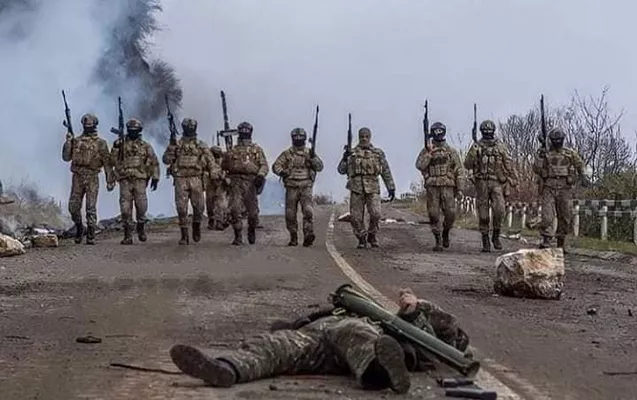
Against this backdrop, the Battle of Shusha deserves particular attention.
Source: AzerTAG
The liberation of Shusha remains one of the most closely studied operations conducted by the Azerbaijani Armed Forces from the perspective of modern urban warfare. The city sits in mountainous terrain, access routes were limited, and the use of heavy armored vehicles was severely constrained. Under such conditions, a conventional large-scale assault would have been far less effective.
Instead, Azerbaijani special forces advanced in small tactical groups, exploited the terrain, relied on close-quarters combat skills and maintained a high level of coordination throughout the operation. The battle became an example of a different approach to urban warfare-one where success depended not on the mass deployment of equipment, but on mobility, training, decentralized decision-making and coordination.
Urban warfare is widely regarded as one of the most demanding forms of military operations. Every street, building, elevation and passageway can become a separate tactical objective. Such an environment restricts the movement of large formations, complicates communications and coordination, and increases the cost of delayed decision-making.
The Battle of Shusha demonstrated that the Azerbaijani Armed Forces were capable of conducting flexible operations not only in open terrain but also in complex mountainous and urban environments. That capability has become one of the defining indicators of a modern military.
Many of the reforms introduced after the Patriotic War have been shaped by the lessons learned during that campaign. The expansion of commando units, the growing role of special operations forces, reforms in military education, improvements in command-and-control systems and the continued integration of advanced technologies all reflect the demands of today's security environment.
Modern warfare is no longer confined to the front line. Cyber operations, information warfare, electronic warfare, unmanned systems and artificial intelligence have become integral components of the battlefield. This requires armed forces to possess not only physical strength but also analytical thinking, technological literacy and the ability to adapt rapidly.
Azerbaijan's approach to digitalization and the integration of artificial intelligence into its armed forces should be viewed within this broader context. As the volume of battlefield data continues to grow, traditional methods of processing information become increasingly insufficient. Artificial intelligence and digital systems can accelerate decision-making, optimize logistics, assess risks in advance and provide commanders with a more accurate operational picture.
The objective is not to replace soldiers with technology. Rather, technology serves as a force multiplier that expands the decision-making capabilities of professional military personnel. The effectiveness of a modern military increasingly depends on achieving the right balance between human expertise and technological innovation.
Source: AzerTAG
The second pillar of this transformation is military education. New methods of warfare require a new generation of officers and non-commissioned officers. Today's commanders must understand not only conventional tactics but also the capabilities of drones, communications systems, electronic warfare, cyber threats and information management.
For this reason, reforms in military education, the establishment of the National Defense University, expanded commando training and the recruitment of technologically skilled young specialists are becoming key elements in building future combat capability.
Another important feature of today's Azerbaijani Armed Forces is that they are no longer relying solely on the experience gained during the 2020 war. That victory created an important foundation, but the global security environment continues to evolve rapidly. The war in Ukraine, conflicts across the Middle East and other recent military confrontations have demonstrated that drones, air defense systems, electronic warfare and urban combat now occupy the center of military planning.
For Azerbaijan, the primary challenge is to understand these changes in time and adapt its armed forces to emerging risks.
In this sense, the Azerbaijani Armed Forces can increasingly be described not only as a victorious military but also as a learning and evolving institution. Continuous analysis of combat experience, structural reforms, technological modernization and professional development have become the pillars of this transformation.
Ultimately, June 26 is about more than commemorating past victories. It also raises a broader question: how should an army evolve to be prepared for the wars of the future?
Azerbaijan's answer has become increasingly clear-more agile command structures, a stronger technological base, better-trained personnel, highly capable special operations forces, and comprehensive preparedness extending from urban warfare to cybersecurity.
In today's world, an army is no longer simply a force defending the country's borders. It has become an integral part of a state's technological capacity, governance capability and human capital. The future strength of the Azerbaijani Armed Forces will depend on how effectively these three elements-experience, technology and professionalism-continue to be integrated.