How the Election of the New Georgian Patriarch Can Impact Ukraine
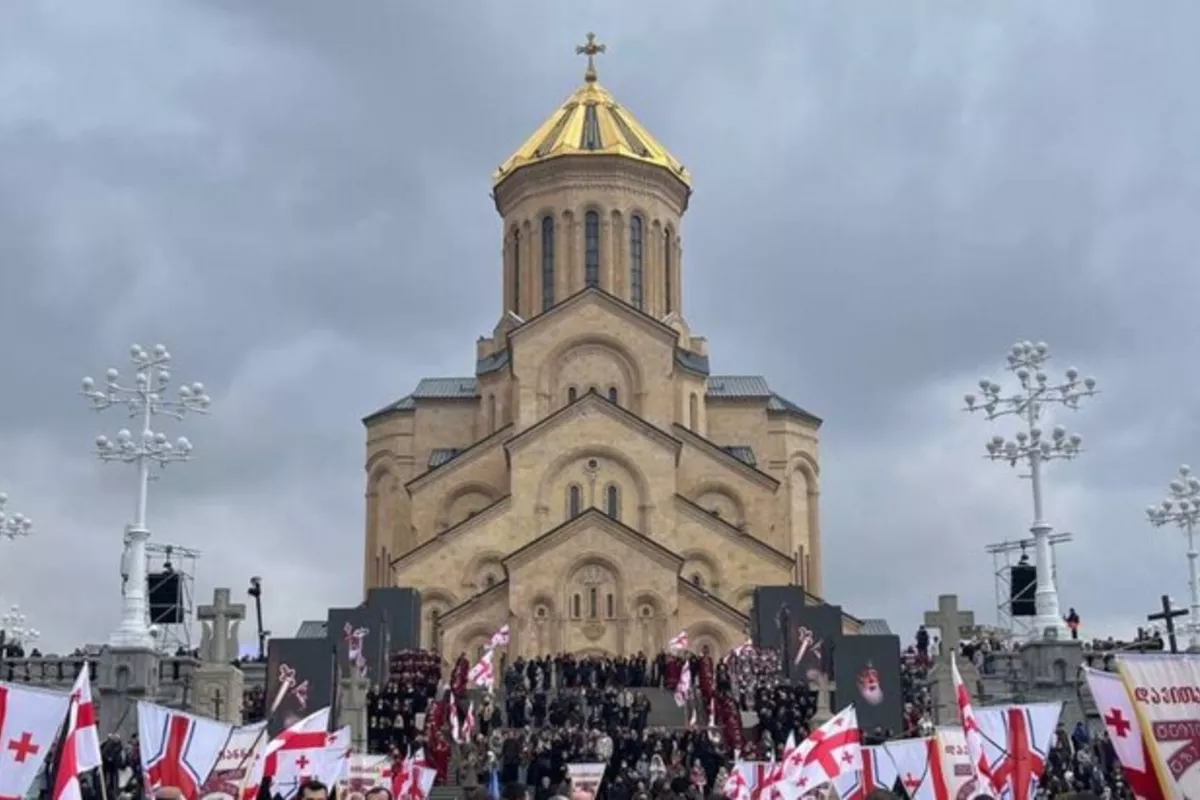
The death of Patriarch Ilia II of the Georgian Orthodox Church has left the country in mourning and simultaneously launched a battle to succeed him.
Ilia II served as Catholicos and Patriarch of the Georgian Church from 1977 and has consistently been the most trusted leader in the country according to numerous sociological surveys. Since Orthodox Patriarchs typically serve for life, Ilia II reigned for 49 years until his death at age 93. Days after Ilia’s death, Metropolitan Filaret who was instrumental in the creation of the Orthodox Church of Ukraine (OCU) also died. Now, a key issue for the successor to Ilia will be whether to recognize the autocephaly of the OCU.
Throughout his nearly half a century of leadership, the Georgian Patriarch was a strong voice for Georgian sovereignty and independence. He supported the April 1989 protests against Soviet rule, made public pleas for peaceful protests during the November 2003 Rose Revolution, and blessed the “Stop Russia” demonstrations during the Russian invasion in August 2008.
Because of Patriarch Ilia’s leadership the Georgian Orthodox Church (GOC) was also highly trusted (70%) in public opinion surveys. Depending on who is chosen as his successor, though, trust in the Church may decline dramatically if a pro Kremlin clergyman is elected.
Unfortunately, that seems to be the most likely scenario at the moment. In 2017, the aging Ilia made a surprise announcement that he was appointing Bishop Shio Mujiri as the locum tenens of the Church. “Locum tenens” in Latin translates as the person who “holds one’s place,” similar to a vice president or heir apparent. During the 40-day period following the death of a patriarch, the locum tenens leads the Church and administers the election of a successor through the Holy Synod, the legislative body of the Church. Normally the appointment of a locum tenens is done via the patriarch’s last aill and testament rather than while the patriarch is living. With Ilia already elderly at the time though, announcing an interim successor is understandable. What was not understandable was the person who was selected.
Local officials have warned residents of fake bills dropped by Russian drones bearing QR codes with “hostile resources” that call for locals to share coordinates to aid Russian strikes.
Shio Mujiri graduated from divinity school in Moscow and pastored the Georgian Church in the Russian capital. He is boyhood friends with Levan Vasadze, a Georgian businessman with strong anti-Western views and follower of the “Russki Mir” ideologist Aleksandr Dugin.
After the conferment of autocephaly to the Orthodox Church of Ukraine (OCU) by the Ecumenical Patriarch Bartholomew of Constantinople, the “first among equals” of the Eastern Orthodox Churches in January 2019, many expected the Georgian Orthodox Church (GOC) to recognize the Ukrainian Church given the historical close ties between Georgia and Ukraine. Yet at the Holy Synod meeting the same month, only 10 of 47 clergy supported the de facto recognition of the Orthodox Church of Ukraine (OCU).
Afterwards Shio Mujiri stated: “The Holy Synod has already expressed its position; we will familiarize ourselves with the text of the tomos, and the decision will of course follow after that.”
Will the Georgian Church choose solidarity with Russia or embark in the direction of Constantinople and Kyiv?
The full-scale Russian invasion of February 2022 reignited interest in recognition of the OCU and Patriarch Ilia criticized Patriarch Kirill of the Russian Orthodox Church stating: “Russia has started a war in another country. And only the Moscow Bishop (Patriarch Kirill) closed his eyes and his mouth.” Still though, after seven years there is no recognition of the Orthodox Church of Ukraine by the GOC.
While the issue of recognition for the OCU remains outstanding, another issue looms. If elected as Ilia’s successor, what will Shio Mujiri do as Patriarch of the GOC? If Mujiri openly embraces the Russian Orthodox Church (ROC), this could result in the annexation and loss of independence of the GOC. In fact, it happened before in 1811 when the ROC annexed the GOC under its control, despite the GOC being awarded autocephaly by Constantinople more than a thousand years before the Russian Church received it.
The issue of who has the right to award autocephaly is a longstanding battle between Constantinople and Moscow. Church canon and practice since 451 AD bestows authority solely to Constantinople. Yet the Russian Church, which received its autocephaly from Constantinople only in the 16th century, has made a practice of offering its own autocephaly to Orthodox Churches. This alternative autocephaly from the ROC is part of the Russki Mir mentality and mythology that Moscow is a “Third Rome.”
As the interim leader of the GOC, Mujiri is the frontrunner to succeed Ilia as patriarch, but the Holy Synod has the final say when they likely convene in late April. For Ukraine, having a Patriarch like Ilia, who is a friend of Ukraine, is important because of the influence of the Church on the country’s politics - especially given the pro-Moscow sympathies of the current Georgian government. Having an openly pro-Ukrainian Georgian patriarch though is the ideal outcome.
In Georgia family relations rule everything and some believe that Ilia’s nephew, Dimitri who is the Metropolitan of Batumi and Lazeti, might have a chance to be elected. Dmitri spoke against the Russian invasion of Ukraine stating, “We are horrified by the evil happening in Ukraine, and expressed sympathy for the “firm, resilient, fearless [Ukrainian] people.” Metropolitan Dmitri went further stating that, “an evil ruler emerged” threatening all of humanity with nuclear weapons. “He [Putin] regards himself as a Christian and, I would say, he has nothing to do with Christian values.”
Another potential contender for the patriarch position is Archbishop of Bodbe Yakob Yakobashvili. Yakobashvili has called for the recognition of the Orthodox Church of Ukraine (OCU) and positioned himself as a public opponent of Mujiri.
Aware that public support for Russia is toxic in Georgia, Locum Tenens Mujiri deferred to the Ecumenical Patriarch Bartholomew to lead the funeral service, and the Russian Patriarch Kirill did not attend. Immediately after the funeral, though, Mujiri launched a public relations campaign to solidify support within the Holy Synod for his election, meeting various visiting hierarchs from Romania, Bulgaria, etc., while keeping potential opponents far from the meetings.
When Georgia was invaded by Russia in 2008, Ukraine strongly supported Georgia militarily and politically. When Russia invaded Ukraine, though, in 2022, the Georgian government chose public neutrality with underlying sympathy for Moscow. Now, in the religious realm, will the Georgian Church choose solidarity with Russia or embark in the direction of Constantinople and Kyiv? Since patriarchal positions are for life, whichever course is chosen is likely to impact both geopolitical and religious relations for decades.
See the original article here