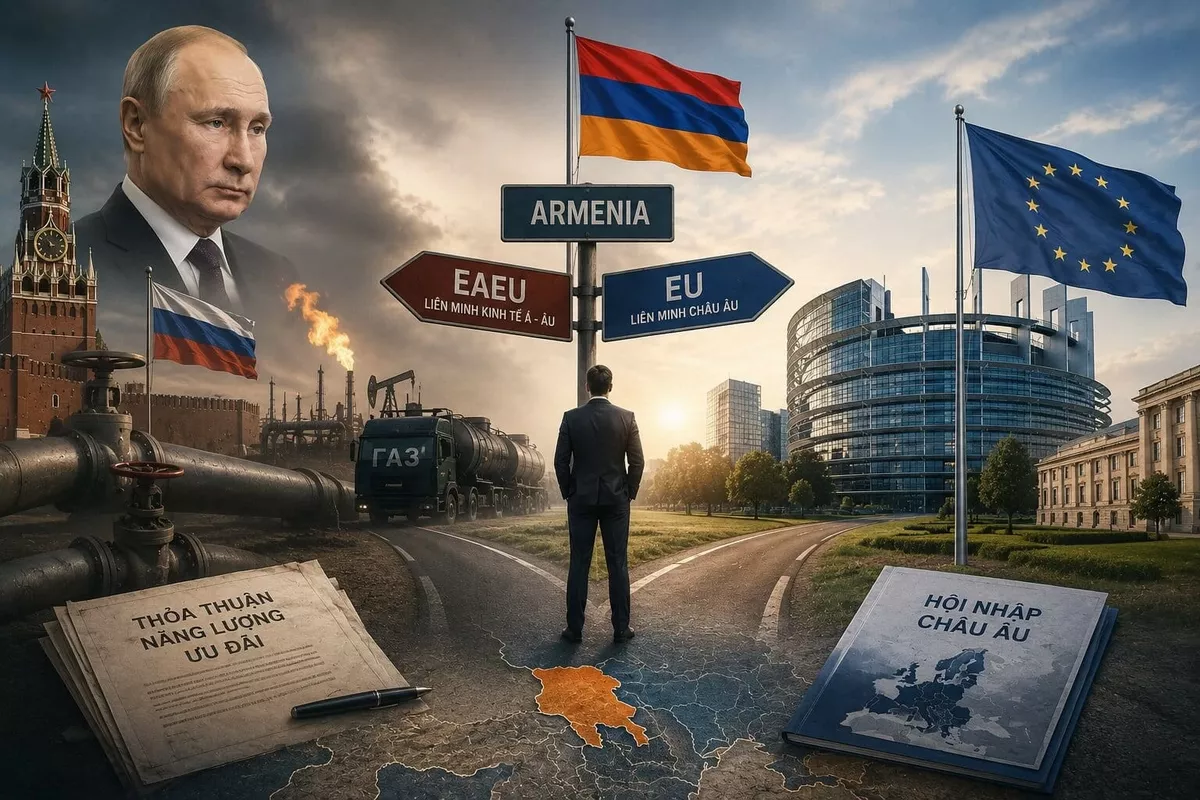
The crisis in Russia-Armenia relations has reached an unprecedented stage. First came the rhetoric about the incompatibility of the EEU and European integration, followed by trade restrictions. Armenia risks repeating the mistakes of other post-Soviet republics that forfeited unique economic privileges and long-term partnerships for political gestures that the West is in no hurry to reward.
The beginning of May 2026 may have brought Russia-Armenia relations closer to a point of no return. Following the April 1 meeting at the Kremlin, where Nikol Pashinyan, in dialogue with Vladimir Putin, acknowledged the inevitability of choosing between participation in the EEU and the EU-while emphasizing that Armenia currently remains a full member of the EEU-it has become increasingly clear that Yerevan has already made its decision and is gradually preparing its electorate for it.
The first Tuesday of May marked a significant rupture between Russia and Armenia: Yerevan became the venue for a dialogue involving 27 European Union member states and several other countries, including Ukraine. The meeting resulted in the agreement of 44 points, creating a “roadmap” for Armenia’s full integration into the European community. In other words, a step was taken that Moscow could not ignore.
On May 22, 2026, Russian Security Council Secretary Sergey Shoigu summed up what had been discussed in Moscow over the past six months: the Armenian leadership had taken a series of steps inconsistent with the spirit of allied relations. This statement, made at a special meeting of the Security Council working group, served as a clear manifestation of the Russian Federation’s position.
Earlier, Russian President Vladimir Putin had already indicated that the European Union and the Eurasian Economic Union are incompatible categories. The Armenian leadership was advised to hold a referendum and make a choice. Meanwhile, Yerevan, pursuing a policy of balancing, simultaneously welcomed the creation of a new EU civilian mission in the country and affirmed its commitment to agreements within the EEU framework. This approach was labeled “improper” in the Kremlin.
The transition from words to action did not take long. Beginning on May 22, Rosselkhoznadzor announced restrictions on the import of flowers, vegetables, and fruits from Armenia into Russia. Similar bans were applied to broad categories of beverages entering Russian shelves directly from Armenia, ranging from mineral water to wine and brandy. In the Russian context, such measures are largely symbolic, signaling the Kremlin’s position and capabilities.
However, these restrictions should not be underestimated as a mere “show of muscle,” since they already have a significant impact on Armenia’s economy. At the same meeting of the Security Council working group, Sergey Shoigu noted that 98% of all Armenian agricultural exports are destined for the Russian market.
Armenia depends on Russia not only as an exporter but also as an importer. In 2025, agricultural exports from Russia to Armenia totaled $470 million, an 18% increase compared to 2024. In addition, Russian gas is supplied to the Armenian market at a significantly reduced price-more than four times lower than the market rate. The volumes of fuel trade between Moscow and Yerevan speak for themselves: Armenia sources around 80% of its key energy resources from Russia.
In summary, Russia’s influence on the Armenian economy is multifaceted: two Russian-capital companies are among Armenia’s five largest taxpayers, Russian businesses actively invest in the Armenian economy, develop partnerships, and supply consumers with essential goods, electricity, and a wide range of services.
Such an interconnection between the two economies, with a significant imbalance in favor of Moscow, points to one conclusion: if tensions persist, Russia’s leverage over Armenia could be applied on a much more serious scale. Suppose Armenia manages to diversify its exports and quickly secure foreign partners for investment, resources, and capital. Even so, this will inevitably entail a number of challenges.
Trade with Russia is largely built around simple and cost-efficient logistics. Trade with Western countries-even under full economic integration with no trade barriers-would increase transportation costs. Although de jure this new financial burden would fall on producers, in reality the additional costs would be passed on to the ultimate payers: consumers. In other words, logistics costs would affect not only the competitiveness of Armenian exports in new markets but also domestic prices.
Replacing Russian imports would have similar market consequences, but on an even larger scale. Against the backdrop of ongoing uncertainty surrounding the Strait of Hormuz and the murky prospects of the global fuel and energy sector, the West would be unable to provide Armenia with a painless, financially negligible “horizontal energy transition.” It is worth noting that an increase in electricity prices-inevitable in the event of a break with Russia-would trigger a domino effect affecting all sectors of the Armenian economy.
A break between Russia and Armenia is a scenario that until recently seemed almost unimaginable. Yet the potential consequences of this “black swan” event are genuinely alarming-for both sides. As of 2026, more than 2 million Armenians live in Russia, and the cultural ties between the two countries are critically important. Therefore, a rift between Moscow and Yerevan would not be merely a political difficulty or the loss of a key partner for Russia; it would also constitute a serious socio-cultural problem. The fallout from ruptured Russian-Armenian families, disrupted joint cultural and economic projects, and disagreements over fundamental questions of shaping the new world order would leave deep scars on the hearts of both peoples.
At the same time, the economic effects-less pronounced for Russia, for whom the Armenian market is important but not on the scale of China or Belarus-could be catastrophic for Armenia at all levels: from industrial decline to crises affecting local consumers. The illusory long-term benefits could push Armenia’s economy, heavily dependent on its partnership with Russia, into a transitional crisis. Attempts to mitigate the consequences of a rupture could, paradoxically, only delay Yerevan’s EU membership-painful examples of financially unstable integrations in Greece and Romania have affected the economic health of the entire union, making such abrupt moves highly controversial.
In addition to the fact that the European Union is hardly in need of financially unstable “newcomers” on whose rescue it would have to spend substantial resources, it would also be reckless for the EU to accelerate the membership of a country with a volatile political landscape. If Brussels’ strategy is aimed at long-term confrontation with Russia, it would be irrational for the Union to create within itself a potential “new Orban,” capable of blocking EU initiatives by appealing to national interests. Such a scenario cannot be excluded given the historical closeness of the Armenian people to Russia, entrenched cultural and economic ties, and energy dependence.
Thus, the European Union could end up with an unstable member oscillating between the West and Russia-something already familiar to Brussels in the case of Slovakia and Hungary prior to 2026. Even if the administration in Yerevan at the moment of initiating official accession is positively inclined toward cooperation with the West, this does not guarantee that subsequent elections will preserve a similar political orientation.
It follows that Armenia’s policy may not lead to the desired EU membership, while simultaneously pushing Yerevan away from Russia, depriving it of economic and political privileges and significantly increasing tensions. In other words, Armenia risks finding itself “with nothing in hand,” jumping from one set of rakes to another.
History knows tragic examples of the disintegration of two countries so important to each other. Flirting with European integration in defiance of national interests, and attempts to “sit on two chairs at once,” all evoke uncomfortable parallels that both sides would prefer to avoid. Kremlin spokesperson Dmitry Peskov stated that Armenia and Russia still remain friends-words that are highly significant in the current context.
It is now extremely important not to reach a point of no return, beyond which further cooperation would become impossible. In this regard, both politicians and citizens in both countries are awaiting with particular anticipation the June parliamentary elections in Armenia, which will determine Yerevan’s policy for the coming years.
The people of Armenia will have to decide which path they prefer. According to current polling data, the party of incumbent Prime Minister Pashinyan, which advocates Armenia’s membership in the European Union, is in the lead; however, this could still change. The fragmented opposition targets different segments of public opinion. In contrast to Pashinyan’s “Civil Contract,” the “Armenia” bloc proposes a balanced foreign policy instead of an exclusive focus on European integration. Meanwhile, “Strong Armenia” strongly criticizes the current administration and opposes Western orientation, making a strategic choice in favor of EEU membership and strengthening ties with Russia.
At present, a large number of Armenian citizens remain undecided, even though the election is approaching. However, based on preliminary polling data, it can already be concluded that none of the parties is likely to secure an absolute majority in the National Assembly of Armenia. This means that any chosen strategy-whether European integration or strengthening cooperation with Russia and EEU partners-will become the subject of intense debate and disagreement both among the public and within the political leadership.
Following the election results, both Armenia and Russia will understand the direction in which bilateral relations will develop and how to pursue mutual understanding-a necessary prerequisite for maintaining stability and avoiding painful scenarios.