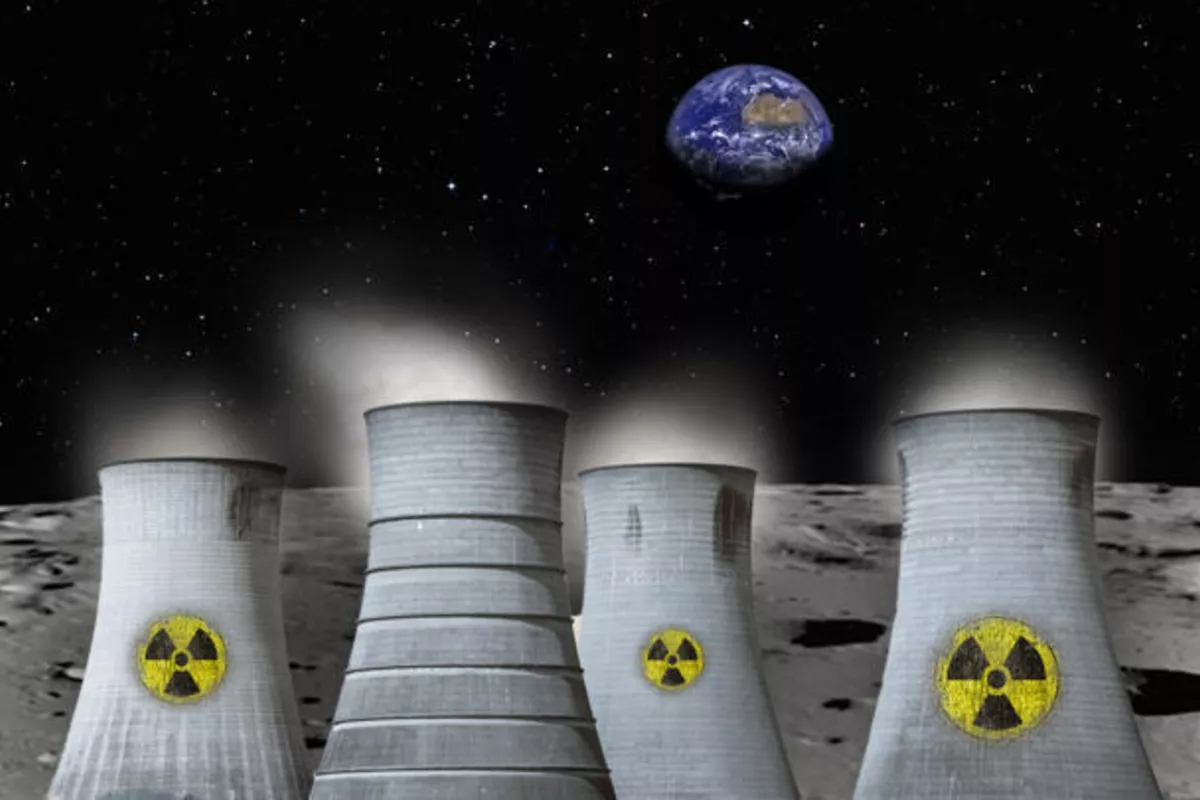
Russia is advancing plans to deploy a nuclear power plant on the Moon by the mid-2030s, a project that reflects growing global ambitions to establish a long-term human and technological presence beyond Earth. The initiative, led by the state nuclear corporation Rosatom, is designed to provide a reliable and continuous source of energy for future lunar missions, infrastructure, and potential settlements.
Speaking at a seminar hosted by Russia’s Energy Ministry on the development of the national power industry, Rosatom CEO Alexey Likhachev outlined the timeline and scope of the project. According to Likhachev, the transportation of components for a lunar nuclear power facility could begin in the 2030s, with the plant expected to deliver at least 5 kilowatts of power and operate for up to a decade.
Although modest in output compared to terrestrial power plants, a 5 kW system is significant in the context of space operations. Energy demands on the Moon are currently limited to scientific instruments, communication systems, robotic missions, and potentially small-scale habitation modules. In such an environment, a compact, durable, and long-lasting power source is far more valuable than high-capacity generation.
The Need for Reliable Lunar Power
One of the central challenges of sustained lunar exploration is the availability of consistent energy. The Moon experiences extreme day-night cycles, with one lunar day lasting approximately 29.5 Earth days. This means that any solar-powered system must endure roughly two weeks of continuous darkness, during which temperatures can plummet to extremely low levels.
Solar panels, while effective during the lunar day, become unreliable during these prolonged nights unless paired with large-scale energy storage systems. Batteries capable of storing enough energy to last through the entire lunar night would be heavy, costly, and technologically demanding.
In contrast, nuclear power offers a stable and continuous energy supply regardless of environmental conditions. A nuclear reactor can operate independently of sunlight, making it particularly suited for harsh extraterrestrial environments. This reliability is essential for supporting life-support systems, scientific research equipment, and communication infrastructure, all of which require uninterrupted power.
Rosatom’s Role and Strategic Vision
Rosatom, Russia’s state nuclear energy corporation, has long been involved in advanced nuclear technologies, including compact reactors designed for remote and specialized applications. Its experience in developing small modular reactors (SMRs) and nuclear propulsion systems provides a foundation for adapting such technologies for space use.
Likhachev’s announcement underscores Russia’s intent to remain a key player in the next phase of space exploration. By investing in lunar energy infrastructure, the country is positioning itself to support future missions not only to the Moon but potentially to Mars and beyond.
The proposed reactor’s operating life of up to 10 years suggests a focus on durability and minimal maintenance. In the lunar environment, where human intervention may be limited or delayed, systems must be capable of functioning autonomously for extended periods. This requirement places significant demands on engineering, materials, and safety systems.
Technological Developments and Supporting Research
The concept of a lunar nuclear power plant is closely tied to broader technological advancements in space propulsion and energy systems. In February 2025, during the Future Technologies Forum, Mikhail Kovalchuk, head of the Kurchatov Institute National Research Center, provided further insight into these efforts.
Kovalchuk noted that the Kurchatov Institute, in collaboration with Rosatom and the Russian Academy of Sciences, is developing electrodeless rocket plasma engines. These advanced propulsion systems are intended for future spacecraft, including missions to the Moon and Mars.
Electrodeless plasma engines represent a potential breakthrough in space travel. Unlike traditional chemical rockets, which rely on combustion and carry large amounts of fuel, plasma engines use electromagnetic fields to accelerate ionized gas (plasma) to generate thrust. This approach can offer higher efficiency and longer operational lifetimes, making it suitable for deep-space missions.
According to Kovalchuk, the technologies being developed for propulsion could also play a role in delivering and supporting specialized infrastructure on the Moon, including nuclear power systems. Efficient transport is a critical component of any lunar project, as launching heavy equipment from Earth remains one of the most significant challenges in space exploration.
Kovalchuk later indicated that the first lunar nuclear power plant could be ready as early as 2030, suggesting that research and development efforts are progressing rapidly. While timelines in space projects are often subject to change, the statement highlights the urgency and priority being given to lunar energy solutions.
Global Context: A New Era of Lunar Competition
Russia’s plans are part of a broader international push to return to the Moon and establish a sustained presence there. Several countries and space agencies are exploring similar concepts, recognizing that energy infrastructure will be a cornerstone of any long-term lunar strategy.
The Moon is increasingly viewed not just as a destination for exploration, but as a platform for scientific research, resource extraction, and future missions to Mars. Water ice deposits in permanently shadowed regions, for example, could be used to produce fuel and support human life. However, accessing and processing these resources will require reliable power.
In this context, nuclear energy is emerging as a key enabler. Its ability to provide consistent power in extreme conditions makes it an attractive option for missions that extend beyond short-term exploration.
Engineering and Safety Considerations
Deploying a nuclear reactor on the Moon presents unique engineering and safety challenges. Unlike on Earth, where reactors are supported by extensive infrastructure and oversight, a lunar reactor must be self-contained, robust, and capable of operating in a vacuum.
Radiation shielding is one of the primary concerns. While the Moon lacks a dense atmosphere, it also does not have a large population that could be affected by radiation exposure. Nevertheless, any system must be designed to protect nearby equipment and potential human habitats.
Thermal management is another critical issue. On Earth, reactors use water or air to dissipate heat. On the Moon, where there is no atmosphere, heat must be managed through radiation and specialized cooling systems. Engineers must design solutions that can function effectively in these conditions.
Additionally, the process of transporting nuclear materials into space requires stringent safety protocols. Launch failures, though rare, pose a risk that must be carefully mitigated. This includes designing containment systems that can withstand extreme conditions and prevent the release of radioactive material.
Implications for Future Exploration
If successfully deployed, a lunar nuclear power plant could serve as a cornerstone for future exploration efforts. It would enable longer missions, support more complex scientific experiments, and provide the energy needed for construction and resource utilization.
For example, a stable power supply could allow for the operation of 3D printing systems that use lunar regolith (soil) to build structures. It could also support mining operations aimed at extracting valuable resources, such as helium-3, which has been proposed as a potential fuel for future fusion reactors.
Moreover, the experience gained from operating a nuclear reactor on the Moon could inform similar projects on Mars and other celestial bodies. As humanity looks toward becoming a multi-planetary species, the ability to generate power in remote and hostile environments will be essential.
Challenges and Uncertainties
Despite the promise of lunar nuclear power, significant challenges remain. The technical complexity of the project, combined with the high costs of space missions, means that timelines and outcomes are uncertain.
International cooperation, or competition, could also influence the trajectory of such initiatives. Space exploration has historically involved both collaboration and rivalry, and the development of lunar infrastructure is likely to reflect this dynamic.
Regulatory frameworks for nuclear power in space are still evolving. While existing treaties, such as the Outer Space Treaty, provide some guidance, new agreements may be needed to address the unique challenges posed by nuclear technologies beyond Earth.
Looking Ahead
Russia’s plan to deploy a nuclear power plant on the Moon represents a significant step toward the next phase of space exploration. By focusing on energy infrastructure, the initiative addresses one of the most critical requirements for sustained lunar activity.
As research and development continue, the project will serve as a test of technological innovation, international ambition, and the ability to operate complex systems in one of the most challenging environments known to humanity.
Whether the first lunar nuclear reactor becomes operational by 2030 or later, its eventual deployment could mark a turning point in humanity’s relationship with space-transforming the Moon from a distant destination into a functional and enduring outpost.