At the Bishkek Business Forum, Washington is seeking to strengthen economic and people-to-people ties with Central Asia at a moment when US visa barriers are becoming increasingly restrictive. The dynamic was highlighted in an article by journalist Alexander Thompson, published on Eurasianet, which explores how US engagement efforts are unfolding on the ground even as mobility challenges complicate deeper cooperation.
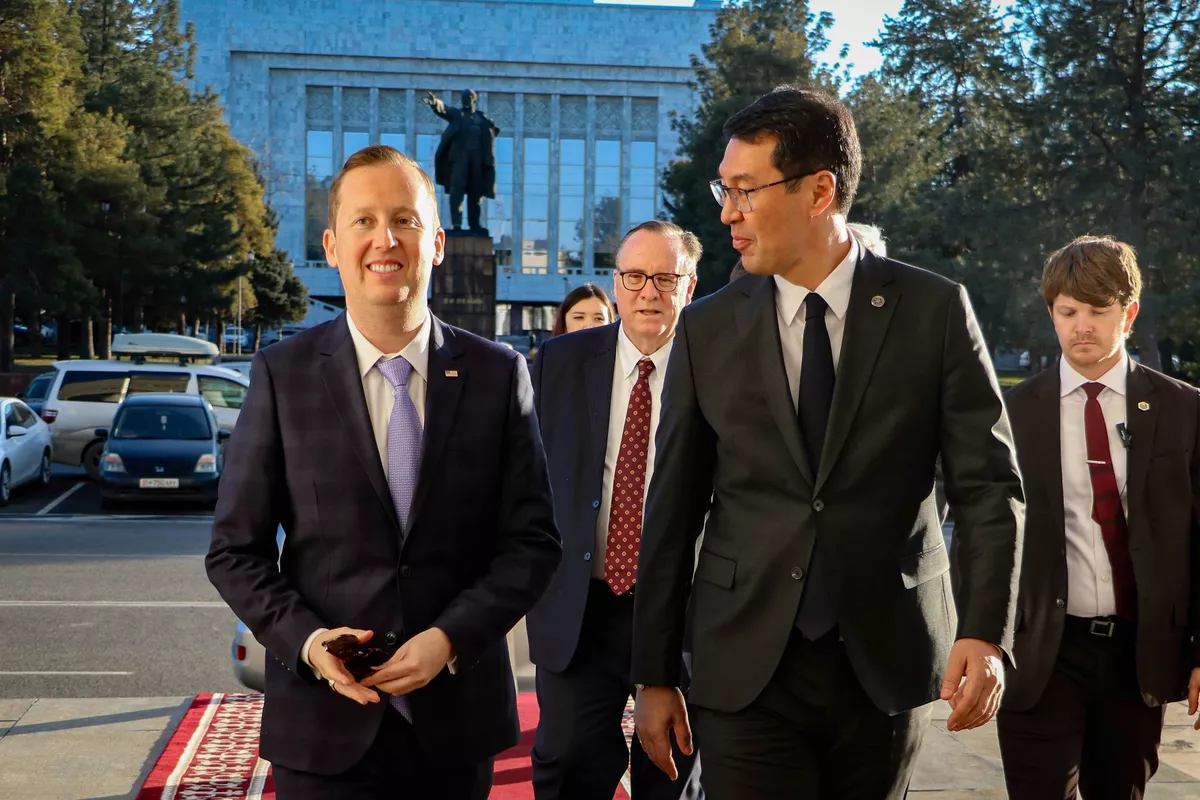
President Donald Trump’s special envoy for South and Central Asia, Sergio Gor, flew into Bishkek on February 4 to convey a message to Central Asian leaders that “since President Trump arrived in office … the United States is open for business”, The Caspian Post republishes the article.
Speaking at the B5+1 business forum, a gathering designed to forge stronger trade ties among governments and entrepreneurs in Central Asia and US corporate players, Gor said the region had “not gotten the attention it deserves” from the American business community. He added that the Trump administration is prioritizing the region and is intent on promoting sustained engagement that results in a “win-win for all of us.”
But to many Central Asians, especially in Kyrgyzstan, which is hosting this year’s B5+1 forum, the United States has become increasingly closed, due to travel restrictions imposed over the last eight months.
“It’s really a huge barrier to the development of business relationships between, for example, Kyrgyzstan and the United States,” said Tikel Toktogaziev, the head of the Berry Growers Association of Central Asia who organizes visits by delegations of the region’s berry producers to California. Those trips have become more complicated to organize because of the new restrictions, he said.
The Trump administration began tightening visa rules as part of its campaign to curb mass immigration. Turkmenistan was the first Central Asian state to experience visa restrictions after ending up on a US travel ban list last June. In January, the restrictions were eased for Turkmen citizens seeking non-immigrant visas.
In July, the administration cut the validity for non-immigrant visas from 10 years to three months for Kyrgyz citizens. That was followed at the beginning of this year by the announcement that Turkmenistan, Kyrgyzstan and Tajikistan are among 38 countries whose citizens are now required to post a bond between $5,000 and $15,000 for a non-immigrant visa.
On January 21, the administration froze immigrant visa processing for applicants from 75 countries, including Kyrgyzstan, Kazakhstan and Uzbekistan.
The administration has defended the restrictions, saying they are necessary to prevent visa overstays and weed out immigrants who might become a burden to the American social welfare system.
Gor defended the restrictions at a news conference February 4, indicating that the tightened rules were provisional, intended to give the US policy makers time to develop new, global visa eligibility frameworks that better addressed the illegal immigration issue. He stressed that the restrictions were not targeted at Central Asian states but applied worldwide.
“While we recalibrate and ensure that we have safe and secure borders, there’s a few limitations that have come into place,” he told reporters. “I know every one of these [Central Asian] countries takes their borders very seriously, and so the United States is looking to do the same.”
In fiscal year 2024, 648 Kyrgyz tourists or business travelers overstayed their visas, a rate of about 8 percent, according to Department of Homeland Security data. There were about 140 overstays in the same category from Tajikistan and 320 from Turkmenistan, working out to overstay rates of 7 percent and 15 percent.
photo: LandLopers
The average overstay rate was just above 2 percent, though Central Asia represents a tiny fraction of the total visas issued.
The restrictions have ruffled feathers in Kyrgyzstan. Some are rankled by the fact that Americans can visit Kyrgyzstan for up to 60 days without needing to obtain a visa.
“We should initiate a review of our visa-free policy for US citizens after the new visa requirements announced by the State Department yesterday,” Kyrgyz Deputy Premier Edil Baisalov wrote on social media January 8 following the visa bonds announcement. “Visa policy is a question of parity and mutual respect. If such high barriers are introduced for our citizens, we can’t pretend that nothing happened.”
During a February 4 meeting between Gor and Kyrgyz Foreign Minister Jeenbek Kulubayev, “particular attention was paid to visa issues,” the ministry said in a statement.
Askar Sydykov, the executive director of Kyrgyzstan’s International Business Council, said the group has received “quite a lot of concerned messages” from the country’s business community about the restrictions.
“It’d be preferable for them to have long-term visas and that, of course, any bond also creates an extra hurdle,” he told Eurasianet. “The basic idea is that visiting each other creates the basis for business. People want to visit, talk and build contacts and build trust.”
A representative of the Tajik technology sector at the forum, who requested anonymity to speak frankly, told Eurasianet there is some disappointment in the country’s business sector about the new bond requirement, but they said most companies should be able to come up with the cash.
“It would be better if it weren’t like this,” the person said. “We’re not going to sit around with our arms crossed. We’ll find a way forward.”
Toktogaziev, the head of the berry growers’ association, is trying to find a way forward too. He travels to California about three times a year, looking to buy technology and seedlings, meet with business partners and lead groups of Central Asian investors and growers to observe American agricultural techniques. “We have such a saying: it is better to see once than hear 1,000 times,” Toktogaziev said.
Though he has a 10-year visa that remains active, many of the Central Asian investors and berry producers he works with will be subject to the new restrictions, he told Eurasianet.
“What are the potential opportunities we’re losing every day because of visa issues?” he asked.