Water is becoming not just a natural resource for Azerbaijan, but a matter of strategic security. Against the backdrop of climate change, declining river flows, growing agricultural demand and the reconstruction of liberated territories, the problem of water losses is becoming increasingly urgent. Today, the issue is not merely the modernization of individual canals, but the need to rethink the entire system of water resource management in the country.
In this context, the documents signed during last week’s Annual Meeting of the Islamic Development Bank Group in Baku are of particular importance. Among them were a framework loan agreement and a grant agreement for the reconstruction of the Karabakh Irrigation Canal. The signing of these documents shows that water infrastructure has become a major priority and is now being addressed with the involvement of international financial institutions.
The project is aimed at creating modern irrigation infrastructure to support the recovery of agriculture, strengthen food security and ensure more efficient use of water resources in the Karabakh region. The reconstruction of the Karabakh Canal is expected to address several problems at once: reduce massive water losses, eliminate shortcomings in irrigation water supply, improve the condition of irrigated lands and reduce the environmental impact on surrounding areas.
In essence, this is about restoring one of the country’s key water arteries.
The process began on April 15, 2024, when President of Azerbaijan Ilham Aliyev signed an order “On measures for the reconstruction of the Karabakh Irrigation Canal.” The order provided for the reconstruction of the Upper Karabakh Irrigation Canal and its renaming as the Karabakh Irrigation Canal. This decision had not only technical, but also political and economic significance: the full return of Karabakh to active economic life is impossible without reliable water supply and a modern irrigation system.
In February 2026, the Board of Directors of the Islamic Development Bank approved financing for the Karabakh Irrigation Canal project in the amount of $436.67 million. In May, work began on preparing the feasibility study as well as design and cost-estimate documentation for the project, and a relevant tender was announced. Thus, the project moved from the stage of political decision-making to practical implementation.
The Karabakh Irrigation Canal is not just another canal on the map of Azerbaijan. It is the country’s largest main irrigation canal in terms of the area of irrigated land it serves. Commissioned in 1958, the canal is about 173 kilometers long. It begins from the Mingachevir Reservoir and the Kura River and extends toward the Araz River. It supplies irrigation water to up to 115,000 hectares of farmland across nine districts in the Karabakh zone and adjacent areas, while also providing domestic water to nearby settlements.
However, over decades of operation, the canal has become not only a source of water, but also a source of enormous losses. The main problem is that a significant part of its bed is not lined with concrete. As a result, water that should reach fields and farms seeps into the ground. According to official data, annual water losses in the Karabakh Canal reach approximately 300 million cubic meters. This is a huge volume, especially for a country facing a shortage of water resources.
The problem has another, less visible but equally damaging consequence. Continuous seepage causes groundwater levels to rise and approach the surface, leading to waterlogging and deterioration of soil conditions. In other words, the country loses water twice: first, the water is not used for its intended purpose; then, excessive seepage damages agricultural land.
According to expert estimates, around 20 cubic kilometers of water have seeped into the soil over the years of the canal’s operation. To understand the scale, this volume exceeds the capacity of the Mingachevir Reservoir. In other words, through this canal alone, Azerbaijan has effectively lost a volume of water comparable to its largest reservoir.
The reconstruction of the Karabakh Canal is intended above all to solve this problem. After modernization, enormous volumes of water will be saved - water that is critically needed by Azerbaijan today. In conditions where every cubic meter of water has economic and strategic value, reducing losses is no less important than building new reservoirs or searching for additional water sources.
A similar problem previously existed on the Shirvan Irrigation Canal, formerly known as the Upper Shirvan Irrigation Canal. Its reconstruction also began in April 2024 and is currently ongoing. Before modernization, water losses on the Shirvan Canal amounted to almost one-third of the water passing through it. After the reconstruction is completed, these losses are expected to fall to 5 percent, which is considered an acceptable level.
These projects show that the problem is systemic. Azerbaijan is losing water not only because of drought, climate change or declining inflows from transboundary rivers. A significant share of losses occurs inside the country itself - during water delivery, distribution and use.
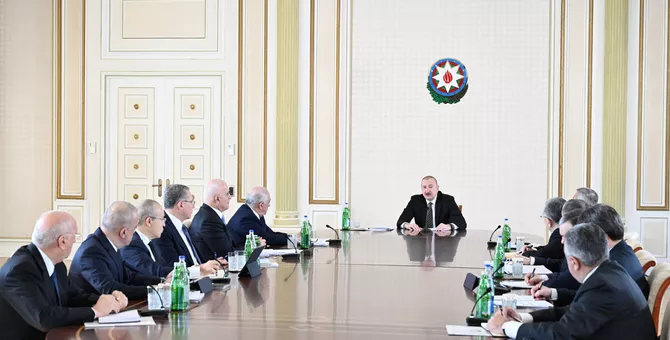
photo: president.az
At a January meeting on water supply issues, President Ilham Aliyev paid particular attention to losses during water delivery. According to him, one of the main problems today is precisely the level of losses: if losses were lower, even the country’s existing water reserves would be sufficient.
This view is supported by figures presented at the same meeting by Zaur Mikayilov, Chairman of the State Water Resources Agency. According to him, actual water losses in Azerbaijan’s networks amount to 38.6 percent. By comparison, the average figure in the European Union is 22 percent. If losses not only during water delivery through canals but also during internal use are taken into account, Azerbaijan’s overall figure rises to 46 percent. In Europe, internal losses amount to around 3 percent, while in Azerbaijan they stand at 9 percent.
These numbers point to a major efficiency problem. Nearly half of the water that should serve the economy, agriculture and households is lost on the way or used inefficiently. For a country with limited water resources, this is an unaffordable loss.
Speaking in parliament, Zaur Mikayilov said that over the next 10 years Azerbaijan plans to reduce national water losses to 20 percent, and by 2050 to 10 percent. This is an ambitious target, but without such progress it will become increasingly difficult for the country to ensure the sustainable development of agriculture, especially amid rising temperatures and changing precipitation patterns.
A comparison with Türkiye helps put the issue into a broader regional context. In Türkiye, irrigation losses amount to around 65 percent, while losses in drinking water use are about 30 percent. At first glance, these figures are higher than Azerbaijan’s. However, this should not become a reason for complacency. Türkiye has more abundant internal water resources and is ahead of Azerbaijan in terms of water availability per capita. In Azerbaijan, this figure is around 851 cubic meters per year - the lowest in the region. In Türkiye, it is about 1,301 cubic meters per person.
Population size should also be taken into account. For Azerbaijan, with a population of about 10 million, the country’s available water reserves of roughly 35 billion cubic meters would generally be sufficient if losses were not so high, according to the State Water Resources Agency. This is the central paradox: Azerbaijan faces water scarcity not only because water is limited, but also because a significant part of it never reaches the consumer.
Azerbaijan has an extensive network of main irrigation canals. The largest and most important among them are the Samur-Absheron, Karabakh and Shirvan canals. They supply water to a major share of the country’s irrigated lands. The Samur-Absheron Canal, more than 180 kilometers long, begins from the Samur River on the border with Dagestan and is the longest canal in Azerbaijan. The Karabakh Canal, as noted above, is the largest in terms of irrigated area. The Shirvan Canal was 123.5 kilometers long before reconstruction began; after the completion of works, its length is expected to exceed 200 kilometers.
In addition to these three main canals, the country has dozens of inter-district and intra-farm canals, including the Main Mil Canal, the Main Mughan Canal, the Jeyranbatan Main Canal and others. Together, they form a vast system on which food security, regional development, land quality and living standards depend.
The total length of Azerbaijan’s irrigation network exceeds 50,000 kilometers. However, only a small part of this network is lined with concrete. This means that the problem of water losses is not limited to one or two facilities. The Karabakh and Shirvan canals are simply the most visible examples. Behind them lies a much broader infrastructure challenge: the modernization of the entire water supply and irrigation system.
Azerbaijan now faces a clear choice. It can continue losing hundreds of millions of cubic meters of water every year, while dealing with worsening land conditions, declining agricultural efficiency and growing dependence on weather patterns. Or it can turn water policy into one of the priorities of national development.
The reconstruction of the Karabakh Irrigation Canal is an important step in this direction. But it should not remain an isolated project. It must become part of a broader and systematic national program. The water the country loses today may tomorrow become a decisive factor for food security, the reconstruction of Karabakh, regional development and the resilience of the entire economy.
Water losses are no longer just a technical problem of old canals. They are a question of Azerbaijan’s future.
by Fariz Samedov