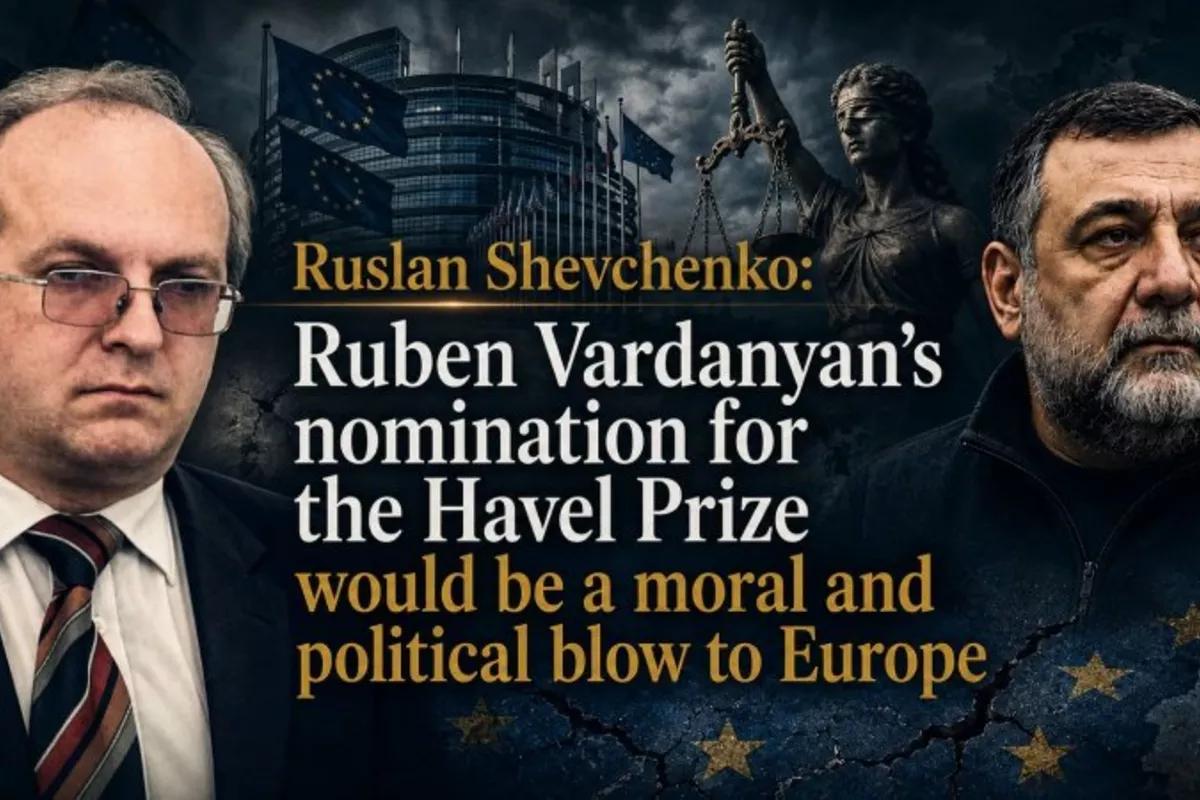
Ruslan Shevchenko: Ruben Vardanyan’s Nomination for Havel Prize Would Be Moral and Political Blow to Europe
As discussions continue in Europe over the possible nomination of Ruben Vardanyan for the Václav Havel Human Rights Prize, the controversy surrounding him is taking on renewed political significance. For Azerbaijan, the issue goes far beyond a single award nomination. It touches on broader questions of separatism, Russian influence networks, hybrid warfare, and the ability of European institutions to distinguish genuine human rights advocacy from politically motivated campaigns.
Vardanyan, who was previously listed in Ukraine’s Myrotvorets database and has long been associated with Russian financial and political circles, remains a deeply controversial figure due to his role in Karabakh and his links to structures close to Moscow. His supporters in Europe portray him as a philanthropist and public figure, while his critics argue that attempts to portray him as a human rights defender ignore serious political and legal realities, The Caspian Post reports via News.Az.
To better understand how this issue is viewed from the perspective of countries that have themselves faced Russian hybrid pressure, News.Az spoke with Moldovan political analyst and Doctor of History Ruslan Shevchenko. In this interview, he explains why he believes the campaign around Vardanyan should be seen as part of a broader information operation against Azerbaijan, why his possible nomination could damage Europe’s credibility, and why European politicians should exercise greater caution regarding figures promoted by pro-Russian lobbying networks.
- How do you assess the fact that Ruben Vardanyan, who was listed in Ukraine’s Myrotvorets database and has been associated with Russian elites and financial structures, is now being portrayed in Europe as a human rights defender and a possible candidate for the Václav Havel Human Rights Prize?
- What is happening around Ruben Vardanyan in Europe should be viewed as part of Russia’s hybrid warfare - now also directed against Azerbaijan. We have seen how this works in the cases of Moldova, Georgia and Ukraine. When it is impossible to launch a “hot” war, an economic war begins - through embargoes on agricultural or industrial goods - alongside a propaganda war aimed at discrediting the political leadership, foreign policy and domestic policy of any country that has fallen out of favour with the Kremlin. Today, the Kremlin is using both of these tools against Azerbaijan.
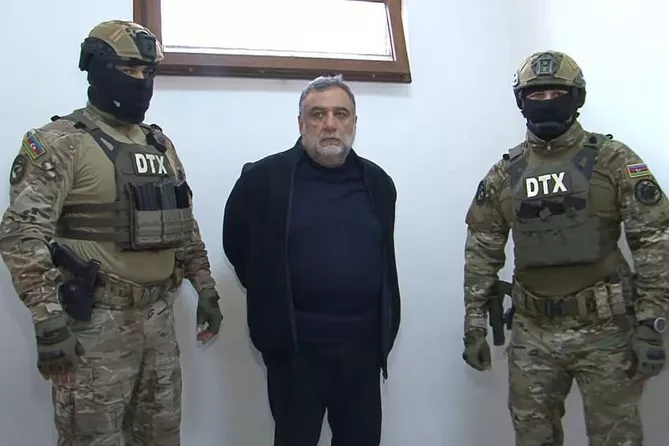
Source: State Security Service of Azerbaijan
Ruben Vardanyan, one of the leaders of Karabakh separatism and a billionaire who is now serving a long-overdue prison sentence in Baku, has become one of the instruments used by the Kremlin and by parts of the Armenian diaspora that align with it in various countries in their campaign against Azerbaijan.
Since Moscow currently has no grounds for a direct attack on Azerbaijan, it is developing a propaganda narrative around Vardanyan as a “victim of the criminal Baku regime” - a regime that allegedly imprisoned an “honest and respectable Armenian patriot” without justification. Taking advantage of the fact that Vardanyan was, until recently, almost unknown in Europe, Kremlin-linked networks in EU countries are trying to promote his image as a “fighter for truth and justice” and a “respected entrepreneur-philanthropist”, while also using every opportunity to attack Azerbaijan over what they describe as a “cruel sentence” against him.
To compare Vardanyan - a state criminal who, under the laws of any country, including Russia itself, would have received a very long prison sentence for his actions - with Václav Havel, a genuine anti-Soviet dissident who actively opposed the communist regime in Czechoslovakia, is deeply immoral, blasphemous and politically criminal.
Azerbaijan’s Ministry of Foreign Affairs should do everything possible, through Azerbaijani embassies in European states, to launch counter-propaganda efforts explaining to ordinary Europeans and politicians who Vardanyan really is, what exactly he did, and why the sentence he is currently serving is fully justified. If this is done quickly and effectively, it may still be possible to prevent the Havel Prize from being awarded to Vardanyan.
- Does the attempt to nominate Vardanyan for a European human rights prize amount to a blow to Europe’s own reputation, given his ties to Russia, his role in Karabakh, and the accusations involving actions that contradict the principles of international law?
- Absolutely. The idea of nominating Vardanyan for a European human rights prize damages Europe’s image - not only in the eyes of Azerbaijanis, but also in the eyes of people in many other countries.
Russian intelligence services and the Armenian diaspora in Europe, which is largely pro-Russian, are successfully using the “Vardanyan case” as yet another instrument aimed at discrediting European politicians in the eyes of their own societies. If a convicted criminal were to receive the Havel Prize, it would represent another success for Russia and its propaganda inside the European Union.
European politicians who verbally claim to be waging a “fierce struggle” against Russian influence should take a much closer look at the figures being promoted to them by pro-Russian lobbying networks in the EU before allowing such individuals to be nominated for such a prestigious award.
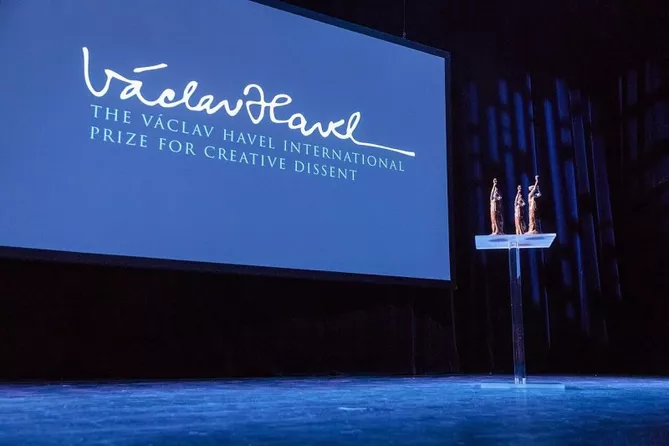
Source: Wikimedia Commons
- From the point of view of Moldovan society, which has faced Russian hybrid aggression for many years, how dangerous is it for Europe to ignore the past of figures like Vardanyan and turn individuals with a Russian financial and political background into “victims” and “human rights defenders”?
- In our view, concealing the past of dangerous criminals such as Vardanyan is not merely dangerous for Europe - it is extremely dangerous. Vardanyan undoubtedly played the role of the Kremlin’s overseer in Karabakh, which was then occupied by Armenia, as well as in Armenia itself. At the first suitable opportunity, he was expected to remove the sitting prime minister, Nikol Pashinyan.
Ignoring this past undermines the very foundations of Europe’s security and calls into question its future stability and normal development. If Europe begins whitewashing a separatist and criminal acting under instructions from handlers in another country, it may soon find itself facing countless similar figures. These individuals will not only seek justification for their actions, but may also push for the fragmentation of nation states within the European Union.
That would amount to a sentence for modern European states and for the European Union as a whole. The late Václav Havel would undoubtedly be turning in his grave at such a monstrous act of sacrilege.
This is why it is essential to ensure that Europe understands the full truth about who Ruben Vardanyan really is, who stands behind him, and why there can be no question of nominating him for the Havel Prize, especially in the context of Russia’s hybrid warfare against Europe and against all opponents of Vladimir Putin’s regime.
By Murad Samedov