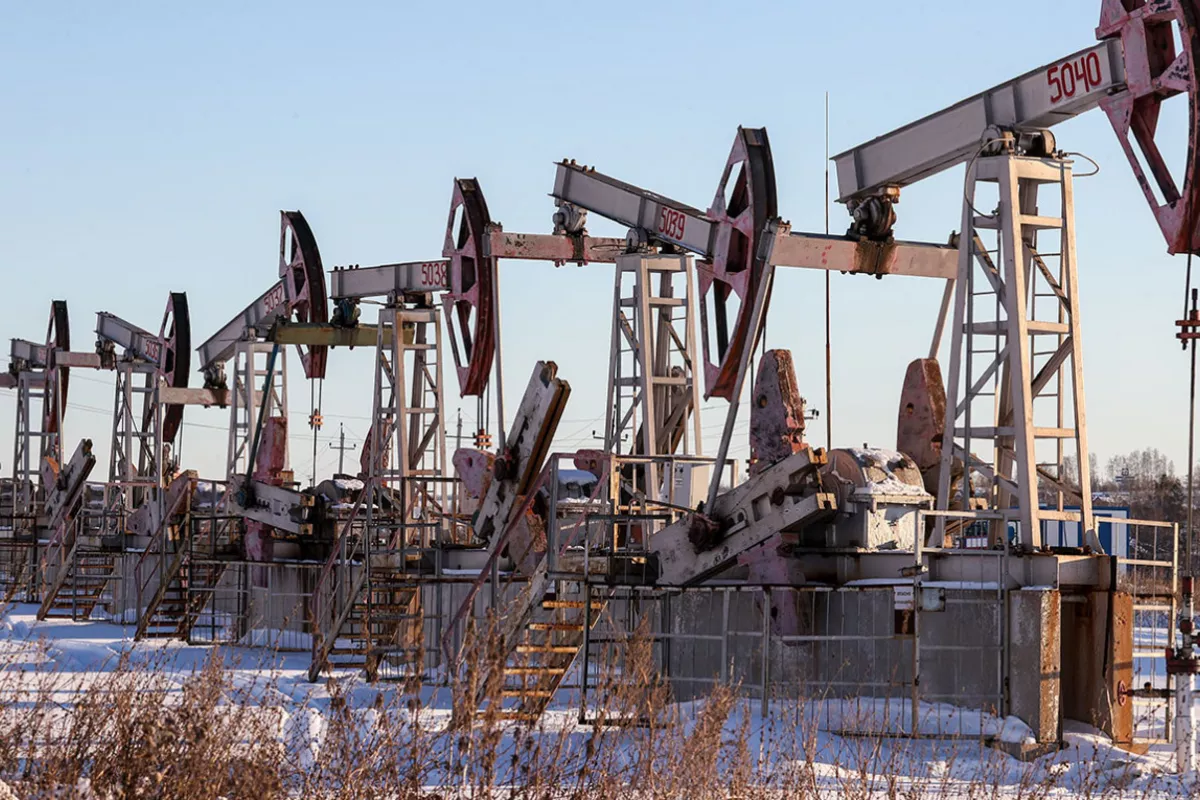
Russia’s oil industry-long considered the foundation of the country’s economic stability and fiscal strength-is confronting what many analysts describe as its most severe structural crisis in decades.
A combination of intensified US sanctions, widening discounts on Russian crude exports, global oil prices drifting toward the $40-per-barrel mark, and persistently high domestic interest rates has exposed deep weaknesses within the sector. The strain is particularly visible among small and mid-sized producers operating in Russia’s key extraction regions, according to media reports.
Recent bankruptcy cases involving regional oil companies highlight the growing financial pressure. What was once viewed as an adaptable sanctions environment has increasingly evolved into a systemic challenge for Russia’s energy complex.
Mounting Bankruptcies Signal Deeper Structural Stress
One of the clearest signs of trouble is the reported move by state-owned VTB Bank to initiate bankruptcy proceedings against First Oil, a company associated with former Sibur shareholder Yakov Goldovsky. First Oil operates in the Khanty-Mansi Autonomous Okrug (KhMAO), Russia’s most important oil-producing region, which accounts for roughly 40% of national output.
The company has reportedly accumulated around 6 billion roubles in debt. Its assets include several relatively small oil fields with combined reserves estimated at 14 million tonnes and annual production of approximately 500,000 tonnes. While such output is modest by Russian standards, companies of this size play a meaningful role in supporting regional employment and maintaining overall production volumes.
According to market sources, First Oil’s financial troubles date back to the COVID-19 crisis in 2020, when global oil demand collapsed and Brent crude briefly fell below $20 per barrel. Although global markets later recovered, the company never fully regained financial stability. The renewed tightening of US sanctions and deepening export discounts have now pushed it to the brink.
First Oil is not alone. Late last year, Youngpur Oil-representing Belarusneft’s operations in Russia-entered bankruptcy proceedings. The company operates two fields in the Yamalo-Nenets Autonomous Okrug (YaNAO), another crucial hydrocarbon-producing region. Earlier, Astrakhan Oil Company and NK Gorny, which holds three licenses in the southern part of the Nenets Autonomous Okrug, were declared bankrupt following tax claims. In January, Moscow Credit Bank reportedly demanded around 7 billion roubles from owners of insolvent oil enterprises.
These cases reflect a broader pattern: independent producers are struggling to absorb the combined impact of sanctions-driven price discounts, increased transportation expenses, restricted access to Western technologies, and higher domestic borrowing costs.
Source: Reuters
Discounted Exports and Collapsing Profit Margins
Since 2022, Russian crude-particularly the Urals blend-has been sold at a significant discount to Brent. In recent months, that discount has reportedly widened to between $25 and $30 per barrel in certain transactions.
With benchmark global prices subdued and export blends trading near or below $40 per barrel after discounts, many Russian oil fields are operating at or below break-even levels. According to Craig Kennedy, a Russia and Eurasia specialist at Harvard’s Davis Center and former Bank of America executive, roughly half of Russian oil fields become unprofitable when prices approach $40 per barrel. Only projects benefiting from tax incentives or preferential fiscal treatment remain sustainably profitable at that level.
Estimated losses on unprofitable output average about $5 per barrel. While this may seem limited, the cumulative effect across millions of barrels per day is substantial. Russia currently produces around 10 to 10.5 million barrels per day (bpd), down from roughly 11 million bpd before 2022. Even marginal losses on half of this production translate into considerable aggregate financial strain.
Official data from Rosstat underscore the severity of the situation. Between January and November, approximately half of Russia’s oil and gas producers operated at a loss. Combined losses reached 575 billion roubles during that period. Even among profitable companies, earnings declined by more than 50% year-on-year, falling to around 3 trillion roubles.
While large state-controlled companies such as Rosneft, Gazprom Neft, and Lukoil maintain stronger financial buffers and benefit from preferential tax arrangements, overall sector profitability has deteriorated sharply. Smaller firms operating mature or higher-cost fields lack similar fiscal protection and are more exposed to market volatility.
Financial Pressures: Debt, High Rates and Restructuring
The strain is also evident in the banking system. According to Russia’s Central Bank, approximately 2.7 trillion roubles in loans to the oil and gas sector have been restructured. This makes the industry the largest both in total volume and proportion of restructured loans-accounting for nearly 20% of all loan restructurings nationwide.
High domestic interest rates have intensified the problem. To combat inflation and stabilise the rouble, the central bank has maintained elevated key rates, increasing borrowing costs across the economy. For capital-intensive oil projects-especially those located in remote Arctic or Siberian regions-financing expenses represent a crucial cost component.
When export revenues decline due to discounted sales and borrowing costs remain high, profit margins shrink rapidly. Analysts have described this combination of falling income and tight monetary policy as a “volatile cocktail” for the sector.
At the same time, Russia’s oil industry faces long-standing structural vulnerabilities. Much of the country’s output, particularly in Western Siberia and Khanty-Mansi Autonomous Okrug, comes from aging fields with natural production decline. Maintaining output requires advanced enhanced oil recovery techniques, horizontal drilling, and sophisticated technologies-many of which were historically supplied by Western firms such as Schlumberger, Halliburton, and Baker Hughes.
Sanctions have limited access to certain technologies and expertise. Although Russia has accelerated efforts toward import substitution and increased reliance on domestic service providers and Chinese suppliers, technological gaps remain. As costs rise in mature fields, sustained low prices make operations increasingly difficult to justify economically.
Source: TASS
Export Shifts, Fiscal Risks and Strategic Choices
Sanctions have also reshaped Russia’s export geography. Europe, once the principal destination for Russian crude, has largely phased out direct imports. Today, China and India are the primary buyers. India in particular sharply increased purchases after 2022, drawn by discounted supplies.
However, this concentration reduces Russia’s bargaining power. With limited alternative markets willing to handle sanctioned crude, buyers can demand deeper discounts. Kennedy notes that beyond China and, to a lesser extent, India, few countries are prepared to risk trading sanctioned Russian oil. Complications surrounding shipping insurance, payment systems, and compliance obligations further constrain trade.
The fiscal implications for Moscow are significant. Oil and gas revenues typically account for around 30-35% of Russia’s federal budget income, depending on price levels. Lower export prices and widening discounts reduce tax inflows from mineral extraction taxes and export duties. The Ministry of Finance has already drawn from the National Wealth Fund to cover budget deficits.
Although the government has adjusted tax formulas to stabilise revenue flows, prolonged oil prices near $40 would strain public finances further. Expanding tax incentives to support struggling producers could erode the revenue base, creating a policy dilemma: preserve fiscal stability or sustain production levels.
Projects benefiting from special tax regimes remain among the few that can operate profitably at current price levels. However, broadening such incentives nationwide would worsen fiscal pressure.
If prices fall toward $35 per barrel or lower after discounts, financial stress would intensify sharply. Potential consequences include accelerated consolidation around large state-backed companies, additional bankruptcies among independent producers, declining output in mature fields, greater reliance on state credit guarantees, and increased pressure on regional budgets in oil-dependent areas such as Khanty-Mansi and Yamalo-Nenets.
Despite mounting challenges, Russia has demonstrated notable resilience since 2022. Production has remained relatively stable compared to early forecasts of collapse. This resilience has been supported by shadow fleet shipping networks, alternative insurance arrangements, expanded use of national currencies in trade, flexible tax mechanisms, and a pivot toward Asian markets.
However, short-term adaptability does not eliminate long-term structural pressures. If capital investment declines due to financial constraints, production could gradually fall over the coming years as mature fields deplete and new projects fail to compensate.
Looking ahead, three broad scenarios appear plausible. The first is stabilisation through adaptation: if global prices recover to the $60-70 range and discounts narrow, profitability could partially return, easing financial stress. The second is gradual consolidation, with smaller firms absorbed by larger state-controlled entities, increasing centralisation within the sector. The third is a managed production decline if low prices persist and sanctions tighten further.
Current bankruptcy cases suggest that consolidation is already underway. Major state-backed giants may weather the downturn, but the broader industry is undergoing structural transformation.
For now, Russia’s oil sector remains operational. Yet with discounted crude effectively trading near or below $40 per barrel, roughly half of the country’s oil fields are unprofitable. Restructured loans, widespread reported losses, and rising bankruptcies indicate that financial stress is deepening.
The industry stands at a crossroads. Its future trajectory will depend on global price dynamics, the evolution of sanction regimes, fiscal policy choices, and the country’s ability to adapt technologically and financially. In the near term, the system is holding-but the margin for error is narrowing.