The Bayraktar TB-3's NATO debut: Rethinking naval aviation
Anadolu Agency has published an article covering the debut of the Turkish-made Bayraktar TB3 unmanned combat aerial vehicle (UCAV) during a NATO exercise.
The Caspian Post has republished the article, highlighting the TB3’s first participation in alliance drills and its growing role in Türkiye’s defense capabilities.
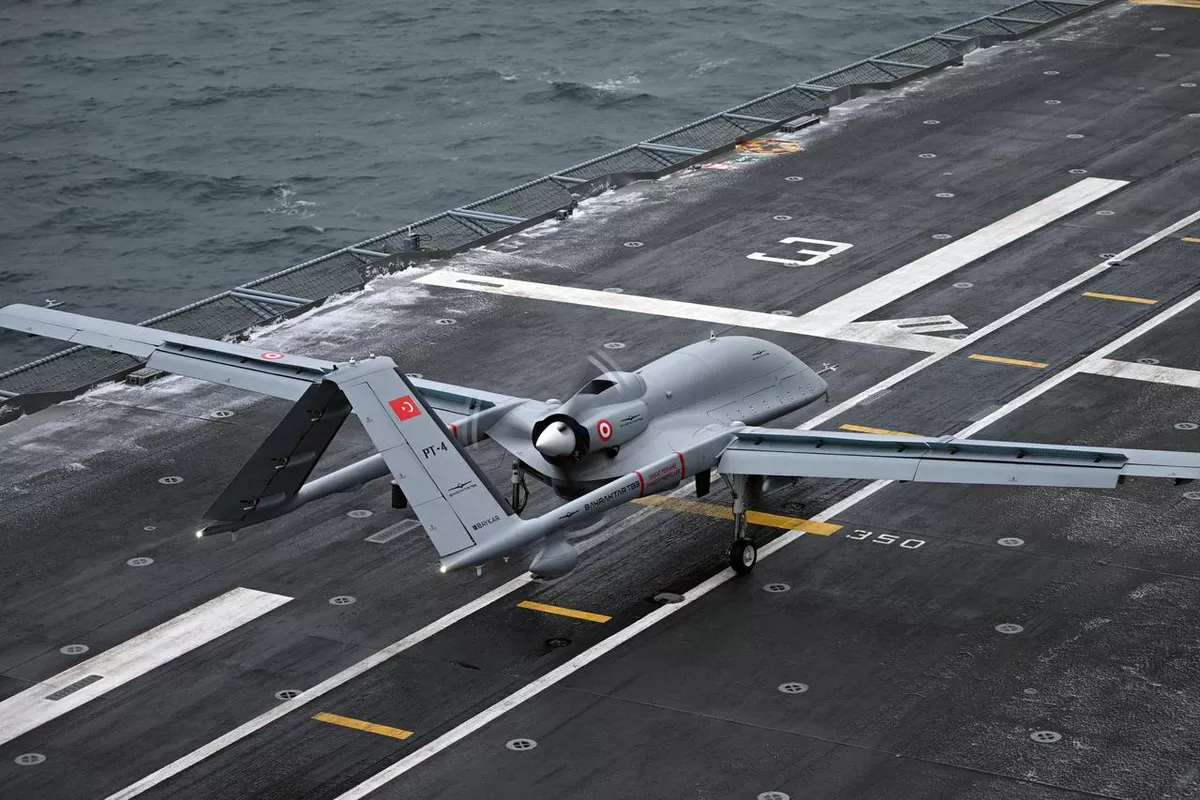
Recently, the Bayraktar TB3 unmanned combat aerial vehicle (UCAV) took part in a NATO exercise for the first time. Bayraktar's unmanned aerial vehicle, designed for naval aviation, executed a live-fire mission during one of NATO’s most disciplined operations under the extremely harsh meteorological conditions of the Baltic Sea -- characterized by cold temperatures, high winds, and heavy seas -- and safely landed back on the TCG Anadolu upon completion.
Certainly, the TB3’s NATO activity should not be interpreted as a mere demonstration flight. The Bayraktar TB3 performing a live-fire mission in Steadfast Dart 2026 and landing on the TCG Anadolu represents the debut of a new naval warfare concept, rather than just a platform test.
From Platform to Architecture: TB3 and Hyper-Warfare Design
Consider a hypothetical conflict scenario in the early 2030s. Imagine that under real combat conditions, Kemankes smart loitering munitions launched from TB3s are simultaneously transmitting sensor data from the theater of operations and advancing toward surface assets using machine-learning-supported target recognition. These munitions are not merely strike elements; they are systems that generate data and function as integral nodes of a combat network.
At the same time, imagine Albatros-S swarms, guided via the TB3’s data link, executing a swarm attack against enemy warships. On the aerial axis, the Kemankes; on the maritime axis, the Albatros-S kamikaze USV (unmanned surface vehicle). This multi-axis pressure overwhelms the enemy ship's sensor-decision-engagement cycle. In the face of such speed and saturation, defense systems are pushed to their ultimate reaction threshold.
Add to this picture the Aselsan Marlin USVs performing missions equipped with Cakir anti-ship missiles and electronic warfare payloads. We are talking about a naval warfare environment where kinetic strikes and attacks within the electromagnetic spectrum are executed simultaneously.
Now, imagine the execution of anti-submarine warfare (ASW) across a broader expanse of the operations theater. Envision the TAI AKSUNGUR UCAV searching for enemy submarines by deploying sonobuoys. Meanwhile, in the upper tier of the maritime operations environment, imagine KIZILELMAs rendering the airspace high-risk for enemy fighter jets with their beyond-visual-range (BVR) missiles.
To speak plainly, the scenario described is as realistic as it is sensational. Each system mentioned either already possesses the capacity to perform combat missions or is seeing its capabilities increase at an accelerated pace.
The national tests conducted at the end of 2025 provided a preview of the architecture under discussion. The TB3 utilized the Kemankes-1, which features AI-supported image processing technology; during the same tests, the Albatros-S KUSV (kamikaze unmanned surface vehicle) was guided via the data link provided by the TB3. Furthermore, the design philosophy of the Albatros-S is centered on swarm attacks.
It is evident that Türkiye and Baykar are not merely developing a platform; they are also constructing a holistic warfare and operational concept. In our view, at the heart of this architecture lies the goal of hyper-warfare capability, which integrates artificial intelligence, autonomy, and robotic capabilities. Within this framework, the TB3's NATO performance should be evaluated not merely as a tactical success, but as one of the first signs of maturity for a strategic concept.
TCG Anadolu: The Drone Carrier Concept
The takeoff of the TB3 from the TCG Anadolu amphibious assault ship during the exercise is significant, as there are several approaches regarding the utilization of this class of warship (LHD - Landing Helicopter Dock). The first of these is to use such vessels as "mini-aircraft carriers" by equipping them with platforms like the F-35B variant, which is capable of vertical landing. Essentially, the inclusion of a ski-jump for short takeoffs on the TCG Anadolu led to assessments that Türkiye -- formerly a member of the F-35 consortium -- would acquire the B variants alongside the A variants to utilize the Anadolu as a mini-carrier.
Another approach to LHDs is to focus solely on amphibious missions, keeping the defense economy burden and politico-military objectives more modest. This is because even the deck coating materials required for the takeoff of platforms like the F-35B from such ships, along with the expensive maintenance and flight-hour costs of these aircraft, require substantial expenditures. Furthermore, it should be noted that high-tech fighter jets face a higher risk of attrition in maritime warfare environments.
Following the suspension of F-35 acquisitions, how Türkiye would utilize the TCG Anadolu became a topic of intense debate in international military circles. Perhaps the most striking concept in these discussions was the idea of using the TCG Anadolu as a "drone carrier," equipped with a naval aviation suite predominantly composed of robotic platforms. The employment of the TB3 in a maritime warfare environment has directly served to support this very concept.
The Next Stage
The integration of Turkish unmanned systems into the battlefield -- from Syria to Karabakh and Libya -- has been characterized as a "game-changer" by numerous international publications. Similarly, in the coming decades, we may witness Turkish unmanned and robotic warfare capabilities being extended into the maritime domain via naval aviation, unmanned platforms, and armed unmanned surface vehicles (AUSVs). Such a landscape will bring with it significant export opportunities and a potent defense diplomacy potential for joint military capacity building, especially considering the rising tensions in the Indo-Pacific and the shift of the center of gravity for international conflict toward that region. The fact that Baykar derives the vast majority of its revenue from defense exports is consistent with this assessment.
So, following the TB3’s NATO exercise phase, what goals might Ankara, Baykar, and the Turkish defense industry pursue? To answer this, we believe it is useful to look at the 2024 Defense Industry Executive Committee (SSİK) decision regarding the design of a national aircraft carrier, as well as Baykar's plans for the Kizilelma family.