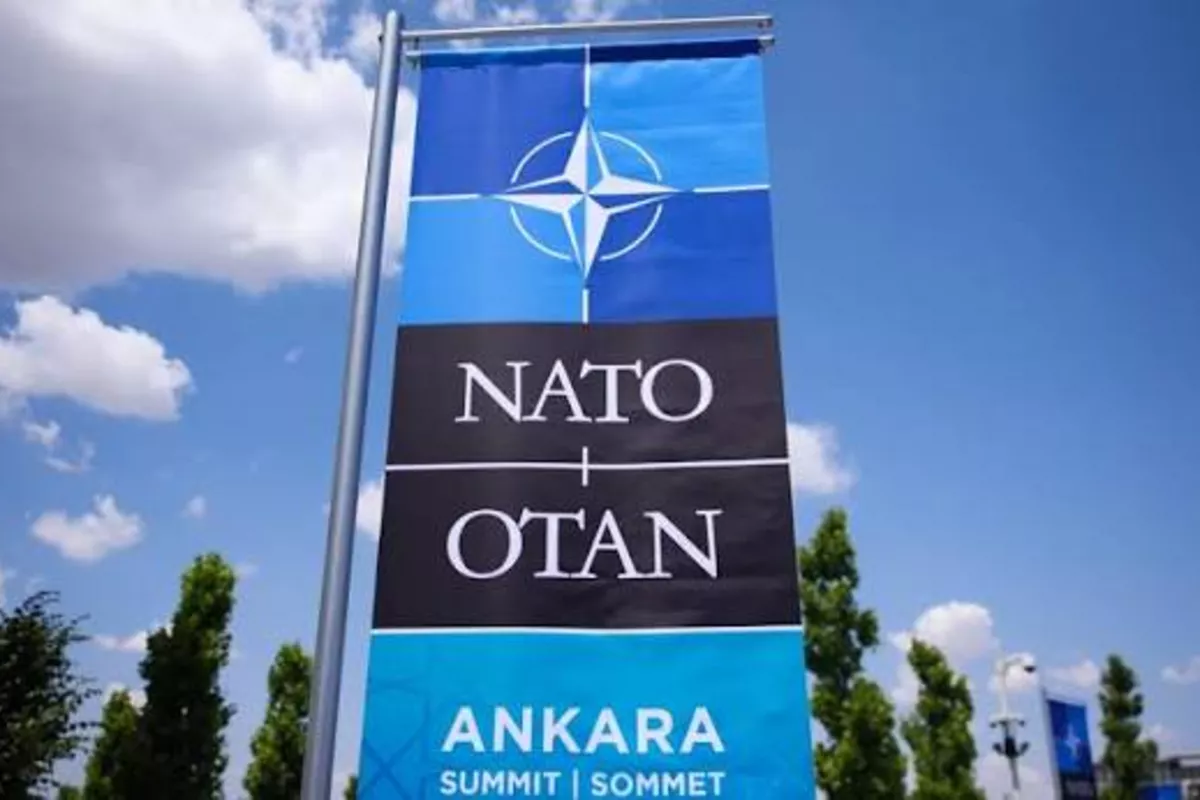
The NATO summit in Ankara ended without a rupture, but the alliance's apparent unity has failed to resolve the deeper uncertainty shaping its future: whether the transatlantic bond can withstand Washington's changing priorities and growing doubts over the US security commitment to Europe.
Despite months of tensions, including US President Donald Trump's repeated criticism of European allies and his questioning of whether NATO members are doing enough for collective defense, leaders managed to avoid an open confrontation during the two-day meeting in the Turkish capital.
The summit produced a carefully balanced outcome: European allies committed to expanding defense spending, NATO reaffirmed support for Ukraine, and member states agreed to strengthen military-industrial cooperation.
Yet analysts warn that behind the diplomatic success lies a fundamental debate over the future balance of power within the alliance.
"The Ankara summit confirmed the difficult phase the Atlantic Alliance is going through. ... Probably, transatlantic relations are now at their lowest ebb," Gianluca Pastori, senior associate research fellow at the Italian Institute for International Political Studies, told Anadolu.
Pastori said Trump's criticism of European allies followed a familiar pattern, while the return of the Greenland issue to the political agenda had revived tensions that appeared to have eased.
"The brief final statement is not without positive signs, especially regarding the alliance’s reaffirmed unity in the face of international threats," he said.
According to Pastori, the center of gravity of the declaration was defense spending and Europe's growing responsibility for its own security.
"Further evidence of how the White House's priorities continue to dictate the basic framework within which NATO operates, and how that framework seems to be shifting ever more clearly from the logic of burden-sharing to that of burden-shifting," he said.
Change in Trump's rhetoric, but will it be permanent?
The absence of a direct confrontation between Trump and European leaders was widely viewed as the summit's most immediate achievement.
Riccardo Alcaro, research coordinator at the Institute of International Affairs, said the meeting succeeded "to the extent that the conditions allowed for it."
He said European leaders had arrived in Ankara concerned about whether Trump would repeat his previous attacks against NATO, portray European allies as unreliable partners, or question the credibility of the alliance.
"Nothing of that happened," Alcaro told Anadolu.
"In fact, Trump also had some warm words about NATO, the atmosphere, and he also seemed to change tack, at least in rhetoric with regard to Ukraine," he said.
According to Alcaro, the key achievement was that "there was no rupture, no falling out between Trump and European countries."
However, he cautioned against interpreting the softer rhetoric as a fundamental strategic shift.
"There has been a change of rhetoric, but this is not entirely out of character for Trump," he said.
"Whether this change of rhetoric actually translates into a change of policy positions, I'm still skeptical. So let's wait, as Trump loves saying, we'll see what happens," Alcaro added.
For Alcaro, European leaders have developed a strategy for managing relations with Trump: avoiding direct confrontation, emphasizing increased defense spending, and demonstrating that Europe is taking greater responsibility.
Marion Messmer, director of the International Security Program at Chatham House, also warned that public disagreements among allies could weaken NATO’s deterrence.
"The display of divisions within NATO is a significant concern because there is a risk here that Russia might draw the wrong conclusions from it. It makes NATO appear weak and undermines credibility," she told Anadolu.
Europe's structural obstacles
The central outcome of the Ankara summit was the continuation of NATO's defense spending commitments agreed previously at The Hague.
The alliance pledged further increases in defense expenditure, including investment in strategic capabilities such as air and missile defense, long-range precision strike systems, drones, artificial intelligence, and intelligence capabilities.
NATO members also committed to expanding military-industrial cooperation, with more than $50 billion in new procurement commitments announced.
But experts warn that increasing budgets alone will not solve Europe's capability gap.
"The burden-sharing/burden-shifting issue is not only about how much money allies contribute but also about how that money is spent," Pastori said.
He argued that Europe's challenge is not simply financial but structural.
"Some countries face financial difficulties in meeting their commitments, while in others there are strong political obstacles," he said.
Alcaro similarly highlighted that while European countries are spending more, most increases remain national rather than coordinated.
"Will that be enough to develop the kind of capabilities we need to replace, if not entirely, most of what the United States now provides?" he asked.
Europe continues to depend heavily on Washington for key military assets, including long-range strike capabilities, missile defense, intelligence and surveillance, electronic warfare, advanced aircraft, logistics, and secure communications.
As Pastori noted, burden-shifting could ultimately benefit Europe by improving not only military capabilities but also its political influence.
"It is not 'the end of NATO,' but to cope with the challenge, the alliance must redefine its internal balance," he said.
Leonardo-Baykar partnership could be 'model'
One of the summit's key themes was strengthening NATO's defense industrial base.
Pastori said cooperation between companies could provide a model for future European and NATO-level projects, pointing to the partnership between Italian defense company Leonardo and Turkish drone manufacturer Baykar.
"I believe the Leonardo/Baykar partnership can serve as a model for other collaborations at both NATO and European levels. In today’s global context, collaboration is the avenue for meeting NATO’s targets," he said.
According to Pastori, Europe's defense industry has significant strengths but remains fragmented.
"Europe has a strong military-industrial tradition with several high-value 'national champions,' its main weakness is fragmentation," he said.
Alcaro also said European defense companies should examine the Leonardo-Baykar cooperation model.
"If I were an EU company working in defense, and if I saw that Turkish companies may have an added value that I cannot find in the EU, I would study the Baykar-Leonardo a partnership to see whether I can build upon that or use that as a model."
Türkiye's diplomatic success
The Ankara summit also represented a major diplomatic success for Türkiye, which used its position as host to strengthen its role within the alliance.
Messmer said the summit was "a great success for Ankara," adding: "Donald Trump confirmed that he only attended because of the personal invitation from President Erdogan."
Türkiye secured progress on defense relations with Washington, including discussions over sanctions and possible developments regarding the F-35 program.
Messmer said Ankara was also able to reinforce its image as a major NATO member with an increasingly important defense industry.
"Türkiye also was able to position itself as a strong NATO member with a significant defense industry that can benefit other allies," she said.
Alcaro said Türkiye's importance goes beyond its military capabilities.
"Türkiye is a really important country. The value that it brings, the capabilities it brings, including in terms of mollifying Donald Trump, and this is because Donald Trump likes relationships between strongmen, and he definitely sees Erdogan as a strong man," he said.
Find the original article here