Glacier Melt Puts Central Asia’s Water Security at Risk, Experts Warn
The rapid retreat of glaciers is emerging as a major threat to water security across Central and West Asia, experts warned during an online media forum held recently.
The event was jointly organized by the Asian Development Bank (ADB) and the International Centre for Integrated Mountain Development (ICIMOD) and brought together scientists and journalists to discuss the growing risks linked to climate change, The Caspian Post reports, citing The Times of Central Asia.
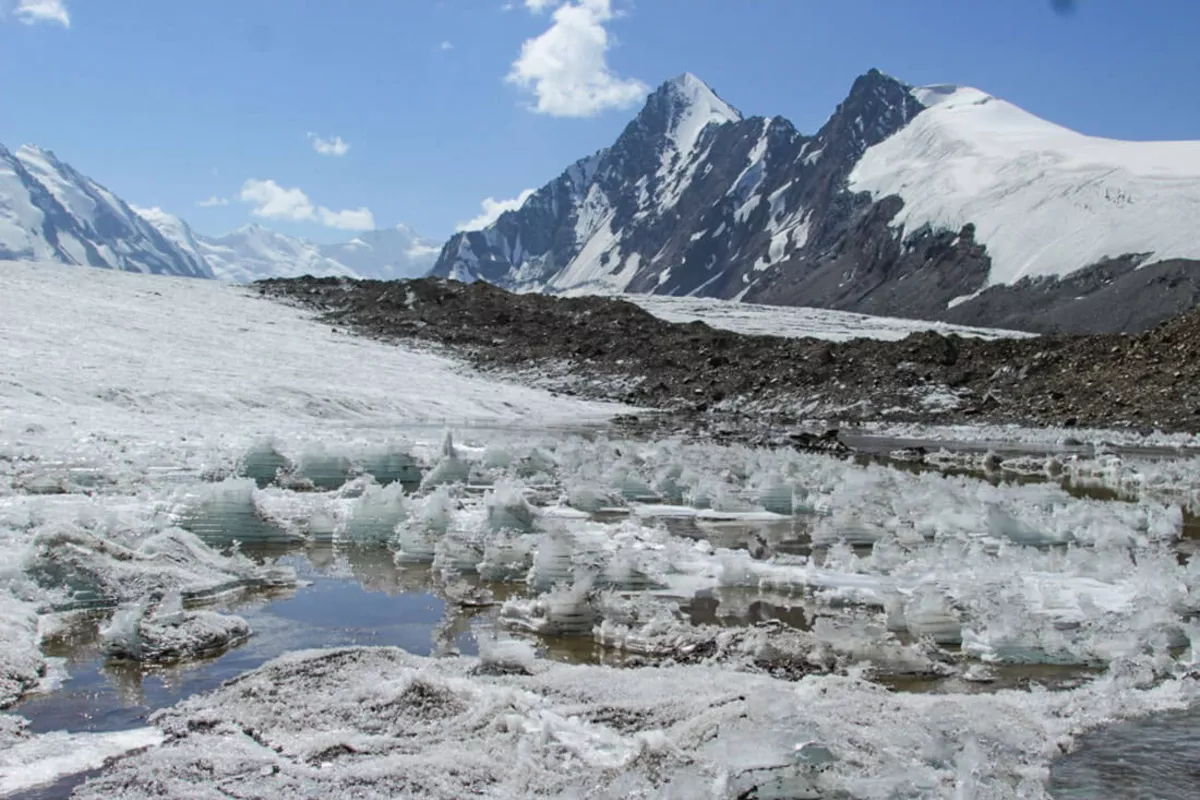
The forum focused on the growing impact of glacial melt in mountain regions, including the Pamirs, Tien Shan, Hindu Kush, and Himalayas, where shrinking ice reserves are increasingly disrupting water supplies for agriculture, energy, and drinking water. A key highlight was the ADB’s Glacier to Farms (G2F) program, presented by senior climate adaptation specialist Chris Dickinson. The initiative, spanning nine countries including Tajikistan, Uzbekistan, Armenia, and Georgia, aims to link glacier monitoring with practical, climate-resilient policy measures.
Unlike past approaches that primarily diagnosed the problem, G2F offers technical and financial solutions designed to support communities in adapting to climate change. The $3.5 billion initiative, backed in part by $250 million from the Green Climate Fund, leverages a co-financing model that aims to attract $10 in additional investment for every dollar committed.
The program envisions a full climate adaptation chain from satellite-based glacier monitoring and mountain observation stations to downstream interventions such as crop insurance, farmer support, and modernization of water infrastructure. “Glaciers are the origin of the entire food and water system,” Dickinson said. “Their rapid retreat threatens lives and livelihoods far beyond mountain regions.”
Tajikistan serves as a pilot site for the program due to its heavy reliance on hydropower and its largely mountainous terrain. One of the project’s key goals is to enhance the country’s hydrometeorological services and strengthen monitoring of snow cover, glacier movement, landslides, and related hazards. A modern early warning system is being developed for the Panj River basin, combining data on glacial lakes, mudflows, precipitation, and seismic activity. The alerts will be sent to vulnerable communities via mobile networks, complemented by local training programs to ensure proper responses.
Forum participants noted that the effects of glacial retreat are already evident. Glaciers in the Tien Shan and Pamir ranges feed the Amu Darya and Syr Darya rivers, vital water sources for Central Asia’s agriculture, energy, and drinking needs. An estimated 74% of the Amu Darya’s flow comes from snow and glacier melt. In the Indus basin, the figure is about 40%. Yet only a small number of the region’s more than 54,000 glaciers are regularly monitored, leaving gaps in early warning systems and long-term planning.
Experts from ICIMOD and ADB described glacier melt as a “cascading crisis.” Rising temperatures are fueling more frequent landslides, floods, and mudflows, while droughts reduce crop yields and damage pastures. Glacial lake outburst floods, sudden and destructive releases of water, pose grave risks to nearby settlements. Since the 19th century, the region has recorded around 500 such incidents, and their frequency could triple by the end of this century. Heatwaves and water quality issues further compound the risks.
Recent glacial activity in Tajikistan underscored the forum’s urgency. In October, a massive segment of a glacier broke off Mount Ismoil Somoni in the Tajikabad district, near the village of Safedobi. The ice mass measured approximately two kilometers in length, up to 25 meters in height, and between 150 and 200 meters wide. It slid into a gorge, but emergency services quickly stabilized the situation, with no casualties reported.
In a separate incident, a large portion of the Didal Glacier in the same district detached and slid more than five kilometers downslope. Experts from Tajikistan’s Center for Glaciology reported that the ice continued to shift for several days and remained unstable. Field teams measuring the glacier in the Surkhob River basin found it to be 1.5 kilometers long, 200 meters wide, and up to 50 meters high.
Research shared by ICIMOD and Norway’s Water Resources and Energy Directorate revealed that Central Asia accounts for roughly 8.5% of global glacier mass loss, one of the highest regional shares worldwide. Miriam Jackson, an ICIMOD representative, warned that if global temperatures rise by 1.9°C, the region could lose up to 50% of its glaciers, significantly worsening pressure on already strained water supplies.