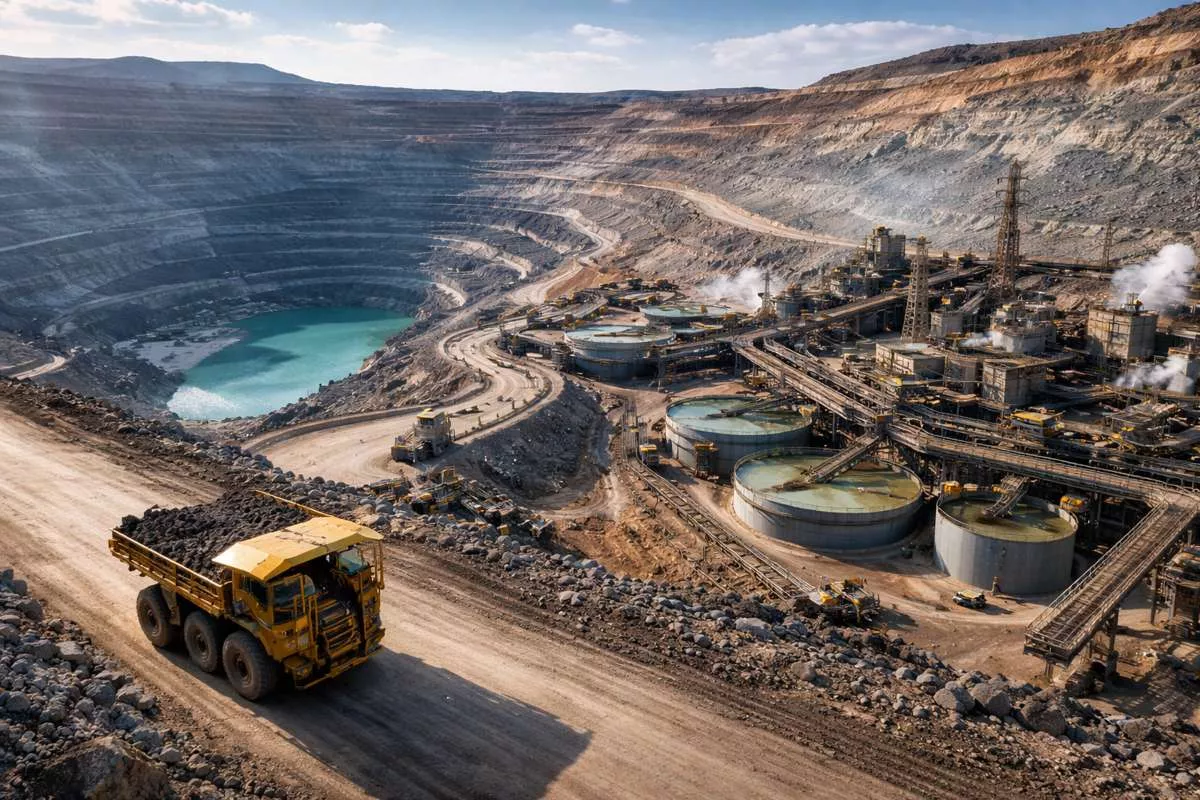
Critical minerals have moved to the center of global attention as export restrictions and highly concentrated supply chains threaten trillions of dollars in industrial production, according to a new report.
The International Energy Agency's (IEA) Global Critical Minerals Outlook, released on Thursday, states that if China's export controls are fully implemented, an estimated $6.5 trillion in annual production outside China could be put at risk.
A complete disruption of battery-grade graphite trade could threaten more than $300 billion in annual production, particularly in electric vehicles, energy storage and battery manufacturing.
Lithium, cobalt, graphite and rare earths are essential for electric vehicles, batteries, renewable energy systems and power grids, while gallium, germanium and tungsten are critical for semiconductors, aerospace, artificial intelligence and defense technologies.
From concentration to disruption
China dominates the processing of most minerals needed for energy and high-tech applications, while Indonesia leads nickel refining.
Excluding rare earths, the average share held by China rose to 72% in 2025 from 70% in 2023.
China and Indonesia accounted for more than three-quarters of the growth in refined supplies of key energy minerals over the past two years.
This concentration has become an immediate economic security challenge as governments increasingly restrict exports.
The number of mineral tariff categories covered by China's export controls has tripled since 2023.
China imposed controls on seven heavy rare earth elements in April 2025, forcing some automakers to reduce production or temporarily halt operations.
Beijing later proposed restrictions on foreign-made products containing Chinese rare earths or produced with Chinese technology.
Although the measures were suspended until November 2026, the IEA said the vulnerabilities remain.
China also announced controls on graphite anode materials, battery cathodes, production technologies and manufacturing equipment.
Other producers have introduced restrictions, including cobalt quotas in the Democratic Republic of the Congo and measures covering lithium in Zimbabwe and graphite in Mozambique.
Prices rise as investment falls
Critical mineral prices recovered during 2025 and early 2026, according to the report.
Prices for aluminum, copper and tin increased by around one-third between January 2025 and April 2026, while lithium prices more than doubled and cobalt prices rose about 130%.
Tungsten prices increased sixfold. Gallium and heavy rare earth prices in Europe climbed to around five times the Chinese domestic level, while germanium prices were almost three times higher.
Despite stronger prices and long-term demand, critical mineral investment fell by 9% in 2025, ending several years of growth.
Capital spending on battery metals declined by more than 20%, while lithium companies cut investment by around 40%. Exploration spending fell more than 10%.
Copper investment increased by 8%, reflecting expectations of strong demand from power grids, electrification and digital infrastructure.
The IEA projects copper supply will remain below demand through 2035, with the expected deficit equivalent to around 25% of demand.
Governments increased public finance commitments for critical mineral projects in advanced economies to about $65 billion in 2025, more than four times the 2023 level, but actual disbursements continue to lag.
Diversification requires more than mines
The IEA said diversification efforts remain focused on mining, while refining and manufacturing capacity lags behind.
Announced rare earth refining capacity outside dominant suppliers could process about two-thirds of expected mined supply by 2035, but planned magnet production would cover only one-third.
Planned battery cathode capacity is similarly equivalent to only around one-third of projected lithium mining capacity.
New projects outside dominant countries face capital costs between 20% and more than 150% higher, while operating costs are about 50% higher on average.
They also face shortages of technology, equipment, infrastructure and skilled workers, alongside lengthy permitting procedures.
The IEA ranks gallium, magnet rare earths, yttrium, graphite, tungsten, tellurium, cobalt and germanium among the minerals most vulnerable to disruption.
Diversifying rare earth magnet supply chains would require around $60 billion over the next decade, a modest amount compared with the potential economic losses.
Strategic stockpiles of 11 high-risk materials would cost countries outside dominant suppliers less than $900 million annually, according to the agency.
The IEA argues that higher sourcing costs should be treated as a "mineral security premium" against supply disruptions.
Critical minerals account for around 3% of the price of an average electric vehicle, while rare earths represent less than 1% of a vehicle's value.
Tripling rare earth prices would therefore increase a car's cost by only about 0.1%, suggesting diversified sourcing could strengthen resilience with limited effects on consumers.
Find the original article here