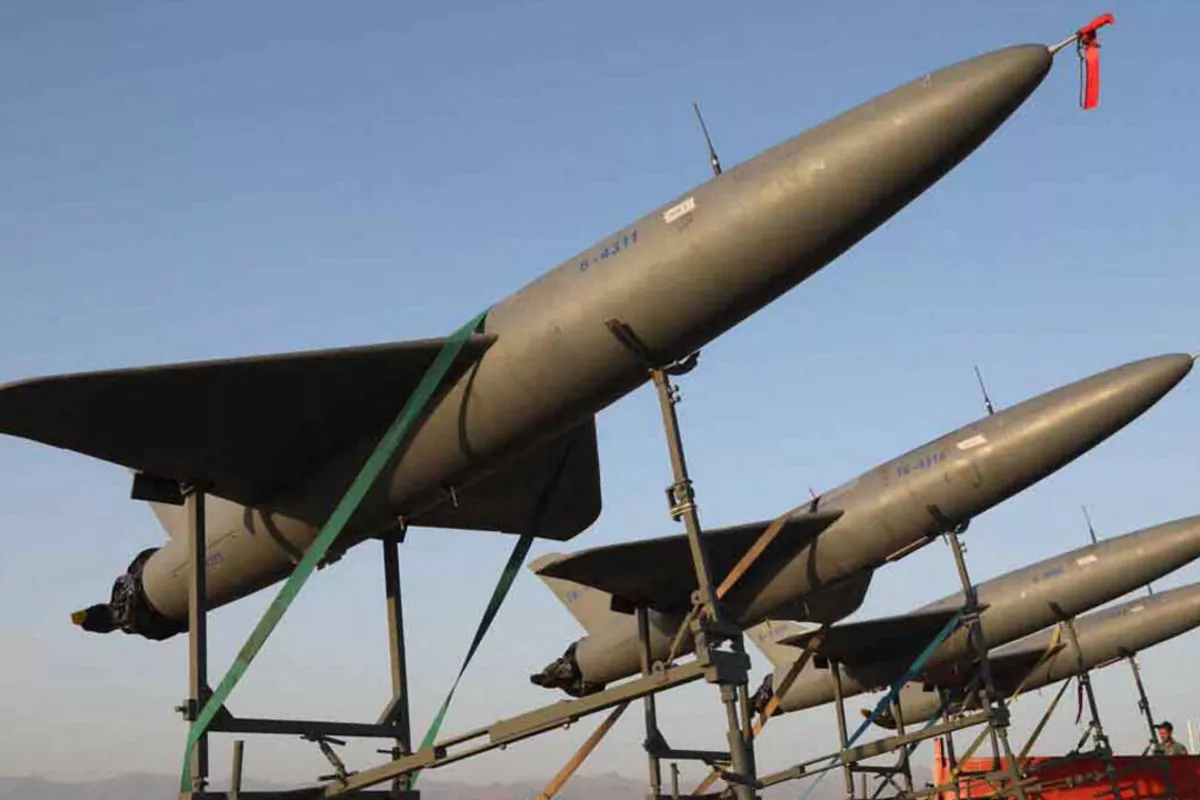
On the last day of February, the United States and Israel launched nearly 1,000 joint strikes on Iran to decapitate its regime. Even after US-Israeli military action blunted Tehran’s retaliatory capacity, Iran launched sweeping drone salvos across almost every country in the Persian Gulf.
Iranian drones targeted not only US embassies and military facilities abroad--from Saudi Arabia and the United Arab Emirates to Kuwait, Lebanon, and Iraq--but also key energy infrastructure, commercial airports, and luxury hotels. Even Azerbaijan and Turkey intercepted drones from Iran. After an Iranian drone struck Akrotiri, the British military air base on Cyprus, several European nations sent naval vessels to defend the island from further strikes.
By March 5, Iranian drone attacks had fallen by 83 percent, but the scale of the campaign is staggering. In total, more than 2,000 low-cost, one-way-attack Shahed-136 drones have entered the Gulf region since the war began. Out of these, nearly half targeted the UAE in the first few days. This number is slightly higher than the 810 Shahed-136-type drones that Russia launched at Ukraine in a single strike during the peak attacks of late 2025. These days, Russian strikes on civil infrastructure in Ukraine average 143 attack drones per day.
Long-range precision used to come at a considerable financial cost. Drone warfare in the Iran and Ukraine wars hail the arrival of precise mass, a strategy of using a high-volume of low-cost drones that is reshaping both battlefields and procurement priorities. The new Low-Cost Uncrewed Combat Attack System (LUCAS) drone that the US military just deployed in combat for the first time confirms this trend. With the LUCAS, modeled after Iran’s Shahed-136, Washington has given Iran a taste of its own medicine.
More important, this event shows that lethal long-range drones are rapidly becoming the newest frontier in an ongoing arms race that carries major consequences for defense budgets and arms trade regulation. However, with the increasing variety of lethal systems called “drones” used in combat, treating all lethal drones as “unmanned aircraft” or “remotely piloted vehicles” creates confusion not only for policymakers and military planners, but also for international regulatory regimes. Countries need to clarify terminology surrounding lethal drones, update end-use and end-user risk assessment procedures to prevent their misuse, and recommit to arms trade transparency before these systems spread faster than the rules meant to govern them.
Is it a drone, is it a missile? In the early 2000s, the United States and Israel helped pioneer what became a quintessential symbol of drone-era military power: remotely operated aircraft without a crew on board but armed with missiles for precision strikes. These exquisite multimillion-dollar platforms, including the MQ-1 Predator and MQ-9 Reaper, first used in Afghanistan in 2001 and 2007, became a key capability in the fight against transnational terrorism.
“Drone” has become an umbrella term for a wild array of weapons systems. Today, lethal drones range from large missile-launching uncrewed aircraft and next-generation collaborative loyal wingmen to loitering munitions and small quadcopters carrying explosives. The low-cost, one-way-attack drones Iran, Russia, and now the United States are using in ongoing conflicts, however, occupy a category of their own.
Although some types of single-mission drones are classified as loitering munitions, not every one-way-attack drone fits the bill. A loitering munition is a hybrid drone-missile system that destroys its target by crashing and detonating on impact. Unlike traditional missiles that strike predetermined targets immediately, loitering munitions can hover over an area of interest until a remote operator designates a target or aborts the strike. Israel began using its delta-wing, “self-sacrificing” IAI Harpy drone to suppress enemy air defenses as early as the 1980s, later followed by the more advanced Harop and the smaller Hero. Similarly, the US military has used man-portable Switchblades for more than a decade. Russia, for its part, fields its own ZALA Lancet.
Russia’s war on Ukraine has turned the embattled country into a drone superpower. Ukrainian warfighters repurposed first-person view racing drone toys into precision weapons almost overnight. Developed as an asymmetric response to ammunition shortages in 2023, these drones operate through a front-facing camera and are now responsible for 60 percent of Russian battlefield losses. Kyiv succeeded in scaling its small, cheap, dual-use variant of loitering munition into a major industry, with more than 160 drone manufacturers that promise to deliver eight million first-person-view drones in 2026. Small but lethal quadcopters have therefore undeniably transformed the battlefield.
Iran, however, has been a pioneer of low-cost, strike-enabled drones since the 1980s. With more than a dozen indigenous models, Iran became the principal supplier of lethal drone technologies to Shiite militias across the Middle East. Tehran’s geopolitical interests drove the development of drones with ever greater ranges. By the late 1990s, its Ababil drones could strike targets at a distance of 200 kilometers. Predecessors to the Shahed series started flying in the mid-2010s, followed by the first confirmed use of the Shahed-131, with a 900-kilometer range, used in the Houthis’ 2019 strike on Saudi oil facilities. Two years later, Israel warned of a new long-range, delta-wing-shaped menace from Iran called the Shahed-136.
This model is essentially a scaled-up version of the Shahed-131, with roughly double the range (2,000 kilometers) and double the payload (40 kilograms). It is, in effect, a one-way-attack drone that carries explosives and detonates on impact in point-to-point suicide missions. Although precise, the Shahed-136 must be pre-programmed because it loses ground communication after flying more than 200 kilometers from its launch point. Because it cannot be remotely operated, the Shahed-136 relies on satellite navigation to reach its pre-determined target. While the characteristics of loitering munitions situate such systems midway between a drone and a missile, these long-range expendable drones are better described as slow-flying, medium-range theater cruise missiles.
At a cost of around $20,000, manufactured from ubiquitous materials, and powered by civilian engines easily obtained on commercial markets, the Shahed-136 has been described by some observers as ingenious. It must be noted, though, that not all Shaheds are one-way-attack drones. For instance, the Shahed-129 is not an attritable-low-cost and somewhat expendable-drone but is a medium-altitude, long-endurance armed uncrewed aircraft modeled after the American MQ-1 Predator, used for both surveillance and strike missions. The Shahed-171 and Shahed-191, designed for stealthy aerial reconnaissance, are largely copies of a Lockheed Martin RQ-170 Sentinel drone that Iran captured in 2011 on its border with Afghanistan. Both are considered multirole specialized platforms produced in low quantity.
From racing drones to drone arms race. Cheap lethal drones are playing an increasingly important role in combat--and word spreads fast, especially among the great power competitors. Where, then, do Russia, China, and the United States stand in the race to acquire long-range, low-cost attack drones?
Russia’s arsenal of long-range, one-way-attack drones consists primarily of various Shahed-type systems. These include the Iranian-designed Shahed-136 and Shahed-131, assembled in Russia, alongside the growing Russian-made Geran family and Gerbera decoy drones. After significant upgrades, the Alabuga drone plant in Tatarstan began producing Russia’s version of the Shahed-136: the one-way-attack Geran-2 drone. Its economical delta-wing-shaped design and slow speed make its Shahed lineage unmistakable. But Russia enhanced the drone with anti-jamming antennas and greater accuracy via video links that allow for better remote navigation and even limited kinetic self-defense. This can increase the cost per unit from $30,000 (the base cost of a Russia-made Shahed-136 drone) to $50,000. They also make the drone far deadlier, increasing its payload to a 90-kilogram warhead. With an operational range of 2,500 kilometers, Gerans can readily reach much of Europe.
Despite sanctions, Russia increased production of its domestic Shahed variant to 3,000 units per month by the end of 2025, obtaining thousands of Western components ostensibly unavailable due to sanctions, through covert transfers concealingthe end-user. Last year, there was not a day when hundreds of Russian long-range Shahed-136-type drones did not attack Ukrainian cities. Russia has also developed and deployed the new Geran-3, which is similar to the Shahed-236, a 2023-version of the Iranian one-way-attack drone upgraded with a fast jet engine. Moscow has also built the larger Geran-5, pushing speeds from 185 kilometers per hour to cruise missile territory of 600 kilometers per hour.
China has also been an attentive student of other countries’ lethal drones. In terms of loitering munitions, China has developed its own ASN-301, modeled on Israel’s Harpy for suppressing the adversary’s air defenses, as well as clonedAmerican Switchblade loitering munitions. In December of last year, China tested its new long-range, one-way-attack drone, the LOONG M9, developed by drone provider LoongUAV. With its delta-wing shape, reported 50-kilogram payload, and a strike range of 1,600 kilometers, the model appears to draw heavily from Iran’s Shahed-136. However, the LOONG M9 is only the latest addition to China’s growing portfolio of long-range, delta-wing, cheap attack drones, which also includes the DFX-100, Feilong-300D, and Sunflower-200. Yet little is known about the operational readiness of these systems, but procurement is likely to be substantial. More important, the dual-use character of China’s technological base, manufacturing products for both commercial and military uses, combined with its civil-military fusion model, allows hobbyist and industrial drones to effortlessly be converted into military-relevant assets.
China’s current drone dominance, however, lies elsewhere. Beijing effectively controls the global drone production ecosystem and serves as the principal supplier of dual-use drone technologies to both Russia and Ukraine. Although Ukraine has built up its domestic drone industry, in practice most of its assembly components still come from China. Indeed, Ukraine’s import of drones and drone-related components from China more than tripled year over year in 2024, and then rose by another 30 percent in 2025. With the attrition rate in the thousands per month, only China has the manufacturing capacity to sustain that level of demand for engines, batteries, optical systems, and microchips.
During the current Iran campaign, the United States has deployed its own Shahed-inspired system. The Pentagon set the scene for unveiling the new LUCAS drone last summer. Through its Unleashing American Drone Dominanceinitiative, US leadership unequivocally prioritized accelerating indigenous production of low-cost drones. Specifically, the Pentagon plans to acquire 300,000 low-cost, one-way, made-in-America drones for combat units by 2027. Concurrently, the first dedicated one-way-attack drone squadron, Task Force Scorpion Strike, was established in the Middle East in December 2025.
The US military was able to field this new drone capability rapidly because it had already been using such a model for training against Iranian drone threats. LUCAS is a spin off from a FLM 136 drone developed by Phoenix-based company SpektreWorks. Though modeled on the Shahed-136, the new delta-wing drones are smaller in terms of both payload (110 pounds versus 40 pounds) and range (1,600 miles versus 800 miles). Just like the Shahed-136, the LUCAS system requires only catapults or mobile vehicle systems to be launched from the ground or a ship. Unlike the pre-programmed Iranian Shahed-136, LUCAS drones can have their missions adjusted in flight thanks to satellite connectivity with its operators who can coordinate strikes in real time. It remains unclear whether LUCAS integrates Starlink terminals or the more secure military-focused Starshield system, also developed by SpaceX.
First-person-view drones are cheap, but their ranges and payload capacity are limited. Cruise missiles, by contrast, are fast and destructive. They are also expensive, and replenishing stockpiles takes time. Low-cost, long-range attack drones present a compromise for $20,000 (Shahed-136, LOONG M9), $35,000 (LUCAS), or $50,000 (Geran-3) apiece. This stands in stark contrast to the $2 to $4 million price tag for a single cruise missile. But it would be a mistake to conclude that the comparative advantage of these lethal drones is measured only in dollar terms. Shahed-136-style attack drones embody a new approach to generating precision through scale: cheap, fast, and many. The Pentagon is already redefining small drones as “consumable commodities” to expedite their mass acquisition by the military. What, then, could possibly go wrong?
Time for an intermission. The emphasis on offensive drone operations carries a price tag of its own. After more than four years of war in Ukraine, Shahed drones are still being shot at with expensive air-to-air and even anti-ballistic Patriot missiles. By the end of 2022, Ukraine had already learned that this was not a good idea. The Gulf States and the United States are learning the very same lesson today. As most Gulf countries have discovered, shooting down an Iranian drone with fighter aircraft can cost about $300,000 per missile. Stopping the drone before it gets airborne also requires expensive missiles to destroy drone production sites, storage facilities, and drone carriers.
What militaries save on attack drones can quickly reappear in their defense expenses, turning cheap offensive mass into a costly defensive burden. In theory, defending against these cheap drones should not be too complicated. They are low and slow flying and thus even simple anti-aircraft guns will do the job. The problem is that their slim profile and ability to fly at a low altitude also make them difficult to detect on radar. Late detection allows Shahed-136s to approach dangerously close to their targets, sharply narrowing the window for interception. GPS jamming and directed-energy systems can help, but on their own they are insufficient and may be constrained by limited area coverage. Without local ground-based air defense units, fast but expensive missiles remain the only other option.
European countries have faced similar threats. Last autumn, more than two dozen Russian Geran-2 and Gerbera decoy drones violated Polish and Romanian airspace. As Polish F-16s, Dutch F-35s, and Romanian F-16s intercepted Russian drones, German Patriot missiles went on high alert, and Warsaw invoked Article 4 of the Washington Treaty, triggering consultations within the NATO alliance. This growing Russian drone interference has also prompted the European Union to invest in a new drone action plan. Meanwhile, the Baltic states are building drone walls, a network of multi-layered defense systems to counter drone threats along their borders with Russia.
Kyiv is far ahead in innovating low-cost drone defenses in terms of both detection and interception. First, Ukraine turned the psychological terror of the Shahed’s signature lawnmower hum against the drone itself. Sky Fortress, a network of 14,000 acoustic sensors spread across Ukraine and along the border with Russia, relays data on incoming drones to mobile firing teams with anti-aircraft guns. Now in its third generation since 2022, this acoustic low-altitude detection system costs less than two Patriot missiles.
Second, Ukraine has been developing purpose-built drones to intercept incoming Shahed-style attacks at a far lower cost than missiles. According to open-source data, most interceptor models, such as SkyFall, Sting, Bagnet, Octopus, and Odin, are small but high-performing, combining a quadcopter-bullet design with large wings. Although their range and endurance are limited, they can reach speeds of more than 300 kilometer per hour. With 3D-printed plastic components and a tiny warhead, these drones cost less than a fraction of a single Shahed-136.
The conflict in Iran shows that a shopping spree for cheap attack drones risks obscuring a more difficult question: whether a state can sustain the defenses needed to counter them over time. This is an opportune time to look at the other side of the drone coin. Investing in appropriate anti-drone defenses, including drone interceptors, can save billions of dollars on missile interceptors that were developed to counter a very different class of security threats.
Ideally, this is the moment for Ukraine to shine. Every Patriot missile fired at Iranian drones is one less available to the Ukrainian defenders faced with incoming Russian ballistic missiles. Ukraine, unfortunately, has more experience with Iranian Shahed-136 drones than any Middle Eastern country. Kyiv has already been approached by the United States and Qatar about its anti-drone defense know-how. Despite intense wartime demands at home, Ukrainian manufacturers are confident that they can still find the production capacity to export thousands of interceptor drones.
Precise mass, imprecise conventional arms standards. The global arms trade regime is not ready for this new drone arms race. It was barely ready for the previous one. Terminology matters here. Whether a drone is classified as a munition, a missile, or an aircraft has significant consequences for arms trade and export control regulations. Importantly, existing standards already fall far short of their transparency targets, since most exporters and importers of lethal drones are not bound by any meaningful international monitoring regime.
In the meantime, the military campaign in Iran is already consuming munitions at a speed that even the United States cannot afford. Russia is passing on its Shahed drone know-how to North Korea with a thank you note for their weapons and troops that are fighting the Ukrainians. Several European countries plan to host Ukraine’s drone manufacturing sitesand export hubs in 2026. Drone exports have also been booming across Africa. Alongside the already widespread use of weaponized commercial drones by violent non-state actors, national governments are building their own drone fleets, contributing to an expanding pattern of drone strikes destabilizingmuch of central and sub-Saharan Africa.
The trajectory of drone innovation coming from Iran and Russia shows that low-cost attack drones can be built from commercially available components that circulate with few effective export restrictions. Where export controls do exist, their supply chains circumvent dual-use control lists and sanctions. In 2024, up to 80 percent of sanctioned Western components reaching Russia reportedly came through China.
Lethal drones require better regulation that reflects their use in combat. A decade on, the American-initiated 2016 Joint Declaration on the export and use of armed drones needs both a revival and a substantial update. At a minimum, any new initiative should clarify best practices for interpreting existing rules in light of the growing variety of lethal drones, strengthen end-use and end-user risk assessment procedures, and apply export control and monitoring instruments accordingly. Drone innovation may save money; drone regulation can save lives.
See the original article here