The principle of an empire is continuous expansion and the widening of its sphere of influence. If, for any reason, this process is interrupted, decline and eventual collapse tend to follow. This pattern has been observed throughout human history and remains relevant today.
The older generation still remembers the rise and fall of the British Empire, on which “the sun never set.” Today, what remains of it is a small island, along with several largely autonomous dominions and scattered territories in different parts of the world. A similar trajectory befell the Soviet Union.
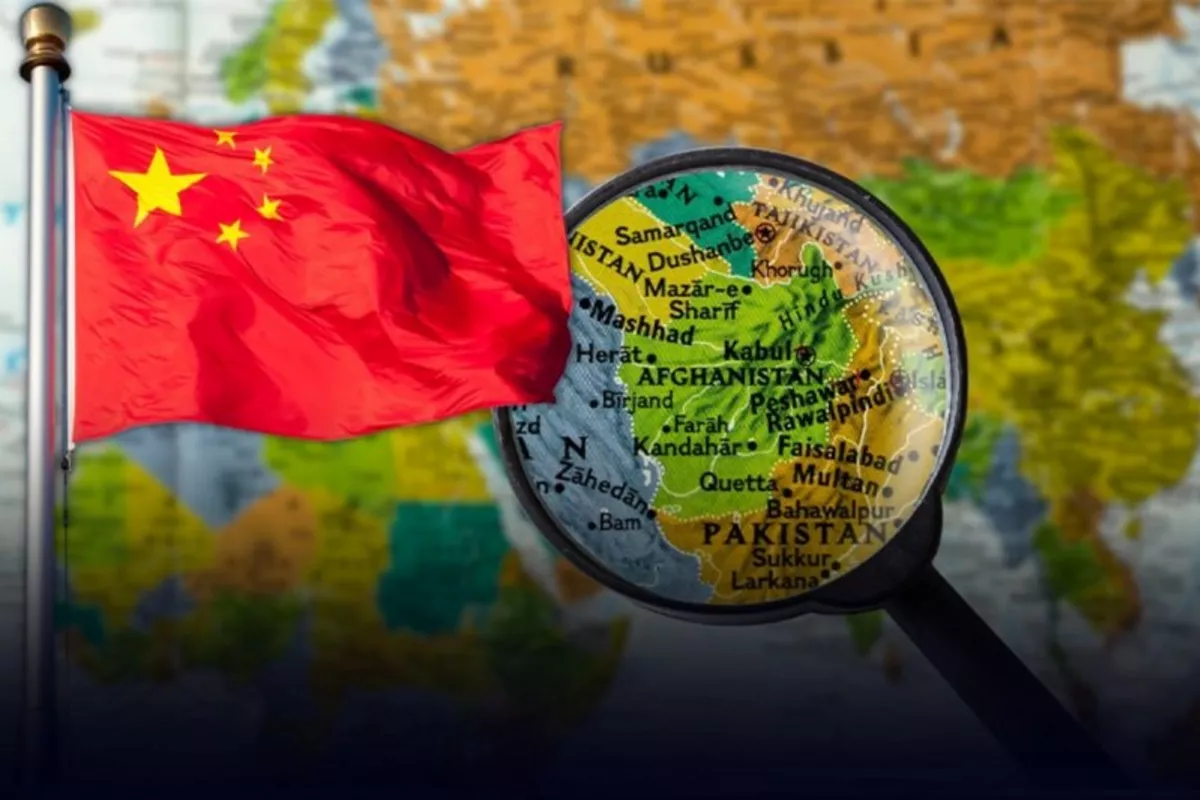
However, what is characteristic of the current global situation is that while modern Russia is engaged in managing its relations with the European Union and the United States, China is steadily advancing northward, gradually displacing former spheres of influence in Central Asia. Having established itself as the “world’s factory,” Beijing is in urgent need of cheap raw materials and labor. These resources are increasingly supplied by the Central Asian republics, which, due to historical circumstances, are in strong need of investment.
Yet financial resources are never provided without conditions. Every yuan invested further draws the weaker economies of the former Soviet republics into the orbit of a powerful neighboring state, which in some cases shares a direct border with these newly independent countries. In this context, China’s engagement with Uzbekistan is of particular significance.
Uzbekistan was one of the most developed republics of the former Soviet Union. Even today, it stands out among neighboring states, with a gross domestic product approaching $150 billion. However, in comparison with China’s $20 trillion economy, this figure is modest. Under such circumstances, Uzbekistan risks being assigned the role of an agricultural and raw-material supplier, providing inexpensive agricultural goods and mineral resources.
At the same time, China is competing for influence in the region with Russia, whose position is gradually weakening. Historically, China has concentrated its economic interests in Central Asia primarily on the two most developed countries - Kazakhstan and Uzbekistan. According to Beijing, these states deserve special attention due to their market capacity and relatively higher purchasing power.
Uzbekistan also possesses significant export potential for goods in high demand by the Chinese economy, including uranium, gold, and cotton, and to some extent natural gas. In addition, due to its relatively more developed infrastructure, Uzbekistan represents a reliable market for Chinese-manufactured goods.
It should also be emphasized that the Uzbek economy has been developing at a steady pace. According to Uzbekistan’s State Statistics Committee, GDP growth was 5.7% in 2022 and 5% in 2023. In 2022, Uzbekistan’s GDP was estimated at $80.4 billion, while by 2025 this figure had reached $150 billion. The country’s growing attractiveness for trade and investment is also reflected in the ease of doing business index, where Uzbekistan ranked 69th in 2019, compared to 76th in 2018.
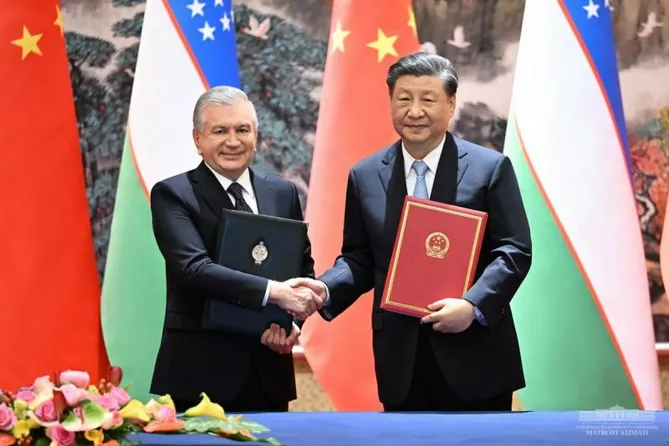
Credit: Press Service of the President of Uzbekistan
On January 25, 2021, during the China-Central Asia Summit, the leaders of Uzbekistan and China signed an agreement on strategic partnership and the development of cooperation both bilaterally and within the framework of the Belt and Road Initiative and the Shanghai Cooperation Organization. These relations were further strengthened by agreements between Uzbekistan and China on trade, investment, and financial and technical cooperation totaling $15 billion at the SCO Summit held in Samarkand on September 15, 2022.
As Chinese leader Xi Jinping noted, both countries need to “expand energy cooperation and jointly ensure the safe operation of the China-Central Asia gas pipeline.” China has remained one of Uzbekistan’s most important trading partners for several years. In 2021, China’s share of Uzbekistan’s foreign trade turnover amounted to 17.7%. In 2022, mutual trade reached $7.5 billion, and by 2025 it rose to $10 billion.
It is also important to note that a significant portion of Uzbekistan’s exports to China consists of strategically important goods, primarily uranium and gold, especially given recent price increases for these metals, as well as cotton and natural gas. In contrast, the bulk of Chinese exports to Uzbekistan consists of machinery, equipment, industrial raw materials, and finished consumer goods.
From 2000 to 2022, annual trade turnover between Uzbekistan and China increased 78.5 times, rising from $95.5 million to $7.5 billion. During this period, Uzbekistan’s exports to China totaled $28.3 billion, while imports from China reached $44.7 billion. As a result, the overall trade imbalance in favor of China amounted to nearly $16.4 billion. These figures indicate that Uzbek-Chinese trade is significantly more advantageous for China than for Uzbekistan.
In this regard, it should be emphasized that Chinese government loans and credits are primarily directed toward financing infrastructure development projects, including roads, tunnels, thermal power plants, electricity transmission lines, and other facilities. These loans are typically provided under conditions that include compliance with Chinese requirements, such as the mandatory participation of Chinese contractors, as well as the supply of materials, equipment, and labor from China.
In other words, China is following a well-established model previously applied in countries such as Tajikistan and Kyrgyzstan. In many cases, this approach is driven by the borrowing country’s lack of sufficient resources to implement large-scale infrastructure projects independently, as well as its reluctance to assume associated financial and technical risks.
Chinese private direct investment is primarily directed toward the extraction of natural resources and the establishment of new production facilities, and less frequently toward modernization of existing industries.
From 2000 to 2021, inflows of direct investment from China to Uzbekistan increased from $22.5 million to $2.5 billion, representing a 113-fold rise. Overall Chinese investment in the Uzbek economy in the form of foreign direct investment during this period amounted to $26 billion.
The greatest interest among Chinese private investors lies in the oil and gas, chemical, textile, electric power, and coal industries, as well as logistics, agriculture, and water management. Over the past three years, China’s largest investments in Uzbekistan have included the construction of cement plants by Anhui Conch Cement in the Akhangaran district of the Tashkent region ($200 million), Huaxin Cement in the Jizzakh region ($150 million), and Hengyuan Cement in Kattakurgan, Samarkand region (up to $420 million). Chinese investors are also strongly attracted to special economic zones, industrial parks, as well as construction and property management sectors.
More than 1,900 Chinese enterprises currently operate in Uzbekistan. Unlike some other Central Asian countries, public sentiment in Uzbekistan is generally not hostile toward Chinese investors, who are seen as contributors to job creation. At the same time, in recent years, official authorities have increasingly called for a reduction in the use of Chinese labor in Uzbekistan in favor of local workers.
As of January 1, 2022, the total number of enterprises with foreign participation in Uzbekistan reached 13,700. Chinese companies rank among the top five foreign investors in the country, second only to Russian-owned companies. Chinese investors are openly intent on securing a leading position in the competition for the Uzbek market across a wide range of sectors.
China is fully aware of the strategic importance of controlling deposits of rare earth metals for the electronics and automotive industries, hydrocarbons for the petrochemical sector, and agricultural commodities. For this reason, Chinese capital continues to strengthen its position in the post-Soviet republics of Central Asia, gradually pushing aside competing external powers.