From Oil to Innovation: What Aliyev’s UAE Visit Really Signaled
Azerbaijani President Ilham Aliyev paid an official visit to Abu Dhabi on December 17, 2025, at the invitation of United Arab Emirates President Sheikh Mohamed bin Zayed Al Nahyan. Beyond routine diplomatic engagements, the visit carried symbolic significance, reflecting a shift in the long-term economic outlooks of two countries whose development has traditionally been anchored in fossil fuel revenues.
A central focus of President Ilham Aliyev’s working visit was the Games of the Future 2025, an international event hosted by the United Arab Emirates. Aliyev attended the opening ceremony of the games, which represent an innovative global competition format combining physical sports disciplines with digital gaming. Often described as “phygital,” the concept brings together real-world athletic performance and virtual competition, assessing physical abilities, digital skills, and technological infrastructure simultaneously. As such, the Games of the Future stand not merely as a sporting or esports event, but as a tangible model of how sport, technology, and digital culture are converging to reshape competition and spectatorship.
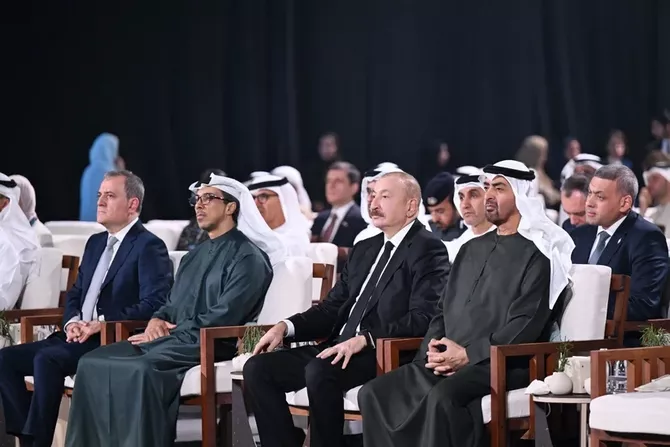
Photo: AZERTAC
As is widely recognized, Azerbaijan’s economy has long been heavily reliant on oil and natural gas revenues. In recent years, however, Baku has pursued policies aimed at reducing this dependence and accelerating economic diversification. President Aliyev’s engagement with a technology-driven global initiative can be viewed as a symbolic expression of Azerbaijan’s ambition to move beyond a fossil fuel-dependent model and toward sustainable development based on digitalization, innovation, and high value added industries. Domestically, the country has also expanded support for technological initiatives, particularly in the defense sector, while providing various forms of state assistance to encourage the growth of a startup ecosystem.
The United Arab Emirates’ decision to host a technology-centered event such as the Games of the Future 2025 similarly underscores a core element of its economic transformation strategy. While the UAE continues to benefit substantially from fossil fuel income, it has made significant investments in artificial intelligence, digital infrastructure, space technologies, renewable energy, and creative industries. By hosting global platforms of this nature, Abu Dhabi signals its recognition of the long-term limitations of a fossil fuel-based economic model and its determination to adapt to emerging global economic paradigms.
Looking ahead, Azerbaijan’s efforts to reshape its economy around technology and innovation, in line with structural changes in the global economy, are critical to its long-term competitiveness. In the coming years, sectors such as digital technologies, the broader digital economy, and sustainable agriculture, particularly organic agriculture, are likely to play a defining role in global economic development.
Against this backdrop, the strategic use of fossil fuel revenues as a transitional instrument to support a technology- and innovation-driven development model emerges as a necessity not only for Azerbaijan but also for other resource-dependent economies. For countries built around fossil fuel extraction, economic transformation is increasingly not a choice, but a matter of long-term survival.