Russian Foreign Minister Sergey Lavrov’s visit to Kazakhstan was not merely another diplomatic contact between Moscow and Astana. Its main political purpose was to prepare for Russian President Vladimir Putin’s state visit to Kazakhstan, which is expected to take place in late May.
Judging by official statements and reports in Kazakh and Russian media, the upcoming meeting between Putin and Kassym-Jomart Tokayev could become one of the central events on the bilateral agenda in 2026.
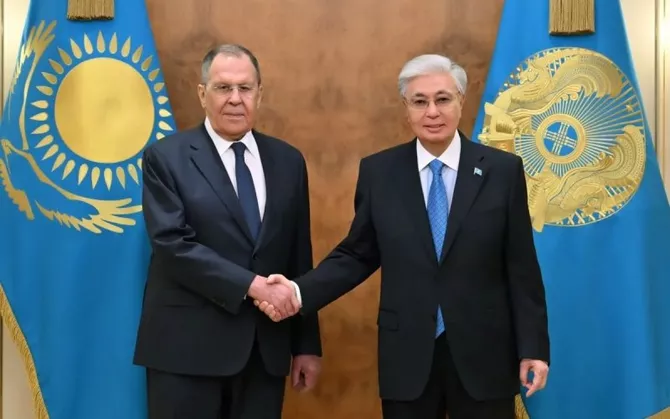
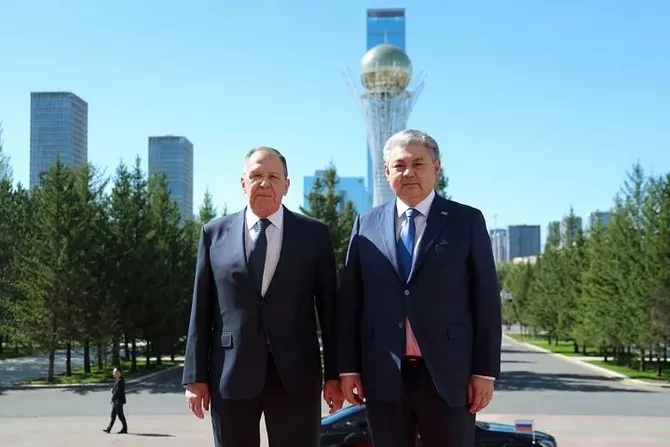
On 30 April, Lavrov was received by Kazakh President Kassym-Jomart Tokayev at Akorda. The Kazakh side emphasised that relations between the two countries are developing “in the spirit of strategic partnership and alliance.” Tokayev separately noted the importance of the practical implementation of agreements reached at the highest level, as well as the further strengthening of trade, economic, investment, cultural and humanitarian cooperation. According to Akorda, special attention was paid to preparations for Vladimir Putin’s state visit, scheduled for late May.
Photo credit: Akorda
Tokayev made it clear that Astana attaches particular importance to the upcoming visit. He described Putin’s planned trip as the “central event of the bilateral agenda this year” and expressed confidence that it would mark an important stage in deepening allied relations between Kazakhstan and Russia. Russian media, including RIA Novosti, also highlighted this message, stressing that Astana views Putin’s visit as a key event of the year in relations between the two countries.
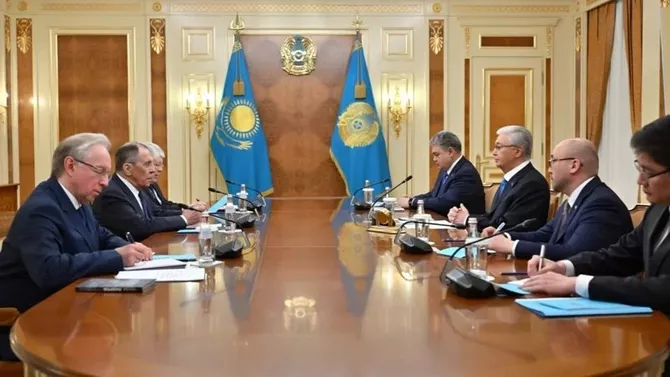
Photo credit: Akorda
Lavrov, for his part, briefed Tokayev on the progress of preparations for the visit and noted that key issues of multifaceted cooperation are already being worked through at the level of the two governments and foreign ministries. This suggests that the meeting between Putin and Tokayev is unlikely to be limited to protocol matters. By the time the two leaders meet, the sides are expected to have prepared a concrete package of issues - from the economy and investment to transport, energy, education and the international agenda.
Before meeting Tokayev, Sergey Lavrov held talks with Kazakhstan’s Foreign Minister Yermek Kosherbayev. According to Kazakh media, the sides discussed a wide range of issues related to Kazakh-Russian cooperation, the schedule of upcoming high-level contacts, and reaffirmed their commitment to further strengthening interaction. Following the talks, the two foreign ministers signed an Action Plan for cooperation between the foreign ministries of Kazakhstan and Russia for 2027-2028.
Photo credit: mid.ru
Kazakh media presented Lavrov’s visit primarily through the prism of preparations for Putin’s visit and the practical bilateral agenda. Zakon.kz gave detailed attention to the economy, investment, industrial cooperation, transport corridors, water and environmental issues, education and humanitarian ties. Kursiv.kz also noted that the main topic of the meeting between Tokayev and Lavrov was preparation for Putin’s state visit to Kazakhstan.
The economy, judging by the statements made by both sides, will be one of the key topics of the upcoming talks between Putin and Tokayev. Russia remains one of Kazakhstan’s largest trade and economic partners.
According to figures mentioned during the visit, trade turnover between the two countries exceeded $27 billion in 2025. At the same time, both sides see potential for further growth in trade and expanded industrial cooperation.
The investment agenda also appears to be one of the main areas of focus. Over the past 20 years, the volume of Russian direct investment in Kazakhstan’s economy has reached $29.3 billion, while Kazakh investment in Russia has amounted to $9 billion. Russian companies are involved in major projects in industry, energy, transport and other sectors. It is therefore expected that during Putin’s visit the sides will discuss not only current indicators but also new investment projects, especially in strategic sectors.
A separate block of future negotiations is likely to be linked to energy. Russian media have already focused attention on the construction of Kazakhstan’s first nuclear power plant based on a Russian project. RTVI noted that Lavrov described the nuclear power plant as one of the flagship joint projects for the coming years, while the consortium for its construction is expected to be led by Rosatom. Channel One also highlighted energy and the nuclear power plant as an important part of the bilateral agenda.
For Kazakhstan, this issue has strategic significance: the construction of a nuclear power plant is expected to address part of the country’s long-term energy needs. For Russia, it is an opportunity to consolidate its technological and industrial presence in one of Central Asia’s key states. Energy, including the nuclear sector, may therefore become one of the central areas of discussion between Putin and Tokayev.
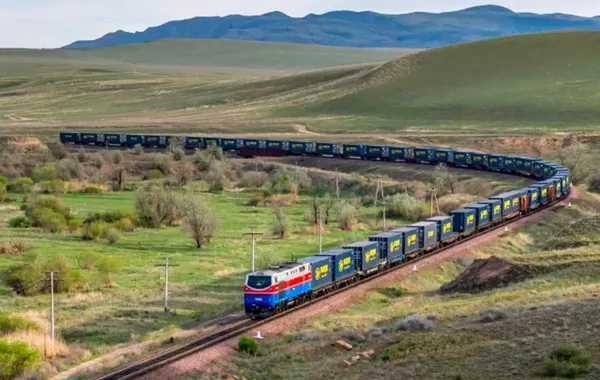
The transport and logistics agenda is no less important. Kazakh sources reported that Kosherbayev and Lavrov discussed the development of the North-South international transport corridor, the Western Europe-Western China highway, and increasing the capacity of border infrastructure. This shows that Astana and Moscow seek to view bilateral relations not only through the lens of trade, but also as part of broader Eurasian logistics.
Transport corridors may become one of the most sensitive and at the same time most promising issues during the leaders’ talks. Kazakhstan is interested in strengthening its role as a transit hub between China, Russia, Central Asia, the Caucasus and Europe. Russia, in turn, is interested in stable routes that allow it to preserve economic ties and develop alternative logistics channels amid a changed international environment.
Another important issue is industrial cooperation and new technologies. The Astana Times reported that the sides identified digital solutions, artificial intelligence and high technologies among the promising areas of cooperation. This is an important nuance: the Kazakh-Russian agenda is no longer limited to traditional topics such as trade, energy and transport.
Astana seeks to advance technological modernisation, and Moscow, judging by the statements made, also wants to be part of these processes.
In the humanitarian sphere, the sides are focusing on education, cultural exchanges and personnel training. Zakon.kz reported that the talks touched on projects to establish Kazakh-Russian schools, the development of joint educational initiatives, branches of Russian universities in Kazakhstan, and the education of around 60,000 Kazakh students in Russia. These issues will almost certainly be included in the agenda of Putin’s visit, since the humanitarian dimension is traditionally viewed by Moscow as an important element of long-term influence and partnership.
Russian media, for their part, placed a noticeable emphasis on shared historical memory and preparations for Victory Day. Channel One quoted Lavrov as saying that the memory of victory in the Great Patriotic War remains one of the most important dimensions of relations between Moscow and Astana. Kosherbayev also underlined the special importance of this topic for Kazakh-Russian relations.
The international agenda will also be an important part of Putin and Tokayev’s negotiations. According to official sources, Lavrov and Kazakh representatives exchanged views on current regional and international issues. Russian media specified that the Ukrainian conflict and the Middle East were among the issues discussed, while presenting the positions of Russia and Kazakhstan as oriented towards diplomatic settlement.
For Kazakhstan, maintaining balance here is extremely important. Astana is developing allied relations with Russia, but at the same time it adheres to a multi-vector foreign policy, actively engaging with China, EU countries, Türkiye, Arab states and Israel. Therefore, during Putin’s visit, Tokayev is likely to seek to demonstrate the high level of relations with Moscow without abandoning Kazakhstan’s independent foreign policy line.
The context of Lavrov’s visit is especially important because it followed other significant contacts between Kazakhstan and Russia. Zakon.kz recalled that on 26 March 2026, Tokayev received Russian Prime Minister Mikhail Mishustin, and preparation for Putin’s state visit was also one of the main issues discussed at that time. This indicates that the upcoming visit is being prepared not hastily, but in a systematic format - through the government, the foreign ministries and the presidential administrations.
Thus, Lavrov’s visit to Astana became a kind of diplomatic fine-tuning ahead of the Putin-Tokayev talks. Outwardly, it looked like a regular contact between the heads of the two countries’ foreign ministries, but in substance it was much broader. The sides were aligning the agenda, clarifying positions, preparing documents and defining the topics that will be brought to the level of the presidents.
Judging by statements and reports in Kazakh and Russian media, the main topics during Putin’s visit to Kazakhstan may include the deepening of allied relations, growth in trade, investment projects, nuclear energy, transport corridors, industrial cooperation, digital technologies, education, cultural and humanitarian ties, and coordination on the international agenda. For Moscow, this is a chance to reaffirm the special nature of its relations with one of its key partners in Central Asia. For Astana, it is an opportunity to consolidate its strategic partnership with Russia while preserving its own multi-vector diplomatic line.
That is why Putin’s upcoming visit to Kazakhstan will matter not only for bilateral relations. It will show how Moscow and Astana see the future format of their cooperation in a new regional and international reality - one that is more complex, more pragmatic, and requires both sides to constantly seek a balance between alliance, economic interests and foreign policy autonomy.