Turkish President Recep Tayyip Erdoğan and his Justice and Development Party (AKP) rose to power amid the economic crisis of 2001-2002. Suffice it to say that, in 2000, the country's economy contracted by more than 26%. As a result, a huge foreign trade deficit emerged: the country imported almost twice as much as it exported, while its external debt reached $23 billion. The tax burden on the economy was so heavy that businesses had to hand over nearly half their income to the state.
To save the country, Erdoğan focused on developing industry and tourism. In addition, Türkiye implemented monetary reform, which helped reduce inflation. Numerous free economic zones (FEZs) were established across the country, offering special tax incentives to export-oriented companies. Businesses also gained access to preferential loans. Economic reforms continued after Erdogan won the country's first direct presidential election in 2014.
By the end of 2022, Türkiye's GDP had grown by 5.6% year-on-year, reaching $10,600 per capita. At current prices, GDP increased by 107% in 2022 compared with 2021. Growth in the financial and insurance sector amounted to 21.8%, while the services sector expanded by 11.7% and information and communication services by 8.7%. Since 2015, Türkiye has overtaken five countries in terms of economic development, becoming the world's 11th-largest economy.
Economic growth created a growing need for new markets for finished products and sources of raw materials for industrial production. It was precisely during this period of economic expansion that Ankara began extending its reach into Africa and the Middle East.
It is well known that, until 1991, Türkiye did not even have an embassy in Somalia. However, the situation changed in 2011, when Ankara began taking active steps to expand its presence. A diplomatic mission was opened in Mogadishu and, as Brendon J. Cannon, Associate Professor of International and Civil Security at Khalifa University (UAE), writes, “the heirs of the Ottoman Empire poured into Somalia to raise their international prestige and make money”.
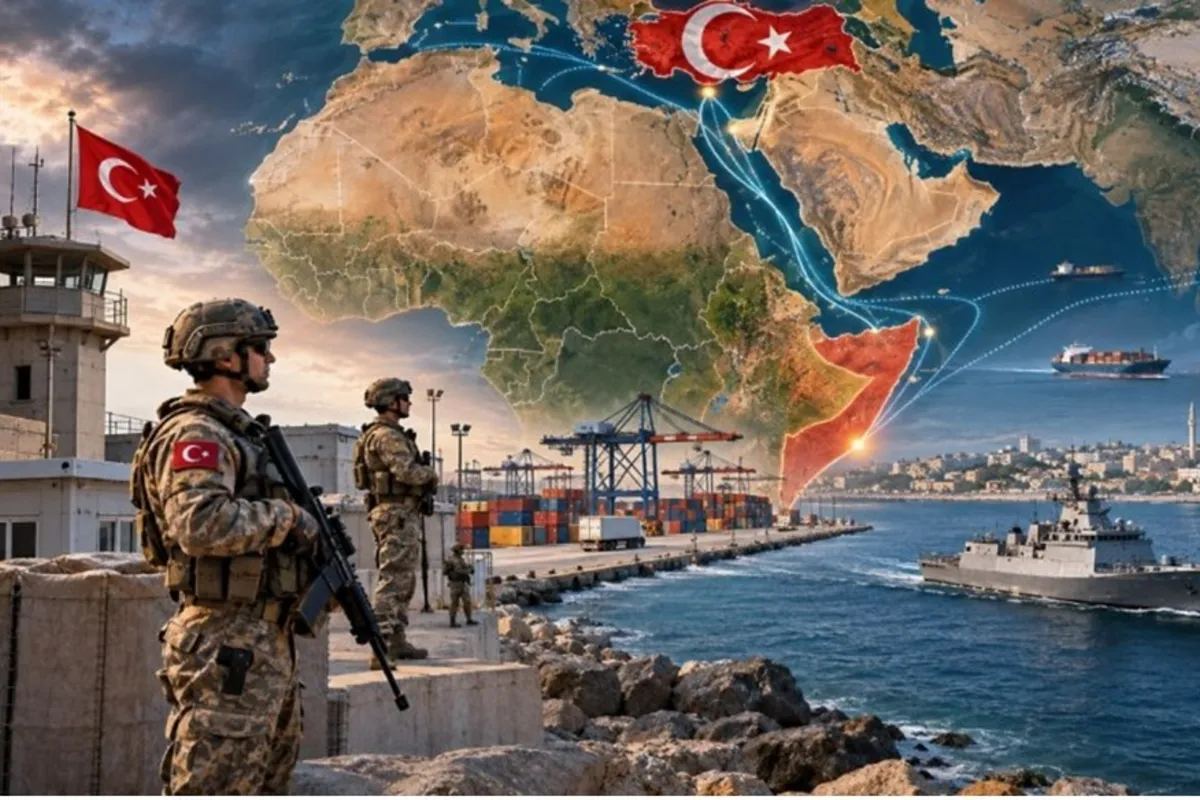
According to Cannon, the reason for choosing Somalia was its advantageous geographical location: its proximity to the major trade route running through the Gulf of Aden and the Red Sea. The presence of a Turkish military base in Somalia gives Ankara the potential to exert influence over maritime trade between Asia and Europe.
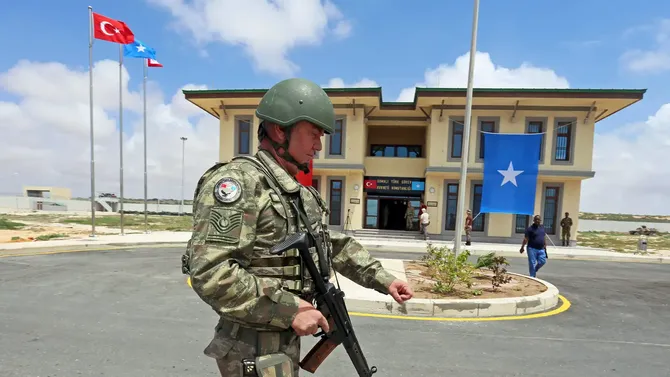
photo: Türkiye Today
“From the standpoint of status, the economic and military presence in this region plays a very significant role, since it makes it possible to create a potential military threat to trade between Asia and Europe.”
Since 2011, Türkiye has provided Somalia with more than $1 billion in aid. The funds have gone towards education, healthcare, transport and security. In 2012, Turkish Airlines began operating regular flights to Mogadishu, ahead of other international carriers, becoming the only airline providing a regular air link between Somalia and the outside world.
Gradually, the fragile African state, which had fragmented into several separate political entities, became dependent on Turkish goods, services and expertise, Cannon writes.
In 2013-2014, Turkish companies signed contracts to manage and maintain two of the Somali government's largest sources of revenue - Mogadishu International Airport and the capital's seaport. Trade turnover between the two countries reached $280 million in 2020, although the balance was heavily in Ankara's favour. Imports from Somalia amounted to just $5 million.
In 2017, Türkiye opened its largest overseas military base in Mogadishu, known as the Somali Turkish Task Force Command (STGK), or Camp TURKSOM. Up to 300 Turkish Armed Forces personnel are stationed at the facility, where they train the Somali army, bypassing the country's Ministry of Defence.
Türkiye's military presence in Somalia has enabled it to establish a guaranteed market for arms supplies. Between 2021 and 2022, Türkiye supplied Mogadishu with $6.5 million worth of products, including ships and aircraft, and donated 22 items of various types of military equipment in 2021.
In February 2024, Somalia signed a defence and economic cooperation agreement with Türkiye, under which Ankara pledged to protect the African state's extensive coastline for 10 years and rebuild its naval forces. In March, the two countries signed an additional memorandum under which Türkiye would receive 30% of Somalia's oil and gas revenues in exchange for strengthening the country's security.
It should be noted that Ankara has deployed its military forces not only in Somalia but also in a number of other countries. It has troops in neighbouring Iraq and Syria, as well as in the Persian Gulf, the Red Sea and the Horn of Africa. In most countries where it currently maintains a military presence, Ankara has deployed its forces under agreements with the respective governments.
Turkish military analyst Levent Özgül notes that Türkiye has “official expeditionary bases” in Qatar, Somalia, Northern Cyprus and Sudan, as well as bases “operating unofficially in Tripoli, Libya”, where it supports and arms the Government of National Accord (GNA), which is fighting against the UAE-backed Libyan National Army (LNA).
As Özgül says, “The deployments of Turkish forces in Qatar, Somalia and Sudan, as well as its efforts in Libya, are directed against Saudi Arabia and the UAE.”
Türkiye has maintained a military base in Qatar for several years, giving its troops a foothold in the Gulf. When Saudi Arabia and the United Arab Emirates imposed a major blockade on Qatar in the summer of 2017, Türkiye strengthened its military presence there, thereby demonstrating its unequivocal support for its ally. The rivalry between the Türkiye-Qatar bloc and the Egypt-Saudi Arabia-UAE bloc encompasses a vast area of Africa and the Middle East.
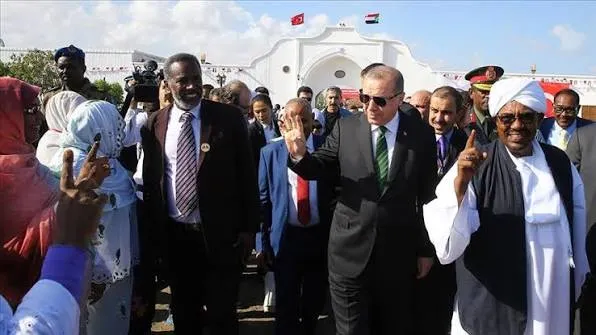
photo: Anadolu Agency
In 2017, Erdogan and Omar al-Bashir, then President of Sudan, signed 12 cooperation agreements covering security, tourism and the defence industry. Particularly noteworthy was the agreement to restore a dilapidated seaport. Türkiye declared that its objectives were exclusively civilian. Specifically, Ankara spoke of its intention to transform the island into a major tourist destination, particularly for pilgrims performing the Hajj.
During the implementation of this project, the Turks were joined by their tactical allies, the Qataris. Speculation emerged in Cairo and the capitals of the Persian Gulf that the authorities of the Republic of Türkiye were building naval facilities on Suakin and intended to establish a fully fledged military base there.
The anti-Qatar bloc of Persian Gulf states viewed the agreements between Ankara and Khartoum with particular concern. Saudi Arabia and the United Arab Emirates have traditionally regarded Türkiye as their geopolitical rival. In 2017, relations between them reached breaking point.
Ankara took advantage of the situation created by the diplomatic blockade of Qatar announced by the Arab monarchies and offered the emirate assistance, including military support. The countries, together with Iran, formed a tactical alliance.
It should be noted that Türkiye has a military base in Qatar, where, according to various estimates, more than 100 Turkish military personnel are stationed. If suspicions that the Turkish leadership also intends to deploy a military contingent on Suakin are confirmed, it will mean one thing: Türkiye is close to completing its strategic triangle around the Red Sea.
The port in Sudan could become Ankara's third military foothold in the region, alongside its bases in Qatar and Mogadishu, Somalia.
However, recently, against the backdrop of the war between the United States and Iran, a new configuration has begun to emerge in the region. Saudi Arabia, Türkiye and Pakistan, seeking to counter the Iran-backed Yemeni Houthis, were compelled to conclude the Mecca Pact.
Thus, alliances in the Middle East are extremely unreliable and temporary in nature, particularly since the struggle for influence itself is constantly shifting.