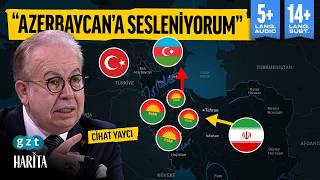
Retired Turkish rear admiral and lecturer at Cihat Yaycı has warned that the growing activity of militant organizations in northwestern Iran could trigger serious geopolitical consequences for the wider region, including the South Caucasus and Azerbaijan.
In a recent interview, Yaycı discussed the increasing presence of organizations connected to the PKK network, including PJAK, YPG, and the Syrian Democratic Forces.
According to the Turkish analyst, these groups are gradually concentrating their forces in northwestern Iran, particularly in territories located near Türkiye and Azerbaijan.
Yaycı argued that describing these organizations simply as “Kurdish groups” is misleading, claiming that they include militants of different nationalities and function primarily as armed networks rather than ethnic movements.
“These organizations consist of militants coming from different countries and backgrounds,” he said, emphasizing that they should be viewed as militant organizations operating within a broader geopolitical framework.
One of the central points raised by Yaycı concerns the demographic and geopolitical importance of Iran’s northwestern regions, particularly West Azerbaijan province.
The area borders Türkiye and lies close to Azerbaijan, making it strategically significant in regional politics.
According to Yaycı, millions of ethnic Azerbaijani Turks live across northern Iran, including major cities such as Tabriz, Urmia and other surrounding areas.
He estimated that the Turkic population in Iran may represent more than 40 percent of the country’s population, making it one of the largest ethnic communities in the country.
Yaycı warned that tensions in these regions could have serious consequences if militant groups attempt to strengthen their presence in areas populated by Azerbaijani Turks.
He also referred to reports suggesting that fighters linked to PJAK have been deployed to parts of West Azerbaijan province and other nearby districts.
According to him, such developments could increase tensions in areas where different communities coexist.
Another major issue raised by Yaycı concerns the movement of militant fighters across several Middle Eastern conflict zones over the past decade.
According to the Turkish analyst, fighters linked to these networks were previously active in Türkiye, Syria and Iraq before gradually being redeployed to Iran.
He argued that political developments in Syria and Iraq created opportunities for these organizations to reorganize and relocate their fighters.
“When pressure on these organizations decreases in one theater, they tend to move their forces to another region,” Yaycı said.
In his assessment, militants who left Türkiye in earlier years regrouped in Iraq and Syria before eventually shifting toward Iran’s northwestern territories.
He suggested that these movements reflect a broader geopolitical struggle in which militant networks are used as instruments within regional power competition.
Yaycı also raised concerns about the potential geopolitical implications of these developments.
According to him, instability in northwestern Iran could disrupt the strategic geographic link between Türkiye and Azerbaijan.
The region forms part of an important corridor connecting Türkiye, Iran and the South Caucasus, and any destabilization there could affect broader regional connectivity.
Yaycı warned that the emergence of armed militant networks near these borders could increase security risks in the wider region.
He also addressed Azerbaijan directly, calling for vigilance regarding developments in Iran’s northwestern territories.
“If militant groups consolidate their presence in this region, their activities could eventually affect neighboring countries,” he said.
According to Yaycı, Azerbaijan’s energy resources and strategic location make it particularly important in regional geopolitical calculations.
The South Caucasus hosts major energy infrastructure linking the Caspian region with European markets, which increases the strategic importance of stability in the surrounding regions.
Yaycı suggested that militant activity in Iran could potentially create new security challenges near these critical energy corridors if the situation escalates.
Another concern he raised involves the potential for ethnic tensions to be exploited by external actors.
The analyst argued that attempts to redefine or reshape political and ethnic dynamics in northwestern Iran could create instability in areas where Azerbaijani Turks form a significant share of the population.
He stressed that any attempt to inflame ethnic divisions could have serious consequences for the broader region.
At the same time, Yaycı emphasized that the issue should not be viewed as an ethnic confrontation but rather as a security challenge linked to militant organizations and geopolitical competition.
He concluded that regional governments should closely monitor developments and coordinate their security policies in order to prevent militant networks from expanding their influence.
“In a volatile geopolitical environment, cooperation among regional states is essential to prevent instability from spreading,” Yaycı said.
The Turkish analyst warned that developments in northwestern Iran should be watched carefully, as they could influence the broader security environment of the Middle East and the South Caucasus.