Source: Russia Beyond
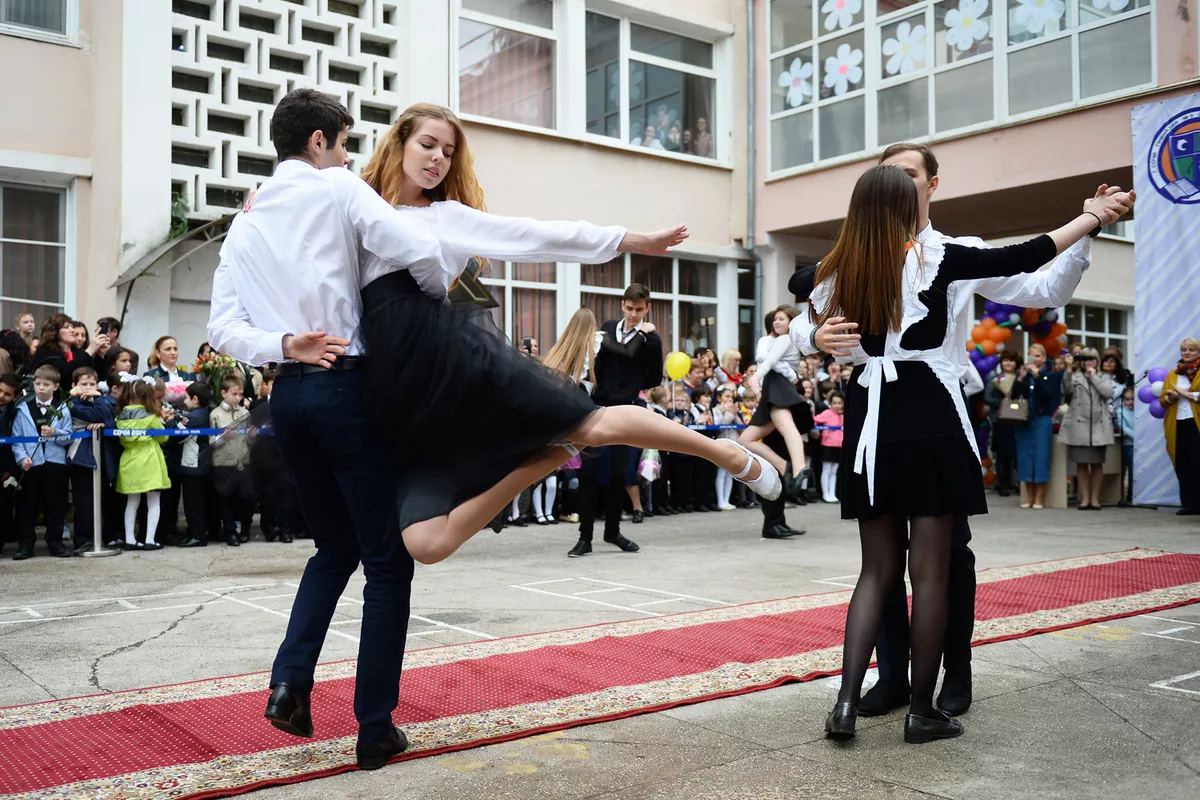
Russian eleventh-grade students who had been preparing farewell waltzes set to Western music were compelled to quickly revise their performances.
The changes stem from the recently enacted law on the “protection of the Russian language,” The Caspian Post reports, citing the pro-government outlet Mash.
At Fomin School in the Ryazan Region, for instance, students selected Sting’s “Shape of My Heart” back in January for their graduation dance.
They hired a choreographer-each contributing 5,000 rubles, totaling 50,000-and spent months rehearsing the routine. However, the school administration ultimately prohibited the use of the song. Despite the students’ emotional response, they were instructed to switch to an alternative: “The Last Waltz” from the TV series “Lilies of the Valley.” Mash reports that similar situations have arisen in the Yaroslavl and Tambov Regions, where waltzes set to songs by Toni Braxton and Whitney Houston were also rejected.
The Ministry of Education of the Ryazan Region told the outlet that schools are entitled to establish their own criteria for musical selections at events. These decisions are guided by federal legislation on the state language and education, as well as internal regulations. Officials noted that music choices must align with age-appropriate standards and reflect “traditional values.” At the same time, certain allowances remain in place: performances set to songs in regional languages such as Tatar, Mari, or Buryat are still permitted.
As of March 1, 2026, a law has come into force in Russia limiting the use of foreign words in advertising, signage, websites, product labeling, and other public information. The legislation prioritizes the Russian language in official and commercial contexts and promotes the use of domestic equivalents in place of Anglicisms.
Proposals to restrict foreign cultural influence have been raised repeatedly by officials in recent years. For example, Andrei Lugovoy, First Deputy Chairman of the State Duma Committee on Security, has suggested cutting the share of foreign music on Russian streaming platforms to 20 percent-or eliminating it entirely. Last September, State Duma deputy Sergei Kolunov proposed a complete ban on foreign songs at domestic sporting events.
In March this year, President Vladimir Putin also called for swift action on introducing quotas for foreign films. He stressed the importance of considering ideological factors in such policies, pointing to China as an example of a country where cultural content is “strictly regulated.”
Share on social media