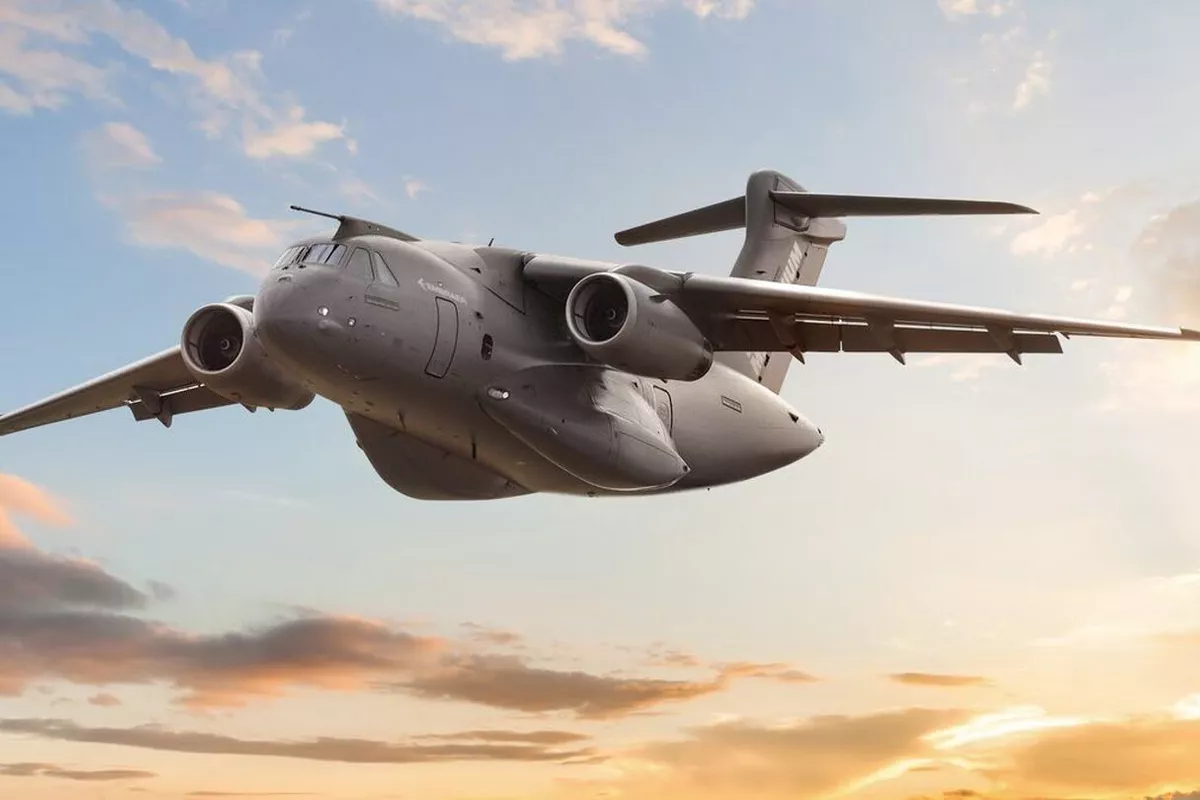
On February 3, 2026, Embraer publicly identified Uzbekistan as the previously undisclosed customer for its C-390 Millennium military transport aircraft, announcing the deal at the Singapore Airshow. The manufacturer framed the purchase around transport and humanitarian missions and highlighted that Uzbekistan will become the first operator of the type in Central Asia.
At face value, the headline is straightforward-Uzbekistan is buying new transport aircraft. Strategically, however, the logic runs deeper. Airlift is a capability that rarely attracts attention until a crisis strikes: an earthquake, a mass evacuation, a border emergency, or the sudden requirement to move battalions, engineering assets, or field hospitals. The decision to acquire the C-390 signals an effort to compress response times at home and across the region, while modernizing a transport fleet still heavily dependent on aging Soviet-era platforms.
Below is what this procurement likely reflects-and what its core objective appears to be.
What was ordered-and why even a small number matters
Industry reporting indicates that the earlier “undisclosed customer” commitment involved two aircraft, with multiple outlets linking that figure to Uzbekistan following the February 3 announcement. Embraer has focused its public messaging on mission profiles rather than fleet size, but reporting that the first delivery will take place this year suggests the program has moved from intent to near-term operational capability.
Even a two-aircraft acquisition is significant. Airlift capacity is non-linear: a small number of modern, well-supported aircraft can sharply improve readiness if availability is high. Such a purchase creates a bridge fleet, allowing legacy aircraft to remain in service for selected roles while shifting high-priority missions to a newer, more reliable platform. It also reflects a cautious procurement model-starting small to limit risk, then scaling later if operations and sustainment prove manageable.
Why the C-390 fits Uzbekistan’s operational profile
Uzbekistan’s current transport inventory includes platforms such as the Il-76, An-12, An-26, and the C-295. In practice, this provides light and medium lift at one end and heavier lift at the other, but leaves a gap for a modern, high-availability “middle” workhorse.
The C-390 is positioned squarely in that space: a medium military transport with jet speed, contemporary avionics, and multi-mission design. Marketed to carry up to 26 metric tons and cruise around Mach 0.80, it emphasizes the combination of speed and payload.
For Uzbekistan, several factors stand out. First, geography matters. Large internal distances, challenging terrain, and harsh seasonal conditions mean that a faster transport aircraft can change the tempo of response for both security and civil contingencies. Second, the aircraft’s modular mission design-cargo, troop transport, medical evacuation, and airdrop-allows a single platform to cover roles that might otherwise require multiple specialized fleets. Third, modern sustainment models typically offer more predictable readiness than aging Soviet-era aircraft, where parts supply, overhaul cycles, and airframe fatigue increasingly constrain availability. Finally, Embraer’s emphasis on austere-runway operations aligns with humanitarian scenarios in which infrastructure may be degraded or congested.
Supplier choice as a strategic signal
Selecting a Brazilian platform also carries strategic weight. Uzbekistan’s defense procurement has long relied on post-Soviet systems and supply chains, but Central Asian states are increasingly diversifying to reduce single-supplier dependence and broaden access to training, financing, and technical support.
A Brazilian aircraft offers diversification without the geopolitical baggage often associated with great-power suppliers. It opens the door to a new defense-industrial relationship with a globally active aerospace company, potentially extending beyond the aircraft itself into training, maintenance practices, and technical skills development. It may also be viewed as a resilience measure: even absent direct sanctions pressure, dependence on supply chains affected by sanctions can disrupt upgrades and spare parts availability.
The main objective: strategic mobility with civilian legitimacy
Based on Embraer’s own framing of the deal, the primary objective appears to be the creation of rapid, reliable strategic mobility for both security and civil emergencies. In practical terms, this means moving people and heavy equipment quickly, within Uzbekistan and across the wider region, with a high degree of readiness.
This objective has multiple layers. Militarily, it supports faster reinforcement of distant garrisons, quicker movement of engineering and logistics units, and more efficient sustainment of exercises and deployments. In civil-defense terms, it enhances the ability to respond to earthquakes, floods, extreme weather, or infrastructure failures-situations where hours can matter. Regionally, becoming the first C-390 operator in Central Asia can strengthen Uzbekistan’s standing as a contributor to joint exercises and humanitarian responses, not merely a recipient of assistance. Institutionally, introducing a modern transport aircraft drives improvements in training standards, maintenance culture, spare-parts planning, and mission management across the air force.
Complementing-not replacing-the existing fleet
The C-390 is best understood as a complement to Uzbekistan’s existing transport aircraft rather than a replacement. Compared with the C-295, it offers greater payload and speed for time-sensitive or bulk logistics. Compared with the Il-76, it cannot match maximum payload, but it can assume many missions that do not require heavy lift while offering modern efficiency and potentially higher availability.
The result is a more tiered transport force: light aircraft for short strips and small loads, a medium workhorse for high-tempo operations, and heavy aircraft for outsized or specialized missions. Such tiering is characteristic of resilient air forces that prioritize flexibility over reliance on a single “do-everything” platform.
Conclusion
Uzbekistan’s decision to acquire the C-390 is best read as a mobility-first modernization move. It reflects a calculation that national security, disaster resilience, and regional influence all improve when forces and aid can be moved quickly and reliably. The aircraft’s blend of speed, payload, and multi-mission flexibility aligns closely with that logic, while the emphasis on humanitarian use and regional “first” status adds political legitimacy and prestige. Whether the investment delivers its full promise will depend on training, sustainment, and utilization-but strategically, the rationale is clear.