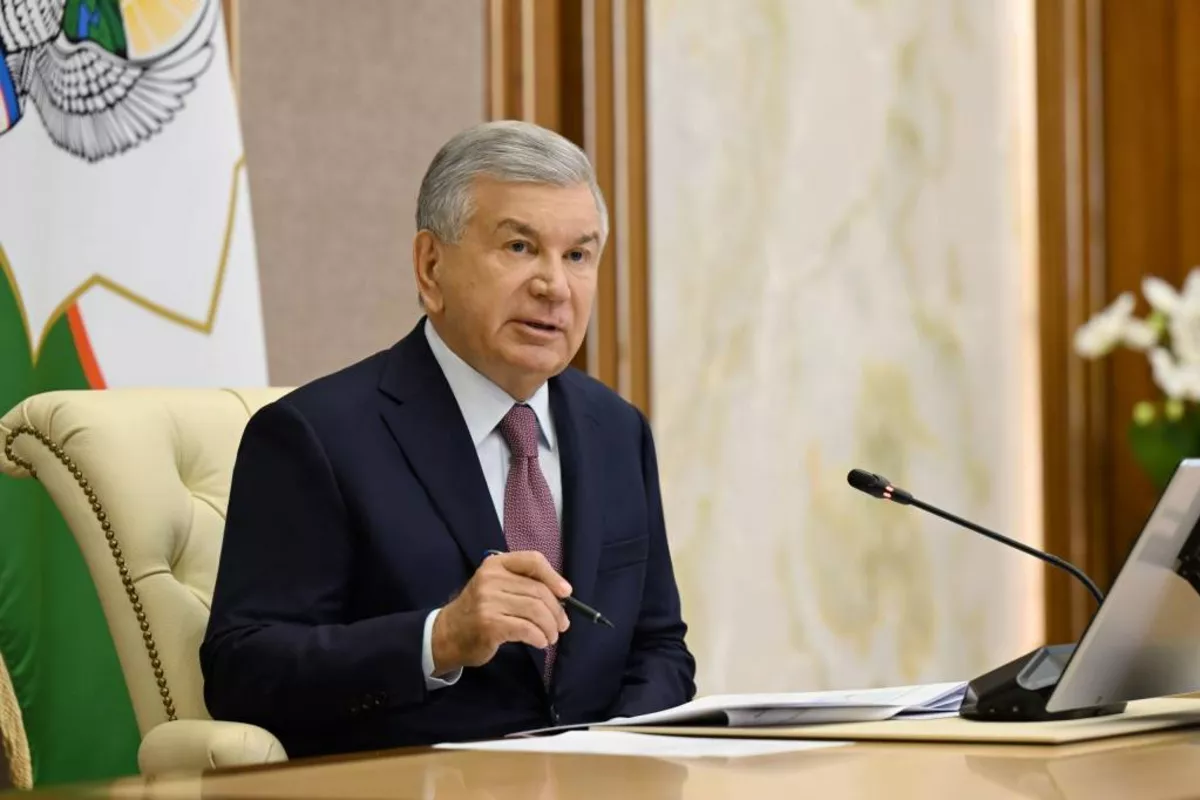
Uzbek President Shavkat Mirziyoyev has reviewed medium- and long-term plans for the development of the country’s electricity sector, along with proposals to reform the management of investment projects in the fuel and energy industry.
The presentation emphasized that energy development is a key factor in supporting economic growth, attracting investment and improving living standards, The Caspian Post reports, citing UzDaily.
In recent years, Uzbekistan has increased private and foreign investment in the sector and launched projects involving new power plants, renewable energy and the modernization of electricity networks.
As a result, the combined capacity of the country’s solar and wind power plants has exceeded 6.3 GW. Uzbekistan now has more than 100 hydropower plants with a combined capacity approaching 2.5 GW. The growing use of renewable energy is also allowing the country to save substantial amounts of natural gas each year.
Forecasts presented to the president indicate that Uzbekistan’s economy could reach $300 billion by 2030, while the population is expected to surpass 41 million. Electricity consumption by industry alone could rise from the current 38 billion kWh to 53.5 billion kWh. Additional demand is also expected from electric transport and data centers.
Against this backdrop, officials have been tasked with expanding generation capacity ahead of demand, strengthening the electricity grid and maintaining adequate reserve capacity.
Under current plans, Uzbekistan’s total installed power generation capacity is expected to reach 46.1 GW by 2030, with annual electricity production of about 129 billion kWh. By 2035, installed capacity is projected to increase to 57.2 GW, while annual generation could reach 154.7 billion kWh.
Several electricity demand scenarios were also presented. Calculations indicate that under moderate consumption growth through 2030, generation would remain broadly balanced with demand. However, faster economic and industrial growth, along with the expansion of electric transport and digital infrastructure, would require additional generation capacity.
President Mirziyoyev instructed officials to factor higher economic growth rates into energy planning and ensure that sufficient reserve capacity is established in advance.
Among the measures discussed were the construction of additional wind farms and energy storage facilities, as well as faster implementation of solar and wind projects. Officials also proposed reassessing projects considered economically inefficient, lacking clear financing sources or facing significant implementation delays.
The selection of new power plants should take into account not only their generation capacity but also electricity production costs, available grid connections, compatibility with storage systems and their impact on the overall energy balance.
Energy storage is becoming increasingly important as the share of renewable sources grows. Such systems can store electricity generated by solar and wind facilities during daylight hours and release it during periods of peak evening demand. This can reduce the need for additional conventional generation and contribute to grid stability.
At present, 26 energy storage projects with a combined capacity of 4.2 GW have been identified, with 17 already at the implementation stage. Additional storage projects are proposed for development through 2030.
The country’s main transmission infrastructure is also set for expansion. By 2030, plans call for the construction of nine 220 kV substations and seven 500 kV substations, together with nearly 5,000 kilometers of new transmission lines.
The new infrastructure is intended to connect additional power plants to the national grid and increase opportunities for electricity exchanges between regions. Projects involving 500 kV transmission lines and substations scheduled for 2027-2029 were also reviewed, including their financing and measures to prevent delays.
Particular attention was given to the development of digital infrastructure in Karakalpakstan, making use of the region’s wind energy potential.
Under the proposal, planned wind power facilities in Karakalpakstan would be connected to data centers with a combined capacity of 1 GW. A new substation and 220 kV transmission lines would be built for this purpose. The infrastructure is expected to link the data centers to the electricity grid, attract high-tech investment and make greater use of the region’s renewable energy potential.
The meeting also examined proposed changes to the process for developing and implementing energy-sector investment projects.
Under the existing system, investors frequently initiate projects before coordinating land allocation, grid connections, technical requirements, tariffs and investment agreements with different government agencies. According to the proposals, this can lead to lengthy procedures, overlapping responsibilities and insufficient consideration of the broader needs of the electricity system.
The proposed approach would instead begin with projected electricity demand from the economy, population and individual regions. The required level of consumption would first be determined, followed by the necessary generation capacity and supporting infrastructure. Land, grid connection points and technical solutions would then be prepared in advance, with investors selected through open competition.
The responsibilities of government institutions would also be divided under the proposed model. The Ministry of Economy and Finance would forecast electricity demand, while the Ministry of Energy would oversee strategic planning and technical policy. The Agency for the Development and Regulation of the Energy Market would be responsible for market relations and tariffs.
Investment authorities would attract investors through open tenders, while local administrations would handle land allocation and the provision of necessary infrastructure.
Officials have also proposed updating three-year investment plans annually on the basis of detailed forecasts of energy resource requirements by region and economic sector. The mechanism is intended to improve coordination in planning new power plants, transmission networks and related infrastructure.
For the longer term, Uzbekistan plans to develop a concept for ensuring the country’s fuel and energy resources through 2050. The document is expected to consider the country’s resource potential, demographic and economic trends, energy efficiency, renewable and nuclear energy development, and energy security. The concept would be reviewed every five years.
Mirziyoyev stressed that every new energy project should meet the long-term needs of the economy and population, while maintaining a continuous balance between electricity generation, grid demand and consumption.
Following the presentation, officials were instructed to ensure the timely completion of major projects already under implementation, work with investors to address delays, develop generation and transmission infrastructure in a balanced manner, expand energy storage capacity and introduce a new planning and management model for the sector.