Uzbekistan Targets $20 Billion in Road Infrastructure Investment
Uzbekistan aims to attract $20 billion in investment to its road sector as part of a broader effort to modernise the country's transport and logistics infrastructure.
President Shavkat Mirziyoyev announced the plans during a meeting with investors and entrepreneurs from the transport and logistics sector at the Scientific and Practical Centre of the Committee for Roads, The Caspian Post reports, citing UzDaily.
The president stressed the importance of developing the country's transport system in line with rapid economic growth, attracting significant investment and modern technologies, and ensuring practical results.
Over the past decade, 80 trillion soums has been allocated to the road sector, during which 7,000 kilometres of roads were reconstructed and 125,000 kilometres repaired. Despite this progress, Uzbekistan retains considerable potential for attracting private investment in road infrastructure, estimated at $20 billion.
Five toll road construction projects, covering a combined 593 kilometres and valued at $5.6 billion, are currently underway. Construction of the $2.2 billion Tashkent-Samarkand highway has already begun, while tender procedures for the $1.6 billion Tashkent-Angren road are nearing completion.
Officials have also been instructed to finalise feasibility studies for projects along the Tashkent-Charvak and Samarkand-Bukhara routes, as well as at the Takhtakaracha Pass. The three projects, with a combined estimated value of $1.8 billion, will be presented to potential investors.
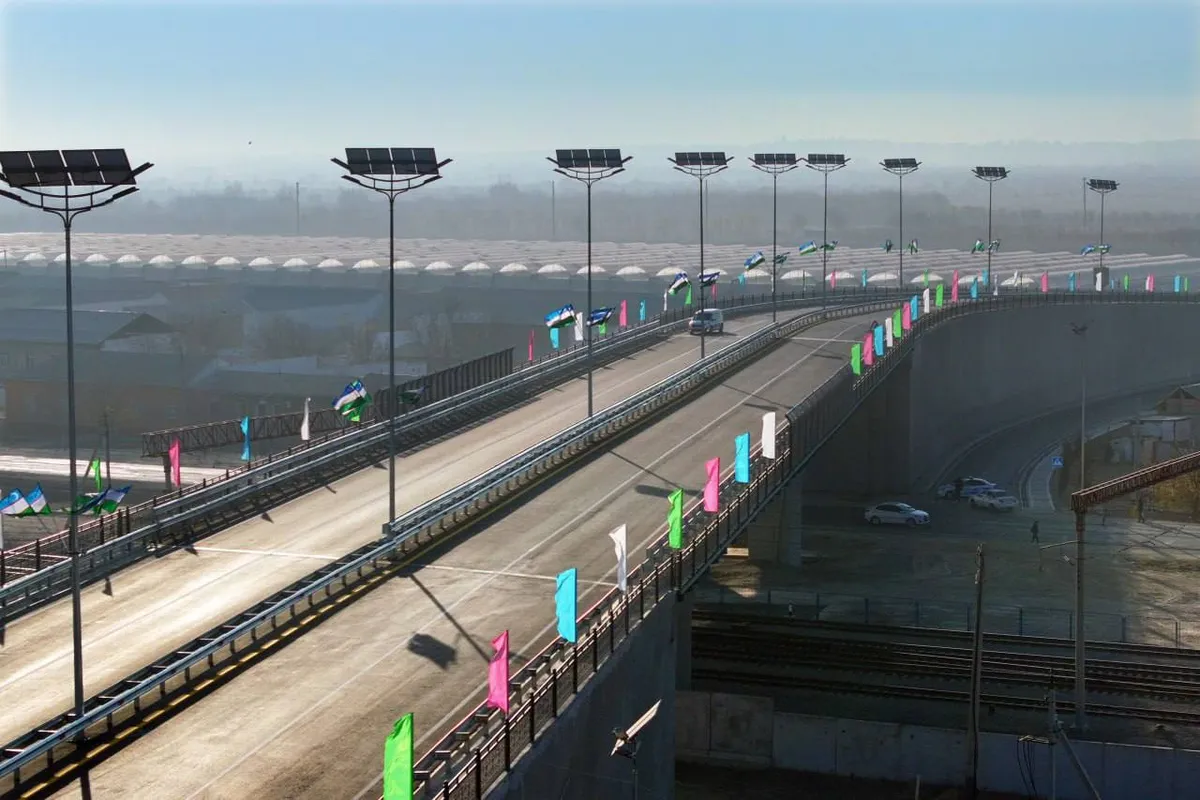
The government also plans to expand private sector participation in road and bridge construction. Regional authorities have prepared proposals for 131 projects worth a total of $4 billion.
Regional governors have been tasked with identifying one or two road or bridge infrastructure facilities in each region within a month and offering them to investors under arrangements covering construction, maintenance and management.
The projects will be presented to private investors as ready-made packages, including completed feasibility studies. Investors will also be given opportunities to establish retail outlets and service facilities along roads. Mirziyoyev stressed that such initiatives should be implemented in every district.
Meanwhile, road infrastructure projects worth a combined $6.5 billion are being implemented in cooperation with international financial institutions. A project to construct the Urgench-Tuprokkala road was recently launched in partnership with the European Bank for Reconstruction and Development (EBRD).
Next year, reconstruction will begin on a 97-kilometre section of the M-41 highway in Surkhandarya Region with support from the World Bank. A 100-kilometre section of the A-380 highway in Kashkadarya Region will also be reconstructed with assistance from the Asian Development Bank (ADB).
Additional projects include the reconstruction of a 37-kilometre section of the A-373 highway in Syrdarya Region in cooperation with the Islamic Development Bank, and a 69-kilometre section of the M-37 highway passing through Bukhara and Navoi regions with support from the Asian Infrastructure Investment Bank (AIIB).
Mirziyoyev expressed his appreciation to international financial institutions for their cooperation in developing Uzbekistan's road infrastructure.
He noted that the country had built up a pool of qualified specialists, major domestic contractors, and engineering and consulting companies in recent years. Opportunities had also been created to equip these companies with modern machinery.
International financial institutions were invited to develop a joint programme to involve local specialists as consulting engineers in major international projects. The initiative would also help domestic companies with road construction experience prepare to participate in overseas tenders.
"We need quality roads that can serve for many years, not roads that are built cheaply today and require budget funds for repairs again tomorrow," the president said.
The meeting also addressed the introduction of modern materials and technologies to improve road quality and durability.
According to the information presented, the use of polymer-modified bitumen can extend road service life by three to four years, improve resistance to high temperatures and reduce the need for repeated repairs.
Production of 50,000 tonnes of polymer-modified bitumen is scheduled to begin at the Fergana Oil Refinery in March next year. Officials have been instructed to increase production capacity to at least 100,000 tonnes by the end of the year.
Geotextile material has also been used for the first time in the asphalt pavement of the Urgench-Khiva toll road. The technology helps distribute traffic loads more evenly, prevent road surface deformation and extend service life by four to five years.
Mirziyoyev instructed officials to incorporate the use of polymer-modified bitumen and geotextile technologies into road construction standards.
Starting next year, these requirements will become mandatory for the construction and reconstruction of international roads before being gradually extended to national and local road networks.