Baku Offers More Gas to Europe—But There's a Catch
Few people probably know that Azerbaijani oil has even reached Japan. Yet, in mid-May, a tanker carrying 283,000 barrels of Azerbaijani crude arrived in the Land of the Rising Sun. Japanese company ENEOS purchased the oil from Azerbaijan to supply its Negishi refinery.
The event largely went unnoticed, apparently because the shipment was a one-off delivery prompted by disruptions to traditional supply routes caused by the war in the Middle East and the closure of the Strait of Hormuz. At the opening of the Shusha Global Media Forum, a representative of a Japanese news agency recalled the delivery and thanked Azerbaijan for its support.
Compared with Japan's overall oil consumption, the shipment from Azerbaijan may seem like a drop in the ocean. However, in a broader context, it is highly significant, once again demonstrating the role Azerbaijan plays under today's complex geopolitical conditions. Much has already been said about the country's irreplaceable importance, and European officials have repeatedly praised Baku for providing Europe with an alternative source of energy in recent years. Although Azerbaijani supplies have not fully replaced previous sources, they have helped European partners bridge critical gaps in their energy security. Azerbaijan has proven itself to be a reliable partner that does not tie its commitments to changing political circumstances, making this cooperation even more valuable.
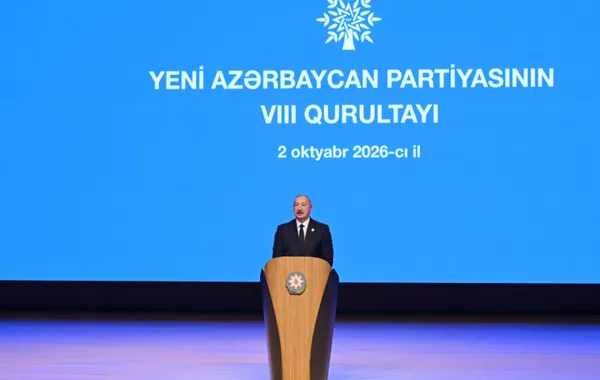
"Demand for Azerbaijan's energy resources, including renewable energy, will continue to grow," President Ilham Aliyev said while answering questions from participants at the Shusha Forum.
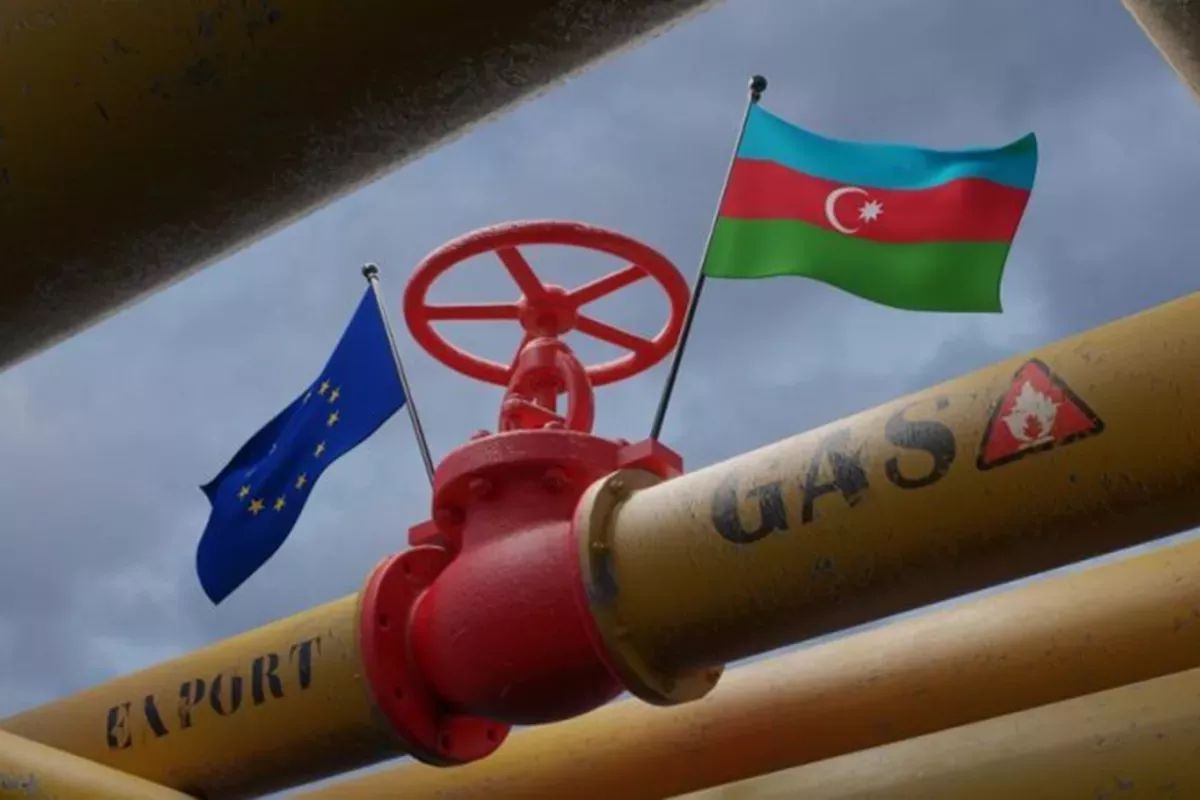
The president noted that in 2026 Azerbaijan began supplying natural gas to Germany and Austria as part of its strategy to expand its presence in global, and particularly European, gas markets. According to Aliyev, the European market is a premium market offering the best prices. Therefore, Baku is keen to increase its export capacity.
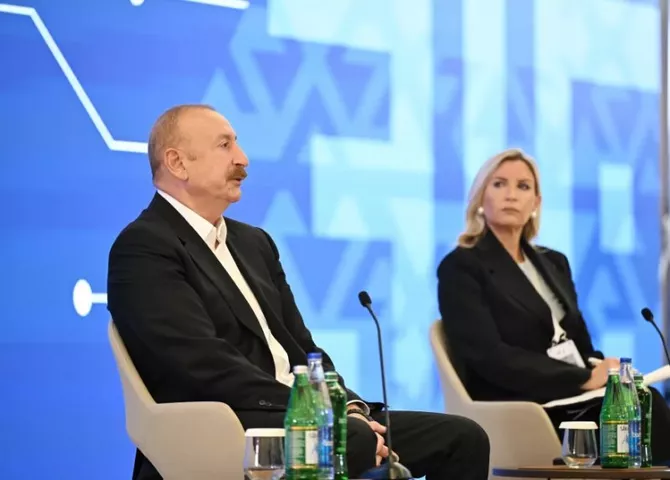
Photo: AZERTAC
It is worth recalling that Azerbaijani gas exports to Europe began on 31 December 2020. In July 2022, Azerbaijan and the European Commission signed a Memorandum of Understanding on a Strategic Partnership in the Field of Energy. Encouraged by the emergence of an alternative energy source, the European Union sought to increase imports from Azerbaijan. Since the memorandum was signed, Azerbaijani gas exports to EU member states have risen by nearly 65 per cent. This is a strong indication that the EU made the right decision in 2022. Today, 10 EU member states receive Caspian gas, and Baku has repeatedly emphasised that it has sufficient capacity to expand its export footprint. Azerbaijani gas reaches European partners through a pipeline network stretching some 3,500 kilometres.
At the Shusha Forum, President Aliyev revealed that negotiations are currently underway with several more EU countries regarding both the launch of gas supplies and increased deliveries to existing customers. He stressed that Azerbaijani gas comes from a reliable and predictable source, whose importance is far greater today than it was a decade ago. There is also room for export growth. Several months ago, gas production began from deepwater reservoirs at the Azeri-Chirag-Gunashli (ACG) field. Output is also expected to increase at other fields, although this will depend on development programmes and investment portfolios.
When speaking about investment portfolios, the president was apparently referring to financing from European financial institutions that had previously been frozen due to the EU's decarbonisation agenda. Recent developments in the Middle East have demonstrated that while decarbonisation is a worthwhile objective, it does not always align with current realities. The modern world still cannot function without fossil fuels, meaning Europe should resume investment in hydrocarbon projects. Azerbaijan, for its part, is unwilling to invest in expanding production without long-term contracts and financial participation from the European Union itself. Furthermore, Azerbaijan has recently expanded the geographical reach of its exports beyond what was envisaged under previous agreements. For example, Syria has begun receiving Azerbaijani gas, creating additional demand.
During European Commission President Ursula von der Leyen's recent visit to Baku, Azerbaijan raised the issue of securing long-term contracts with the EU. Expanding production requires substantial investment, and Baku is unwilling to accept a situation in which European partners could at any moment declare that they no longer need Azerbaijani gas.
In short, if the European Union wants to receive larger volumes of Azerbaijani gas, the gas transportation system must be expanded. That, in turn, requires significant investment.
The development of renewable energy could also help free up additional gas volumes for export. Azerbaijan has adopted a programme under which it plans to generate eight gigawatts of electricity from renewable sources by 2032. This would free up several billion cubic metres of natural gas currently consumed domestically, allowing those volumes to be exported. However, this again raises the issue of expanding gas transportation infrastructure. President Aliyev pointed out that the existing system was designed and built based on the market conditions that prevailed before the Russia-Ukraine conflict.
"The capacity of the pipelines was determined based on our production profile, forecasts, and our strategy regarding the pace of gas extraction. Gas can be produced over 10 years or over 100 years, and for us it was important to determine what would be more profitable - whether to spread production over decades and maintain relatively stable output or invest more and produce more gas. However, after the outbreak of the Russia-Ukraine conflict, demand for Azerbaijani gas rose sharply, and the European Commission asked us to do everything possible to accelerate production," the president said.
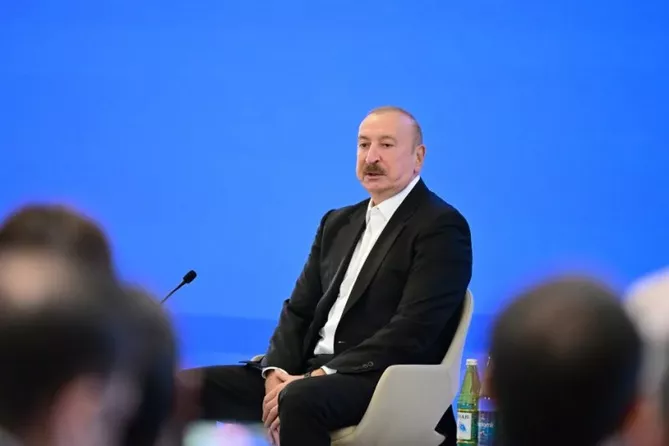
Photo: AZERTAC
Over the past two decades, Azerbaijan has evolved from a regional hydrocarbon producer into one of the key guarantors of energy security across the vast region stretching from Central Asia to Europe. Much of this success stems from a development model in which Baku acts not only as a supplier of energy resources but also as the driving force behind major international infrastructure projects. Azerbaijan was the principal initiator of the Southern Gas Corridor. Initially met with scepticism, the project has since become indispensable.
Following the outbreak of the Russia-Ukraine war, it became clear that Azerbaijan was virtually the only country in the region possessing the necessary energy resources, developed export infrastructure and political stability. As noted earlier, Azerbaijan has also demonstrated predictability and reliability - qualities that are invaluable in an energy partner.
Predictability is equally important for Azerbaijan when it comes to its partners. That was the message President Ilham Aliyev sought to convey while answering questions from participants at the Shusha Global Media Forum.
By Tural Heybatov