The crash of an Azerbaijani passenger aircraft on December 25, 2024, long ago ceased to be merely a tragedy. Over time, it has evolved into a revealing case study of how two mutually exclusive versions of reality can coexist within a single state system - a political one and an investigative one. As the story has unfolded, it has become increasingly clear that the issue extends far beyond the deaths of 38 people. It is a crisis of accountability that reaches well beyond the scope of an aviation investigation.
From the very first hours after the crash of the AZAL Embraer-190 operating the Baku-Grozny flight, which was forced to make an emergency landing in Aktau, it was evident that what had occurred did not fit the pattern of a standard aviation incident. Photographs of the wreckage, the nature of the damage to the fuselage, and testimonies from surviving passengers all pointed to external impact. This was neither a technical malfunction nor a case of “human error.” The aircraft had been struck by shrapnel, and the crew fought for control of the plane until the very end, performing what can only be described as a feat of heroism and saving everyone who could still be saved. It was a fight for life - not a “failed landing.”
The Azerbaijani side adopted a clear and principled position almost immediately. Baku stated that the aircraft had been damaged in Russian airspace as a result of external impact. This version was voiced publicly and at the highest political level. President Ilham Aliyev spoke about it directly, without diplomatic euphemisms. For Azerbaijan, the matter was not only legal but moral. The deaths of its citizens cannot be explained away with vague formulations when the facts point to a specific cause.
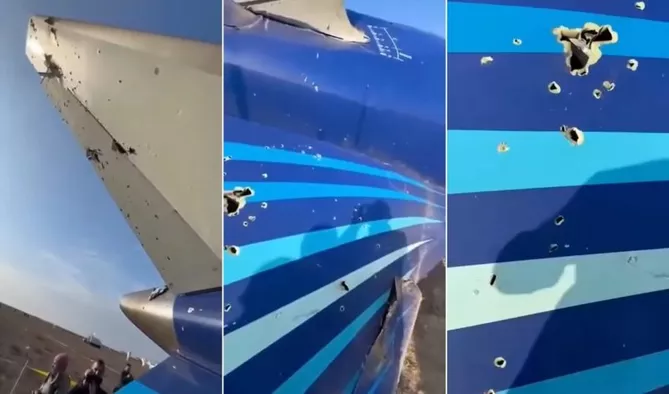
Probable shrapnel marks on the fuselage of the Azerbaijani Embraer 190, December 25, 2024. (Photo: Astra)
Moscow, meanwhile, for a long time preferred a wait-and-see approach. Condolences were expressed, an investigation was formally underway, yet no clear or substantive conclusions followed. Against the backdrop of a growing body of evidence, this silence appeared increasingly troubling. It was for this reason that Vladimir Putin’s statement in Dushanbe in the autumn of 2025 became a turning point.
During a meeting with President Ilham Aliyev on the sidelines of the CIS summit in Dushanbe, the Russian president spoke with striking specificity. He mentioned that Ukrainian drones had crossed the Russian border on the day of the crash, referred to disruptions in the operation of air defense systems, and directly stated that two missiles had been launched. Putin clarified that the missiles detonated at a distance of roughly 10 meters from the civilian aircraft, most likely in a self-destruct mode, and that their fragments struck the fuselage of the Azerbaijani plane. This was neither speculation nor an abstract comment - it was a description of the mechanism of the tragedy.
For Baku, this sounded like a de facto admission: the AZAL civilian aircraft had been damaged as a result of the actions of a Russian air defense system. This is how the statement was perceived both politically and publicly in Azerbaijan. It was logical to expect that legal steps would follow - the completion of the investigation, the formal recording of the causes of the crash, and the conclusion of the process in a consistent and transparent manner.
However, subsequent events took a different and far more disturbing turn.
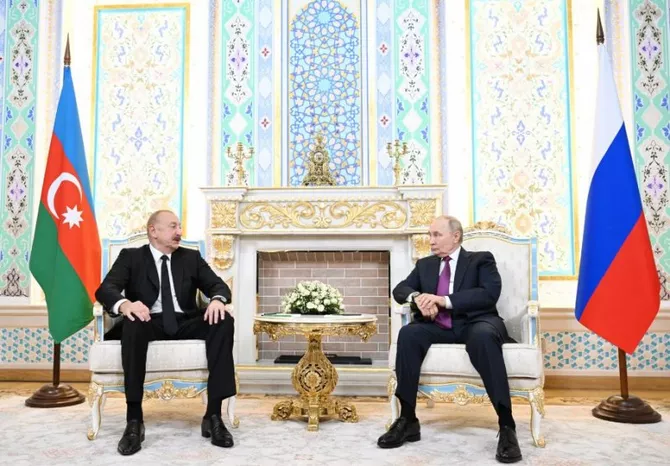
Azerbaijani President Ilham Aliyev and his Russian counterpart Vladimir Putin held a meeting in Dushanbe on October 9, 2025. (Photo: AZERTAC)
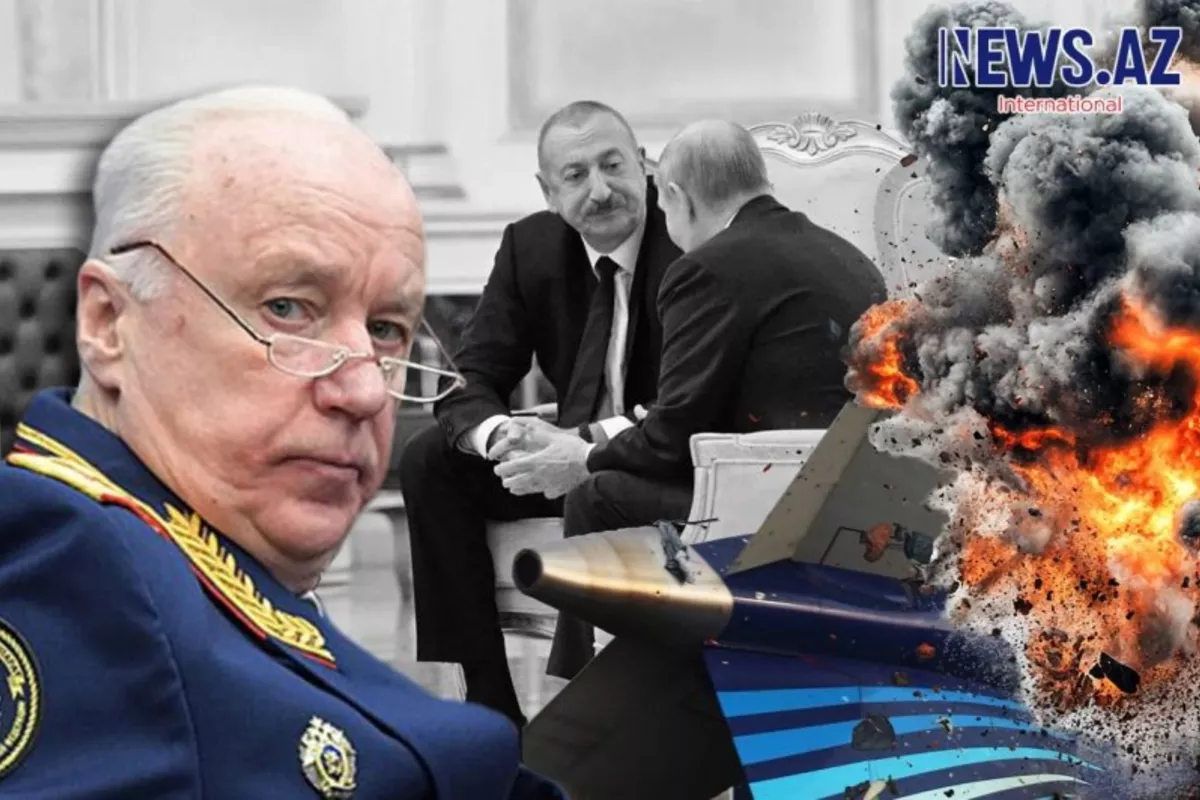
The Telegram channel BT News published a letter signed by Alexander Bastrykin, Chairman of Russia’s Investigative Committee, addressed to Azerbaijan’s Prosecutor General Kamran Aliyev. The very fact that this document entered the public domain was itself telling. Such correspondence rarely becomes public by accident. The leak clearly pointed to internal disagreements and an attempt to formalize an alternative version of events - not at the political level, but at the ostensibly legal one.
The content of the letter was striking precisely because of its disconnect from the words of Russia’s president. In the Investigative Committee’s version, there are no Ukrainian drones, no air defense malfunctions, no two missiles, no explosions near the aircraft, and no shrapnel damage. Instead, the document refers to adverse weather conditions, two unsuccessful landing attempts in Grozny, and the crew’s subsequent decision to divert to an alternate airport. The conclusion is reduced to a dry formulation of a “collision with the ground” during the approach to Aktau.
In effect, the Investigative Committee presents a version in which no external impact occurred at all. The aircraft was not damaged, did not lose controllability, and did not fly hundreds of kilometers with a compromised hydraulic system. In this logic, the crew simply failed to cope with the weather. Everything else is treated as insignificant detail. This approach erases both the professionalism of the pilots and the very essence of the tragedy.
This raises a fundamental question: what exactly was Vladimir Putin telling Ilham Aliyev in Dushanbe? If the Investigative Committee’s letter is to be believed, then either the Russian president was misled by his own institutions, or he knowingly articulated a version that is not supported by the official investigation. Both possibilities are equally alarming and undermine trust in state institutions.
The gap between Putin’s words and Bastrykin’s text is neither stylistic nor procedural. These are two mutually exclusive explanations of the same tragedy. In one case, there is acknowledgment of a civilian aircraft being hit by air defense elements. In the other, the cause is a weather-related incident and a “collision with the ground.” These versions cannot be reconciled, just as it is impossible to simultaneously recognize responsibility and deny its very existence.
It is particularly telling that Bastrykin’s letter includes a caveat about the possibility of additional assessment after the conclusions of the Interstate Aviation Committee. This phrasing reads like insurance and an admission of internal uncertainty. If weather conditions were truly the cause of the crash, there would be no need to leave the door open for revisiting the conclusions.
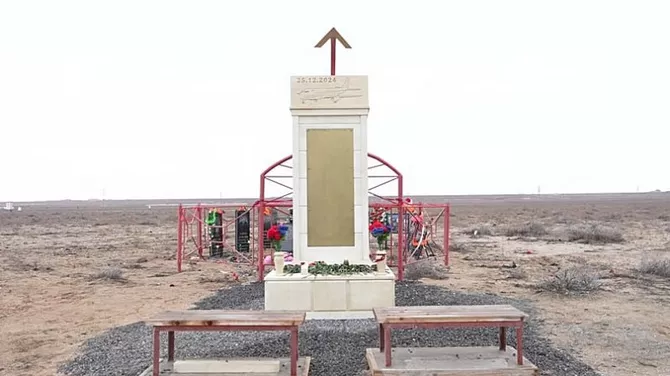
Memorial to the victims of the AZAL plane crash near Aktau, Kazakhstan (Photo: Euronews)
For Azerbaijan, what is happening goes far beyond a legal debate. It is a matter of justice, of honoring the memory of the victims, and of respect for their families. Compensation without acknowledgment of the causes of the tragedy is not perceived as justice restored. It looks like an attempt to close the issue with money, without calling things by their proper names.
For now, Baku continues to exercise restraint. Diplomatic channels remain functional, and public rhetoric remains careful. But the discrepancy between the political statements of the Russian president and the official version of the investigative authorities is becoming increasingly evident and unacceptable. It signals that Moscow is not yet ready to elevate political acknowledgment of responsibility to the legal level.
Ultimately, the AZAL aircraft disaster has become a test not only for Azerbaijani-Russian relations, but for the integrity of Russia’s system of governance itself. In Dushanbe, Putin demonstrated that choosing the truth is possible and politically acceptable. Bastrykin’s letter shows that not everyone within the system is prepared to make that choice.
And this is where the main fault line lies. Either the Russian state apparatus will bring its legal actions into line with the words of its president, or it will cement the impression of a split reality - one in which political acknowledgment exists on its own, while the investigative version lives in a separate, more convenient world. For Azerbaijan, this choice is already clear. Now it is Moscow’s turn.
By Tural Heybatov