Photo: AZERTAC
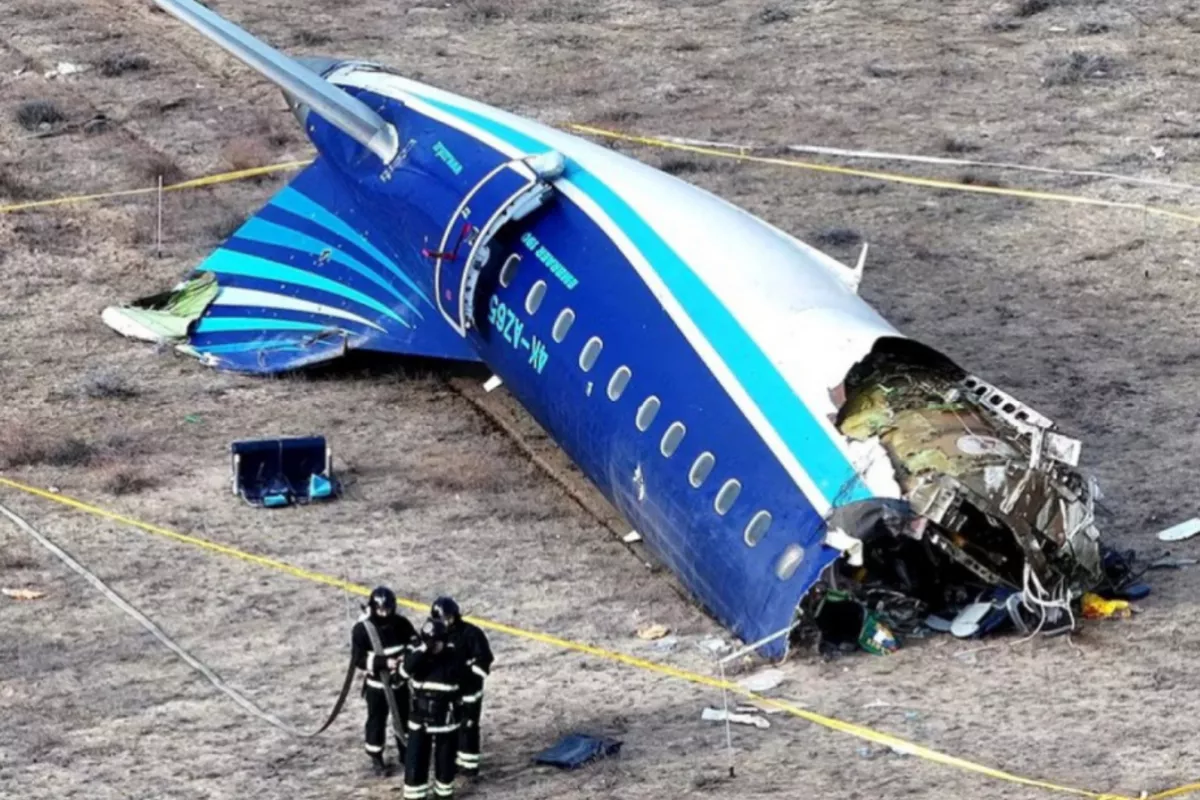
International aviation experts say the crash of an Azerbaijan Airlines (AZAL) passenger plane was caused by an external attack rather than a technical failure, following a joint investigation involving Azerbaijan, Kazakhstan, Russia, Brazil, and the International Civil Aviation Organization (ICAO)
The investigation into the crash of an AZAL Embraer 190-100 IGW, which went down in Kazakhstan on December 25, 2024, is continuing under international aviation rules set out in Annex 13 of the Chicago Convention, The Caspian Post reports via local media.
Kazakhstan’s Ministry of Transport is leading the technical investigation with the participation of experts from the ICAO, as well as representatives from Azerbaijan, Brazil, and Russia.
At the same time, law enforcement agencies in Azerbaijan, Kazakhstan, and Russia are conducting parallel criminal investigations within their respective jurisdictions.
In line with ICAO requirements, Kazakhstan released a preliminary report in February. That document outlined only confirmed facts and deliberately avoided analysis or conclusions. As the final report could not be completed by the anniversary of the crash, Kazakh authorities published an interim public statement, also in accordance with ICAO procedures.
The interim statement confirms that the aircraft’s oxygen cylinders were intact, ruling out the possibility of an internal explosion. It also notes that the damage to the aircraft was caused by foreign metal objects identified as fragments of an explosive device linked to a weapon system. While the specific model of the weapon system was not named, previous political statements - including remarks by the Russian president - have referenced the possible involvement of air defense systems belonging to Russia’s Ministry of Defense.
According to the interim findings, the next step will be the publication of a final report. This document is expected to provide a detailed account of all factual evidence, an in-depth analysis of the causes of the crash, and safety recommendations aimed at preventing similar incidents in the future.
Based on the materials released so far by Kazakhstan and the joint assessments of experts from Azerbaijan, Russia, Kazakhstan, Brazil, and ICAO, investigators conclude that the aircraft lost control and crashed not due to a technical malfunction, but as a result of external interference - specifically, being shot down.
Share on social media