Sanctions Bite as Russia Turns to Mothballed Boeing 747s
Western sanctions are increasingly reshaping Russia’s civil aviation landscape, forcing carriers to look to the past to keep fleets in the air. Simple Flying highlights that the inability to acquire new aircraft and spare parts has pushed Russian operators to reactivate long-mothballed Boeing 747s, a move that highlights both the depth of the industry’s challenges and the stopgap solutions now being adopted.
As Russia shows no sign of ending hostilities in Ukraine, over 3 years after it invaded its neighbor, sanctions from nations in the Western Bloc continued to block the flow of aerospace material and parts. That has left the predominantly imported airliner fleet of Russian carriers in dire straits.
The Odessa Journal reports that Rossiya Airlines is looking toward bringing Boeing 747 "jumbo jets” out of the "boneyard" that were mothballed when Transaero declared bankruptcy in order to supplement its fleet, which is struggling to keep airplanes flying. The 747s that are being considered by Rossiya are over 20 years old.
A Broken Supply Chain
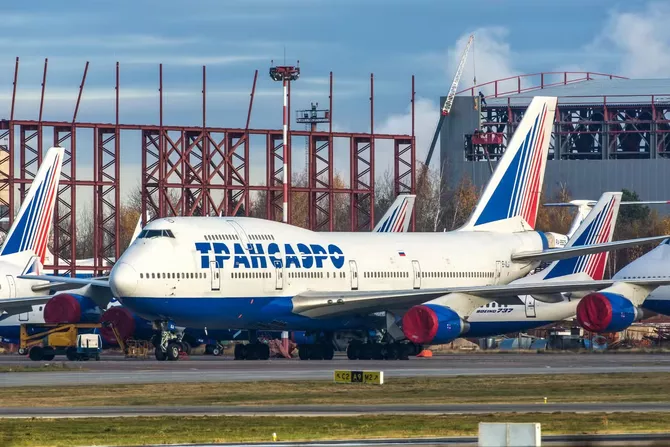
photo: simple flying
The vast majority of Russian commercial aircraft in service are Airbus or Boeing-made jets today. The lack of spare parts and replacement equipment from their original manufacturers has made it difficult to maintain regular air service across Russia. Russian airlines have reactivated legacy platforms made during the Soviet-era, including Tupolev Tu-204s and 214s, Ilyushin Il-96s, and Antonov An-148s.
The Odessa Journal reported that as of late last year, there was a total of 1,135 Russian commercial planes in service, with 1,088 operational, and 67% of those are foreign-made. The lack of alternative aircraft is driving carriers to consider restoring planes mothballed for three decades to reenter service, Soviet and foreign models alike.
Rossiya Airlines will likely begin with the newest and most modern 747s of the Transaero mothball fleet. These jets are 747-400s, which were acquired secondhand from other airlines by Transaero. According to RBC-Ukraine, Rossiya could restore as many as nine 747-400s inherited from the collapse of Transaero.
The Foreign Intelligence Service of Ukraine made these remarks in a recent statement, as relayed by RBC-Ukraine:
"Rossiya Airlines is increasing its fleet of Boeing 747s, inherited after the bankruptcy of Transaero. Airliners that are more than 20 years old are returning to service after many years of storage, in particular due to a lack of alternative equipment."
The Boneyard Fleet
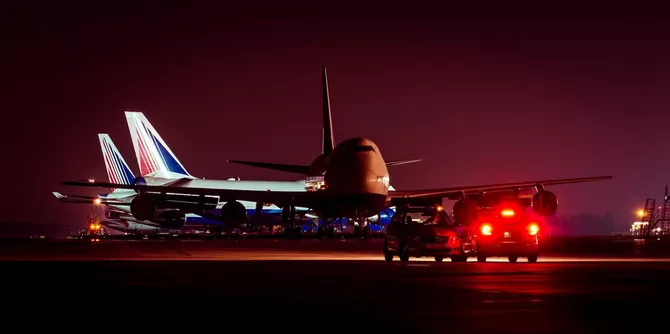
photo: simple flying
Transaero was the first airline in Russia to operate the Boeing 747. When it started service in 2005, flying a leased 747-200 between Moscow and Tel Aviv, Israel. The aircraft would become a critical transcontinental workhorse to not only connect to Russia with international destinations but also bridge the vast expanse of Siberian wilderness across the continent of Russia between the east and west coast.
As a cost-saving measure, the airline did not acquire any new Boeing 747 aircraft until the final, the 747-8, which it did not ever take delivery of due to bankruptcy. The first 747-200's that Transaero acquired were from Virgin Atlantic and Air New Zealand. The carrier later acquired 747-300s and 747-400s from Japan Airlines and more -400s from South African Airways, as well as Singapore Airlines, according to Yesterday’s Airlines.
At its peak in 2013, Transaero had an international portfolio that included 52 destinations. Relying heavily on the leisure market, the economic and political turmoil caused by the conflict between Russia and the international community effectively killed the airline immediately. When Transaero declared bankruptcy, it had a number of 747-8s on order. Since then, the aircraft were resold to the United States Air Force and are being redeveloped as replacements for both the legacy “Air Force One” VC-25 and its “doomsday plane” fleet of E-4B Nightwatch nuclear alert platforms.
Russia’s Future Airliners
photo: simple flying
Yakoklev and the United Aircraft Corporation (UAC) are working on developing a domestically-produced single-aisle, modern airliner, but have yet to reach the production stage. The MC-21, as it is known, is expected to rival contemporaries like the Airbus A320neo and Boeing 737 MAX in performance. The aircraft originally had Pratt & Whitney engines as well as Western-made avionics, and since switching to Russian-produced alternatives, it is still going through pre-production trials.
Similarly, the Sukhoi Superjet regional airliner is still working through testing and certification, with Yakovlev taking over as the lead contractor. The aircraft’s design originally included parts sourced from the West, but will be purely Russian-made under the changes from Yakovlev and UAC. It is intended to compete with Embraer’s E-Jets that seat around 100 travelers, but like the MC-21 is still struggling through development.