Azerbaijan Presents National Statement at UN Environment Assembly
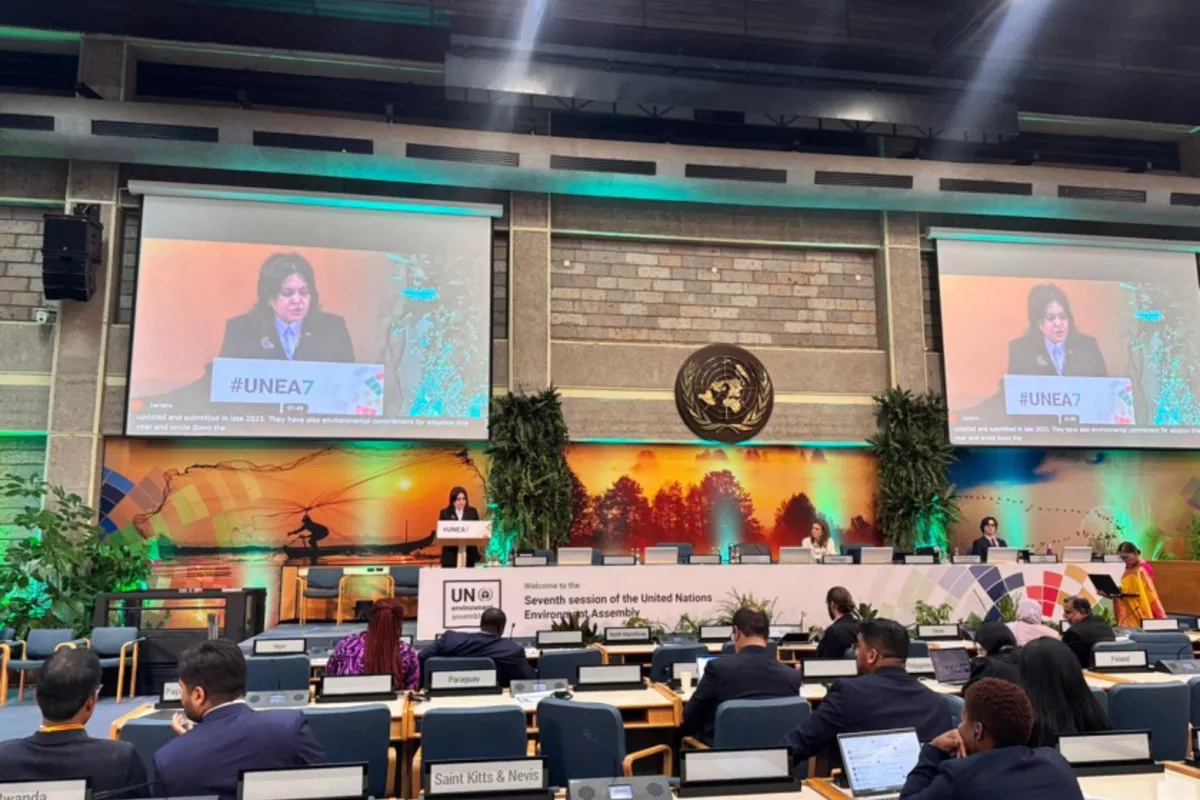
The national statement of the Republic of Azerbaijan was delivered at the seventh session of the UN Environment Assembly (UNEA-7) held in Kenya.
The Statement was delivered by Umayra Taghiyeva, Deputy Minister of Ecology and Natural Resources of Azerbaijan, The Caspian Post reports, citing local media.
In her remarks, the Deputy Minister stated that the impacts of climate change, environmental degradation, and pollution are being felt across all regions, and Azerbaijan is no exception. “We are observing a 30 percent decrease in the country’s incoming water resources, our ecosystems are facing increasing pressure, and the world’s largest enclosed water basin, the Caspian Sea, is shrinking rapidly. These challenges continue to shape Azerbaijan’s national environmental and climate agenda,” she said.
Umayra Taghiyeva touched upon the outcomes of Azerbaijan’s hosting of COP29 last year under the leadership of President Ilham Aliyev. She noted that COP29 ensured the implementation of the mandates agreed upon and strengthened global climate ambition. The agreement reached on the New Collective Quantitative Goal for climate finance became a turning point, enabling developing countries to implement their national climate plans. She stressed that the commitments made in Baku must be fulfilled without hesitation and delay. Other decisions adopted at COP29, including the finalization of the Paris Agreement rules regulating carbon markets, fully activated the Agreement’s policy framework. This created a solid foundation for a more meaningful and practical implementation phase during the second decade of the Paris Agreement.
At the national level, the Deputy Minister emphasized that Azerbaijan is setting an example in climate action and environmental policy. She noted that Azerbaijan has confirmed its commitments under the Paris Agreement by submitting its updated Nationally Determined Contribution “NDC 3.0.” The new target aims to reduce emissions by 40 percent by 2035. By moving this target 15 years ahead of the previous 2050 goal, Azerbaijan has demonstrated a significant increase in ambition within just two years. This decision represents another important step following the updated NDC 2.0 submitted at the end of 2023.
Taghiyeva added that Azerbaijan has further strengthened its environmental commitments by joining the Kigali Amendment and the Rotterdam Convention. These steps demonstrate the country’s determination to align with global efforts on hazardous substances management, air quality improvement, and climate change mitigation.
She noted that work continues across the country in the areas of ecosystem restoration, biodiversity conservation, building climate-resilient communities, and developing sustainable ecosystems. In this context, “green development” remains one of the core priorities of the Socio-Economic Development Strategy for 2027-2030.
The Deputy Minister stated that next year Azerbaijan will co-host the World Urban Forum (WUF13) together with UN-Habitat and will host World Environment Day (WED 2026) in collaboration with the United Nations Environment Programme (UNEP). She invited all partners to Baku to take part in these important events.