Researching a book about the region, author Joe Luc Barnes travelled on this inexpensive 54-hour sleeper train journey from Almaty across the steppe to the ‘Kazakh Riviera’.
Thirty-five years after the Soviet Union fractured into 15 independent states, there are few things that still bind the former republics together. Borders that were once permeable have become rigid and fortified, and yet the railways continue to thread their way across steppe and mountain, their iron tendrils stretching between cities that now belong to different nations, The Caspian Post reports via The Times.
When researching my recent book Farewell to Russia: A Journey Through the Former USSR, I travelled by train whenever possible. I wanted to move slowly enough to appreciate the changing landscapes outside the window, just as the characters changed within.
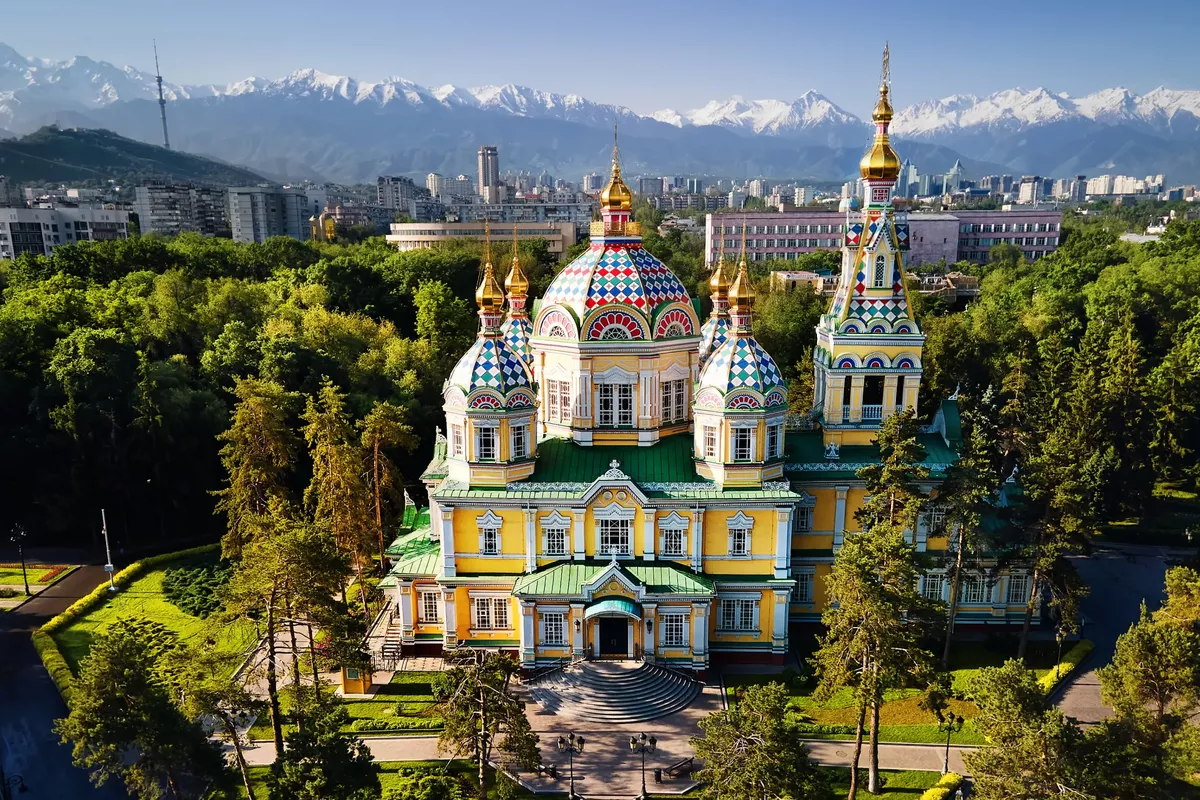
This is why I find myself in Kazakhstan, at Almaty-2 station shortly before midnight on a bitingly cold winter evening, preparing to travel 1,400 miles west to Aktau on the Caspian Sea. Fifty-four hours of overland adventure lie ahead.
It’s the same region, and the same sort of travel, familiar to anyone who has watched the latest TV series of Race Across the World, whose participants have been working their way from Palermo in Sicily across the Stans and the steppe to Mongolia, moving without flying, largely reliant on basic buses and long-distance trains. Almaty was one of the main hubs.
Here, no barriers block access to the platforms; instead, each carriage is guarded by a conductor, known as a provodnik, who demands to see your passport before letting you board, even on a domestic service.
I will be in kupé, a second-class compartment comprising two sets of bunk beds. Crisp white sheets already lie folded on each berth. I make up the bed as we ease quietly out of the station. There are no announcements on these trains - no polite requests not to assault the staff, no demands to report suspicious packages. Soon enough, the soporific clunk of wheels over sleepers and the gentle rocking of the carriage send me to sleep.
I wake in the pre-dawn light. The Tian Shan mountains are glowing a wondrous pink to the south.
Each passenger is provided with a plastic cup filled with sachets of coffee, tea and sugar. I don my flip-flops and walk down the corridor to the samovar.
Kazakhstan’s more modern Talgo trains now have electric water dispensers, but these carriages have a coal-fire tank, a relic of a bygone age that keeps the water and the radiators ferociously warm.
In a country as vast as Kazakhstan, those who can afford it usually prefer to fly. The Talgo trains are more comfortable, plying the routes between big cities such as Almaty and Astana, as well as connecting to the Uzbek network. But for those prepared to put up with a little discomfort, it’s hard to beat the atmosphere on these old-school trains.
Sleeper Cabins are Two-Berth
Brew in hand, I return to the compartment and contemplate the day ahead. I’ve brought Dostoevsky along to keep me occupied. I chose The Idiot, partly because I’m sure that’s what you’re thinking, and partly because it also begins with a chance meeting on a train.
For now I have one companion. When he stirs at 8am, eyes still half-closed, he reaches up into his bag for a can of Holsten lager.
Nurik is also travelling to Aktau, he tells me, where he works in an oil machinery factory. After a couple of revitalising sips, he is quick to start discussing money.
“I earn 500,000 tenge [£790] a month,” he tells me. “How much were your train tickets? Mine were 44,000 [£69], which isn’t so bad. The flights cost 60,000 [£95].”
Oil workers in Kazakhstan are often internal migrants, working in shifts - 28 days on, 28 days off. In their downtime, they hope to squirrel away as much as they can, so saving £26 on a flight is a fair trade.
With unnerving speed, Nurik moves on to beer number two, insisting that I take one myself. I refuse, slightly alarmed at the prospect of a 48-hour binge. Fortunately, salvation arrives in the form of the railway police, who spot the cans of Holsten as they pass our open compartment. Alcohol is not permitted outside the restaurant car. Nurik is summoned into the corridor and soon returns looking sheepish.
“Have you got any money?” he asks. He has been fined about £30 and is a fiver short.
It turns out that this was not an official fine. The police just wanted to make a little on the side out of Nurik’s misdemeanour. He looks cowed as he nestles up in his bunk. So much for the savings.
He is not put off for long. As it begins to rain outside, he opens another can which he keeps concealed in a black plastic bag.
Meeting Kazakh People is Part of the Adventure
A second guardian angel arrives in the form of Saule, who boards the train in the city of Turkestan, where history buffs might choose to disembark to see Kazakhstan’s most famous silk road city. Saule is a kindly woman in her late fifties, and if Nurik will not behave for the police or some nosey foreigner, he will do so for an older woman. He jumps up and takes his beer into the corridor.
The land empties as we leave the mountains behind and head north. We pass the occasional village, but for much of the time the train itself is the largest settlement for miles around. A moving town in a sea of nothingness.
When we do arrive at a station, an army of salespeople have assembled on the platform. Their offerings go far beyond BLTs and a packet of crisps. At many stations we stop for up to 30 minutes, leaving the hungry traveller time to take their pick from corn on the cob, barbecued meat or samsas (a central Asian pasty). At Aralsk, you could even buy a whole smoked fish. Some of these salespeople manage to smuggle their way on to the train, hawking anything from ice cream to clothing between stations.
Saule has little need of this. She has packed enough food for an expedition. While I’ve learnt to get by in Russian - still the lingua franca in most of central Asia’s large cities - Saule, like many people from rural parts of the country, speaks only Kazakh. This does not stop her from encouraging me to eat more through gestures. Bread, Mars bars, cookies, a bottle of Fanta… every time I hesitate, she presses something into my hand anyway.
It’s the kind of absurd generosity that first led me to fall in love with central Asia, and what makes slow travel here all the more enjoyable. Incidentally, if this route doesn’t take your fancy, others to consider that are linked by the modern Talgo trains and might be familiar from Race Across the World include Almaty to the capital Astana, with its lively central park and proximity to the Burabay national park (16 hours); Almaty to Shymkent, with its silk road culture, great food and bazaars (12 hours); or Almaty to Tashkent, Uzbekistan’s culture and museum-filled capital (18 hours).
There is one thing that, remarkably, Saule has not prepared for. Kazakhstan is one of the world’s least densely populated countries, and the phone signal goes dark for hours on end. In these merciful hours she is forced to cease her full-volume doomscrolling on TikTok. The compartment drifts into blissful silence as she stares intently at the phone, as though willing it to come back to life.
The endless steppe, now flecked with snow, drifts past outside. I reach for Dostoevsky.
The carriage has two bathrooms, which are cleaned every couple of hours, but there’s no disguising the lack of adequate washing facilities. By the morning of day three, this is beginning to grate a little.
Seeing Camels and a Fox on the Steppe
On the steppe outside, I see a herd of camels standing resolutely in the wind, and later a fox slinking by. At one station, I step out to stretch my legs for 30 seconds but it’s freezing (better to come when it’s warm, I think).
In 1839 there was a famed Russian expedition to conquer Khiva (now in modern Uzbekistan). Led by General Perovskiy, 5,000 men attempted a doomed march across this winter steppe. In the end, they were forced to turn back before they even got close; 1,000 men and the vast majority of the camels were lost to the snow and the wind. Looking out of the window, I’m not surprised at this failure, and more than anything amazed at the audacity of the attempt.
A layer of snow and ice has formed between the carriages, making passage to the dining car increasingly treacherous. The restaurant is almost empty; the server looks up from the mound of carrots she is chopping to take my order.
The restaurant offers a range of central Asian staples. Mains for under £5 and beers for £2.50 seem extremely good value to me, but I find only one other customer there.
He beckons me over. Daniyar is travelling to the western oilfields, working in security. He comes from Baikonur in south Kazakhstan, the original launch site for the Soviet space programme. The area, though technically in Kazakhstan, has been leased by Russia until 2050. “If you want to work on the space programme, you have to be a Russian citizen,” he explains. “There are no jobs there for us.”
Still, he feels the Russians and Kazakhs in Baikonur rub along well enough. “There’s no such thing as bad nations, only bad people,” he says. Daniyar is divorced, with a son. He shows me photographs of his boy, as well as the house he is building, brick by brick, in his time off. When food arrives - steaming noodles in broth - he insists on paying for us both. “In Kazakhstan, food is meant to be shared,” he says firmly.
Arriving in Aktau, the Kazakh Riviera
We arrive in Aktau, the end of the line, at 5.40am. From here, ferries cross the Caspian Sea to Baku, the capital of Azerbaijan, linking central Asia to the Caucasus and onwards to Europe. These days it is the only practical overland route from Europe to Asia that avoids both Russia and Iran. The ferry is sporadic, unpredictable and far easier to take heading east than west, but it exists. The railway delivers you to its edge.
Aktau, once a closed city and an important centre of the Soviet nuclear industry, is known as the “Kazakh riviera” now. In summer, its beachfront is thronged with tourists, the proliferation of new hotel developments a testament to its growing popularity.
I alight feeling oddly restored, my mind cleared of clutter. A flight would have saved me 51 hours, but what would I have done in that time? Would I have been nourished by landscapes, literature, conversation, and the mountains of food thrust upon me by my travelling companions? I highly doubt it.
Joe Luc Barnes travelled independently. One way tickets from Almaty to Aktau from £50pp (third class), £75 (second class) (tickets.kz). Fly to Almaty. British citizens can enter Kazakhstan visa-free for up to 30 days.
By Joe Luc Barnes