Central Asia now has a chance to turn its geographic isolation into a global advantage. The global energy supply map is undergoing a major transformation. According to Bloomberg, Washington has officially allowed Kazakhstan to continue transit of Russia oil to China until March 19, 2027.
This decision comes amid growing instability in the Strait of Hormuz-a critical chokepoint for global energy flows-forcing Japanese energy giant INPEX to explore redirecting Kashagan crude from Europe to Asian markets, The Caspian Post reports via Russian media.
At the same time, the risk of secondary EU sanctions is already reshaping refining dynamics in the Black Sea region. A refinery in Kulevi has fully shifted to Central Asian oil, reinforcing the region’s emerging role as a reliable and secure energy hub.
According to analysis by JPMorgan, the blockade of the Strait of Hormuz in March 2026 triggered a critical disruption in the global energy system.
A halt in production across Gulf countries led to an unprecedented supply crunch, hitting Asian economies the hardest-especially Japan, South Korea, and China, which relied on the route for up to 80% of their energy imports.
Today, global markets are facing acute shortages not only of crude oil but also refined products such as diesel, jet fuel, and liquefied gas.
In response, Japanese energy giant INPEX-a key player in the North Caspian project-has reportedly launched a sweeping overhaul of its export strategy.
The move centers on redirecting oil flows from the Kashagan field. Supplies that traditionally went to Europe are now being rerouted to Japan, as Tokyo races to strengthen its energy security amid escalating tensions in the Middle East.
The crisis has also forced the Japanese government to take drastic measures, including tapping into its strategic oil reserves. Released volumes are being rapidly distributed to domestic wholesalers to stabilize supply.
Although Japan’s reserves are estimated to cover around 200 days of consumption, authorities are already pushing to diversify import routes and reduce dependence on vulnerable chokepoints.
Amid the blockade of the Strait of Hormuz, several alternative routes are being considered to deliver Kazakhstan’s oil to Japan.
“The challenge is that there is no direct pipeline connection between Kazakhstan and Japan, so logistics rely on a combination of pipelines and maritime transport,” said Grigory Mikhailov, editor-in-chief of LogiStan.info website.
According to the expert, up to 80% of Kazakhstan’s oil exports are shipped via the Caspian Pipeline Consortium to the Russian port of Novorossiysk-a route currently operating at near capacity.
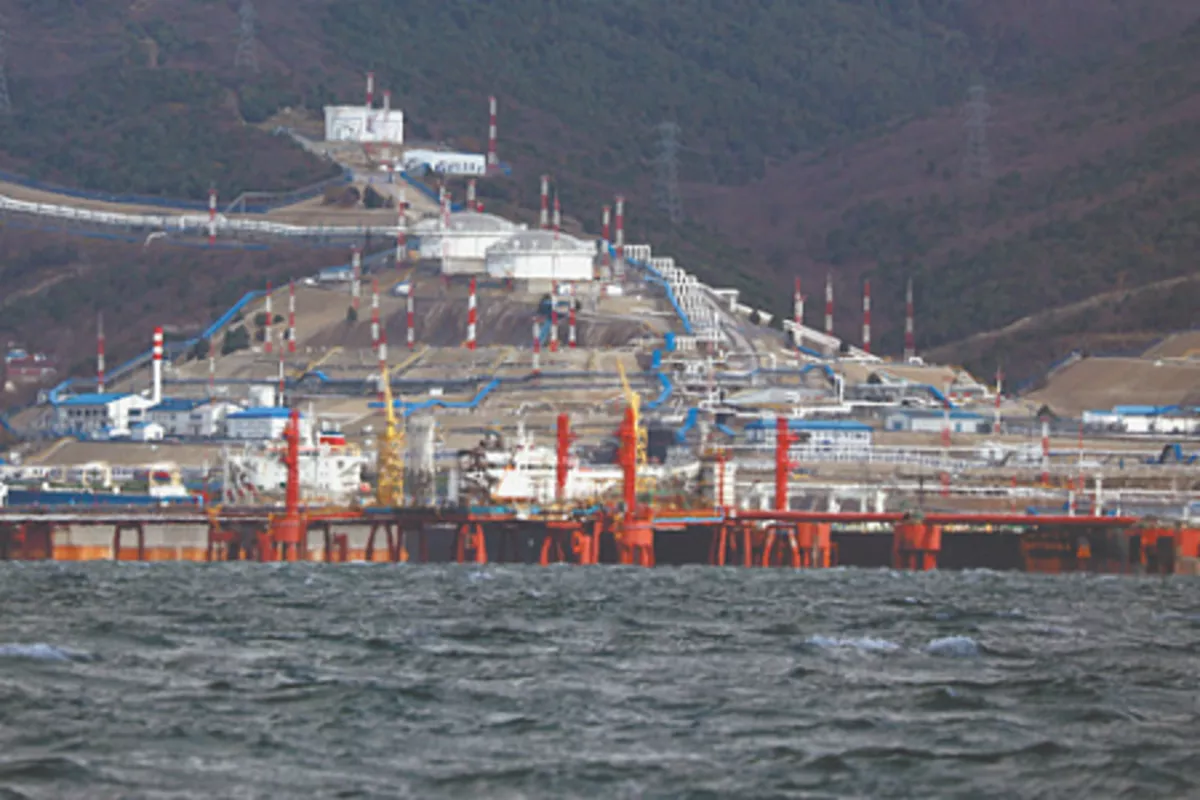
Since late 2025, this critical artery has also been functioning under constraints following damage caused by drone strikes. At present, only one of the three offshore loading terminals remains operational, significantly limiting throughput.
Another option is the northern route via the port of Ust-Luga. However, experts say it is unlikely to be viable for Japan due to its limited capacity and significantly higher transportation costs.
“Transporting oil from Novorossiysk to Japanese ports has become an increasingly complex and expensive logistical challenge. The traditional route via the Mediterranean, the Suez Canal, and the Red Sea is effectively blocked due to military risks. In the current environment, rerouting shipments around Africa via the Cape of Good Hope is considered a safer-though significantly more costly-alternative. Transit times can stretch to 35-55 days,” said Mikhailov.
Despite the longer journey and higher expenses, the African route remains economically viable. By avoiding the Middle East, shipowners can bypass prohibitively high war-risk insurance premiums, which have surged amid regional instability.
However, the implementation of this route is hindered by strict sanctions imposed by Tokyo against Moscow. This is increasingly sparking debate within Japan itself.
Japanese lawmaker Muneo Suzuki has called for an urgent review of restrictions on Russian energy imports, arguing they run counter to national interests.
According to reports, Suzuki believes that easing these barriers could allow Japan-already importing around 10% of its liquefied natural gas from Russia-to significantly boost oil and gas purchases and stabilize its domestic energy market.
As global energy routes come under pressure, experts are pointing to creative solutions to keep oil flowing. One such option, proposed by Mikhailov, is the use of swap operations.
Under this model, Kazakhstan would ship its oil to Europe or Türkiye to fulfill contractual obligations, while Japan would receive equivalent volumes from suppliers in the Asia-Pacific region or the US.
This approach effectively removes the risky Strait of Hormuz from the supply chain and helps reduce transportation costs.
At the same time, Astana continues developing the Trans-Caspian International Transport Route. Oil is shipped from the port of Aktau across the Caspian Sea to Baku, then transported via the Baku-Tbilisi-Ceyhan pipeline to Türkiye and onward to Mediterranean ports.
However, this route-often still requiring shipments around Africa-faces a major limitation: relatively low throughput capacity.
The most promising yet technically complex option is the eastern route. Kazakhstan has already begun redirecting Kashagan oil to China via the Atasu-Alashankou pipeline.
From there, crude moves through China’s internal network to Pacific ports such as Qingdao and Tianjin before being shipped to Japan.
While this corridor is stable, it faces a key constraint: China’s own massive demand, which absorbs a significant share of incoming transit volumes.
The eastern corridor is increasingly becoming a point of convergence for the strategic interests of Russia and Kazakhstan, as both sides explore expanding oil transit to China.
According to Bloomberg, the situation has been eased by Washington’s stance: the United States has extended permission for the transit of Russian crude through Kazakhstan to China via pipelines until the end of March 2027.
This diplomatic window gives market players breathing room to recalibrate supply chains amid ongoing global turbulence.
Despite the opportunity, experts urge caution. The eastern route’s capacity remains far below that of the Caspian Pipeline Consortium, the region’s main export artery.
In addition, related infrastructure-from refineries to rail hubs-is not equipped to handle a rapid redistribution of flows. Expanding these capabilities would require years of investment, while the market needs stabilization now.
At the same time, significant changes are unfolding at the regional level. Black Sea Petroleum, the only refinery in Georgia, has announced a complete refusal from Russian crude.
The decision was driven by the risk of secondary sanctions from the European Union, forcing the facility in Kulevi to urgently switch to supplies from Kazakhstan and Turkmenistan.
The refinery’s management is currently exploring new supply routes, including the transit of Turkmenistan oil via rail through Azerbaijan. Plans for expansion are underscored by the construction of a second phase at the refinery, which will increase capacity from 1.2 million to 3.3 million tons per year.
This positions Georgia’s infrastructure as a “clean” corridor for Central Asian energy resources heading to European markets.
The political foundation for these projects was laid on March 30 in Tbilisi. At a meeting between Turkmen Deputy Prime Minister Nokerguly Atagulyev and Georgian Minister of Economy Mariam Kvrivishvili, both sides confirmed their readiness to accelerate the creation of an energy bridge.
Georgia has pledged to provide maximum support for transporting Turkmen oil and gas through its territory to Türkiye and onward to Europe.
This dialogue will continue practically at the next meeting of the Intergovernmental Commission on Bilateral Economic Cooperation, scheduled for May 6-7, 2026, in Ashgabat. There, agreements are expected to be finalized, cementing the Caspian-Black Sea region’s role as a key transit hub capable of operating under global instability and sanctions pressures.
Political Analyst at Nezavisimaya Gazeta Viktoriya Panfilova