Oil Companies Cut Costs at Kazakhstan’s Environmental Expense
Several of the world’s largest oil companies knew for years that they were at risk of being fined for breaching sulfur-stockpiling regulations in Kazakhstan, but didn’t resolve the problem in part due to concerns about cost.
Court documents seen by Bloomberg offer fresh insights into a case that has seen Kazakhstan impose a penalty of about $5 billion on North Caspian Operating Co., a venture that runs the giant Kashagan project on behalf of Eni SpA, Shell Plc and several other big oil companies, The Caspian Post reports via Bloomberg.
NCOC’s longstanding position throughout the process has been that it had all the applicable permits for the sulfur stash that expanded every year from 2016 to 2022 - the point at which the Kazakh authorities imposed the fine.
The documents seen by Bloomberg, which include internal emails and presentation slides that were submitted to an Astana court, don’t contradict that position but do show an awareness long before 2022 among several partners that such a penalty was possible.
The sulfur fine is connected to a wider $166 billion international arbitration centered around Kashagan, the country’s second-largest oil field. Kazakh authorities have being pushing for higher revenue from the nation’s resources and have sued the venture partners in international arbitration. Most of that amount relates to claims for lost revenue, but also includes environmental violations and deals that Kazakhstan alleged were tainted by corruption.
Kashagan pumped its first oil in September 2013, eight years later than targeted and $45 billion over its initial budget. The field shut down a month later after leaks were detected in a pipeline, finally resuming production in 2016.
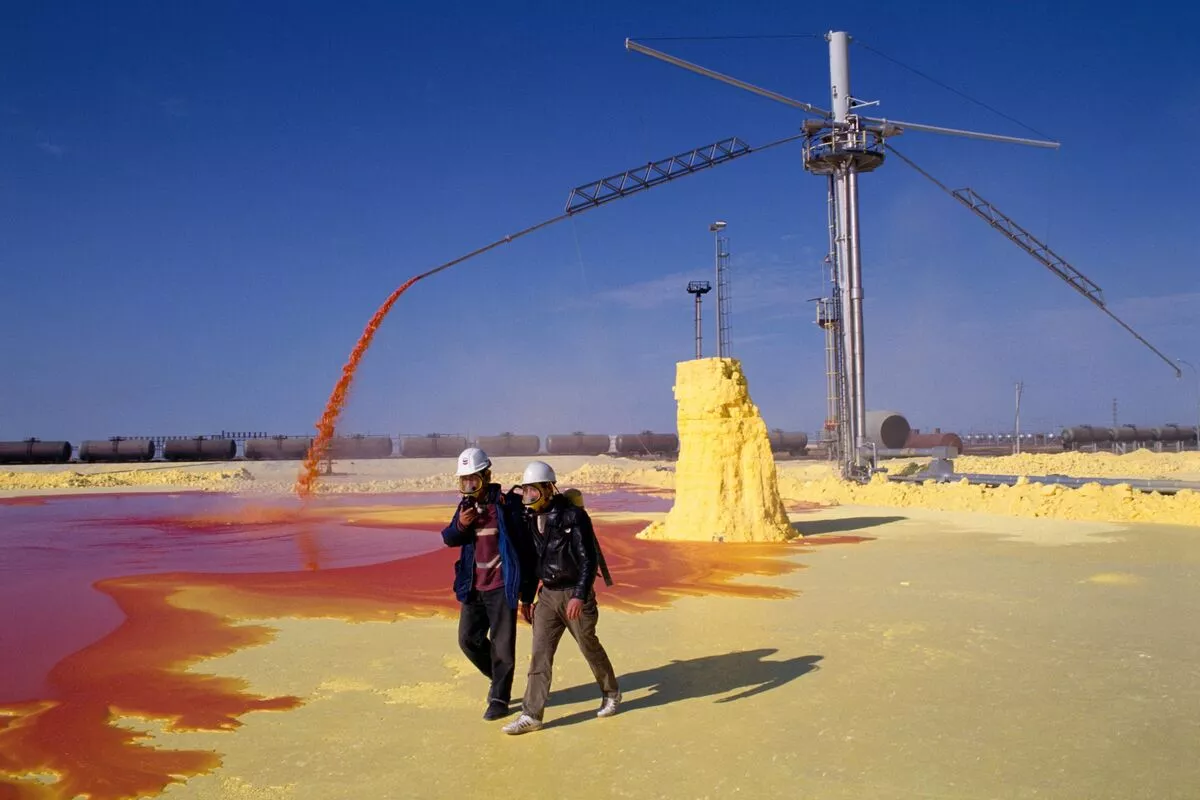
Soon after the restart, the operators faced the problem of what to do with the large volumes sulfur that had to be extracted from the crude to make it suitable for export, the documents show. The chemical was being stored in blocks at the site, a practice the Kazakh authorities wanted to limit in order to minimize the risk of pollution to the local environment.
Italy’s Eni said in an internal presentation in 2017 that the venture was on track to go well beyond mandated sulfur-storage limits. In 2019, Shell warned of the “massive financial risk” posed by 1.3 million tons of the chemical held at the site, which could incur penalties of $1,700 to $3,500 per ton.
By late 2020, North Caspian Operating Co., the joint venture that operated Kashagan, was warning that a new ecological code coming into force the following year would increase the risk of environmental fines. Eni executives were urging within their company to begin crushing blocks of sulfur stored at the field so the chemical could be removed and sold on international markets, the documents show.
However, the other international companies, which include Exxon Mobil Corp., TotalEnergies SE, China National Petroleum Corp. and Inpex Corp. had no immediate plans to do this in 2021, while state-owned KazMunayGas National Co. was still formulating its position, Eni said in an internal email in 2020.
Processing and removing the sulfur for sale on the international market would have resulted in a “negative netback,” meaning the companies would lose money, according to the 2020 document from Eni.
In October 2021, Eni warned of the “increasingly urgent need to evacuate the accumulated sulfur” because future permits would only be granted subject to a decrease in the amount stored. Yet the quantity of the chemical held at the site continued to increase into 2022, according to data on NCOC’s website.
In December 2022, Kazakhstan imposed a penalty of 2.356 trillion tenge ($4.7 billion) on Kashagan. According to the court documents, the venture was storing 1.75 million tons of sulfur at the site, well above the limit of 730,000 tons set in the 2021 ecological code.
NCOC disputed the fine, citing procedural failures and arguing that environmental rules only regulated the amount of the chemical that could be added to storage each year, not the total amount accumulated.
In an emailed statement, NCOC reiterated that Kashagan’s sulfur management facilities had all necessary permits. The company said it will “continue to pursue all available avenues of recourse against this decision” to impose a fine.
Shell, TotalEnergies and Exxon declined to comment, referring all questions to NCOC. KazMunayGas and Inpex declined to comment. CNPC didn’t respond to requests for comment.
“NCOC’s sulfur management facilities have been fully approved and all permits have been in place, in full compliance with the legislation of the Republic of Kazakhstan,” Eni said in an emailed statement.
When asked about the documents submitted to the Astana court, Kazakhstan’s Energy Ministry said it is “aware of materials related to issues of production planning and risk management during sulfur storage at the project,” according to an emailed statement. “These data were taken into account by the competent authorities.”
In December, an Astana-based court denied NCOC’s appeal against the fine. This latest decision hasn’t yet entered into legal force pending an appeal that could be filed within two months of the ruling, Kazakhstan’s Ministry of Ecology and Natural Resources said by email.