Why Kazakhstan Is Rebuilding Its Political System in 2026
The world is entering a period of systemic rupture. The war in Ukraine, rising tensions between the European Union and the United States over Greenland, preparations for a potential large-scale confrontation with Iran, and relentless trade wars are only fragments of a broader picture marked by uncertainty and strategic realignment. Against this turbulent global backdrop, the internal political transformation now unfolding in Kazakhstan has emerged as an event of far greater international significance than it might appear at first glance.
On January 19-20, 2026, the Fifth National Kurultai held in Kyzylorda signaled preparations for a fundamental overhaul of Kazakhstan’s system of supreme state power. President Kassym-Jomart Tokayev announced a radical restructuring of the political system that, if approved by a nationwide referendum, would dismantle the current bicameral parliament and replace it with a unicameral legislative body. As noted by Deutsche Welle, this represents the most far-reaching institutional reform since 2022.
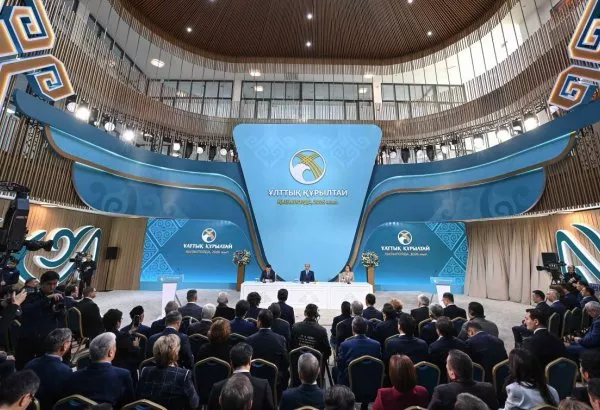
photo: Turkic World
Under the proposed constitutional amendments, the Majilis and the Senate would be abolished and replaced by a single legislative chamber known as the Kurultai. It would consist of 145 deputies elected for five-year terms exclusively through proportional representation based on party lists. Single-mandate districts, reintroduced only in the 2023 elections, would once again be eliminated. Mandatory quotas for women, youth, and persons with disabilities would be retained, reinforcing Tokayev’s stated commitment to social inclusion.
The institutional redesign goes further. The number of parliamentary committees would be reduced from eleven to eight, while the Speaker would be supported by three deputies instead of two. More importantly, the new parliament would acquire expanded authority, including participation in forming the Constitutional Court, the Supreme Audit Chamber, and the Central Election Commission - institutions that until now have largely remained under presidential influence.
One of the most politically symbolic steps is the proposed abolition of the Assembly of the People of Kazakhstan, a consultative body created under the country’s first president, Nursultan Nazarbayev. The Assembly previously enjoyed guaranteed representation in parliament. Tokayev argued that such privileged quotas contradict the principle of an independent and self-sufficient legislature. “The new parliament does not need guardianship or supervision,” he stated, emphasizing that it should be formed solely through universal elections.
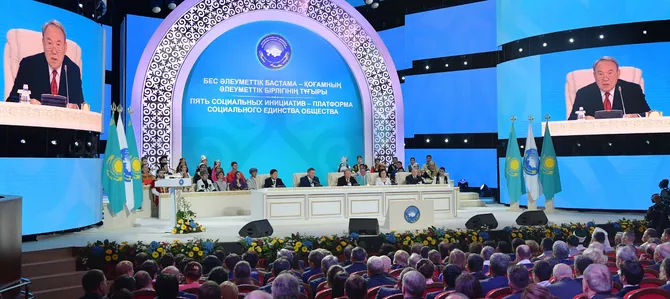
photo: Astana Times
In place of the Assembly of the People and the existing People’s Kurultai, the president proposed the creation of a new consultative institution - the Khalyk Kenesy (People’s Council). Enshrined in a separate section of the Constitution and regulated by a special constitutional law, this body would be designated the country’s highest consultative organ. It would comprise 126 members: 42 representatives of ethnocultural associations, 42 from major public organizations, and 42 from regional maslikhats and public councils. All members would be appointed by the president, while the chair would be elected internally. Notably, the council would be granted the right of legislative initiative, significantly elevating its role within the political system.
On January 21, Tokayev is expected to sign a decree establishing a Constitutional Commission to draft the amendments. A nationwide referendum could follow as early as late March. Should the reforms be approved, elections to the new unicameral parliament may take place within months. The electoral system would be strictly proportional, with party lists as the sole mechanism, while maslikhat elections would retain their majoritarian format. The five-percent electoral threshold would remain unchanged, despite earlier proposals to raise it to seven percent.
Equally consequential is the restoration of the post of vice president - a position abolished in the early years of independence. The vice president would be appointed by the president with parliamentary approval and tasked with representing Kazakhstan internationally, acting as the president’s liaison with parliament, and engaging with domestic and foreign public, scientific, and cultural institutions. Simultaneously, the position of state counselor, previously responsible for domestic political affairs, would be eliminated, alongside parts of the existing parliamentary apparatus. The presidential administration itself is also set to undergo reform.
According to Tokayev, these changes are not designed to weaken presidential authority. On the contrary, he stressed that the presidency would remain the central pillar of the state system and that Kazakhstan would continue to develop as a presidential republic. The logic is managerial rather than ideological: clarifying the hierarchy of power, reducing institutional duplication, and stabilizing governance in a period of heightened uncertainty.
photo: Qazinform
A particularly notable constitutional innovation concerns presidential succession. Under current rules, if a president is unable to perform duties, power passes to the Senate speaker for the remainder of the term, whether months or years. With the Senate abolished, this mechanism becomes obsolete. The new proposal introduces snap presidential elections within two months, replacing interim rule with rapid democratic renewal.
Taken together, these reforms reflect a broader reassessment of institutional models imported during the early post-Soviet period. Many newly independent states once mirrored Western constitutional designs without fully accounting for their own historical and political realities. A bicameral parliament, logical in federal systems such as the United States, proved less relevant in a unitary state like Kazakhstan. The shift to a unicameral legislature and the introduction of a vice presidency aim to create a more flexible, responsive system capable of managing elite transitions without destabilization.
In essence, Kazakhstan is not merely reforming its political institutions - it is adapting to a world in which predictability has vanished. The proposed changes are intended to strengthen democratic mechanisms, reinforce national unity, and construct a “safe transition corridor” for future transfers of power. In an era of global fragmentation, Kazakhstan’s leadership appears determined to preempt uncertainty at home before it is imposed from abroad.