How Japan Leads Central Asian AI Talks by Focusing on Governance
As artificial intelligence becomes a new arena of geopolitical competition, Japan is advancing a notably restrained yet strategic approach in Central Asia. In an article published by East Asia Forum, Timur Dadabaev, Professor of International Relations and Director of the Special Program in Japanese and Eurasian Studies at University of Tsukuba, argues that Tokyo is prioritizing governance frameworks over rapid technological deployment. Rather than exporting AI solutions at speed, Japan is focusing on institutions, regulatory norms, and policy dialogue-quietly positioning itself as a rule-shaper in Central Asia’s emerging AI landscape.
Japan elevated its Silk Road diplomacy with Central Asia in 2025 by launching an AI cooperation partnership focused on governance, training and institution-building rather than infrastructure. By embedding AI into public administration, logistics and customs systems, Tokyo is reshaping how Central Asian states define efficiency, risk and compliance. The strategy offers capacity gains but risks entrenching external administrative frameworks, The Caspian Post reports via East Asia Forum.
Japan introduced the notion of ‘Silk Road diplomacy’ in 1997 to describe its approach to cooperation with Central Asia. But Japan’s engagement with the region was only elevated to heads-of-state level in December 2025, indicating a renewed strategic commitment to shaping how Central Asian states build institutions and govern emerging technologies like artificial intelligence (AI).
The first summit of the Central Asia Plus Japan Dialogue (CA+JAD) was held in Tokyo on 20 December 2025. The meeting brought together leaders from Japan and the five Central Asian states who together adopted the Tokyo Declaration, which identifies three central areas of cooperation - green and resilience, connectivity and human resource development. The leaders also launched the Central Asia-Japan Partnership for AI Cooperation alongside these broader initiatives, securing ongoing collaboration on emerging technologies.
Unlike the technology- or infrastructure-centred models of international engagement used by China and South Korea, Japan’s approach reflects a distinctly Japanese approach prioritising how foreign institutions adapt and govern, rather than what technologies they adopt.
Within Japan’s AI cooperation framework, the significance of AI is in how it will alter existing administrative practices. Rather than supplying large-scale digital infrastructure, Japan emphasises upgrading existing institutions, particularly within public administration. This is evident in past frameworks supported by the Japan International Cooperation Agency, Japan’s governmental agency for development assistance.
These programs provide a natural entry point for introducing AI-enabled tools, including predictive risk analysis or automated inspection systems, into public administration. AI here systematises, not replaces, institutional judgment. This approach reduces political sensitivity and implementation risk, but it also reinforces an epistemic order in which technical expertise - often external to the region - defines what constitutes efficiency, risk and good governance. When implemented within public institutions, AI becomes a mechanism through which new administrative norms are diffused.
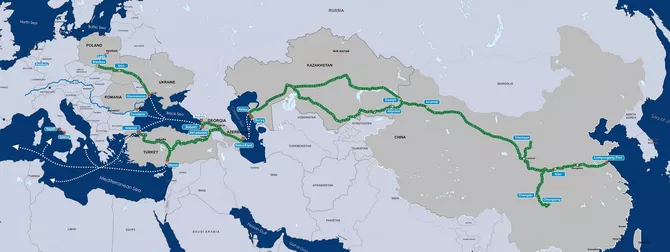
photo: The Times of Central Asia
Tokyo’s declaration following the summit also situates AI cooperation within broader connectivity initiatives, particularly along the Trans-Caspian International Transport Route. Projects in logistics optimisation, customs digitalisation and port modernisation demonstrate how AI-enabled systems are becoming embedded in physical infrastructure essential to public institutions. These technologies promise tangible benefits - faster clearance times, improved predictability and reduced transaction costs. Yet decisions about how they are designed embed particular assumptions about efficiency, security and economic value.
CA+JAD documents also link AI cooperation to economic security. By participating in frameworks such as CA+JAD, Central Asian states can compensate for their economies’ weaknesses, including a lack of visibility and integration into global markets. But this raises questions about who defines the analytical standards used by AI tools and who benefits from the resulting data ecosystems. These standards are embedded in data selection, categorisation and evaluation criteria decisions, typically defined by global technology firms and research institutions, not local stakeholders. AI systems consequently tend to reproduce external epistemic priorities, while the benefits of resulting data ecosystems remain unevenly distributed.
Without strong domestic analytical capabilities, Central Asian states risk allowing value creation and strategic insight to remain concentrated outside their region. Going forward, they must ensure that local institutions develop the capacity to shape, interpret and govern AI systems on their own terms.
Japan’s approach to AI cooperation contrasts with other major Asian actors. China typically bundles digital platforms and infrastructure with financing mechanisms that directly shape technological ecosystems, while South Korea engages through corporate-led technology initiatives and commercially-oriented infrastructure projects. Japan instead prioritises human resource development and the incremental integration of AI into governance routines, enabling engagement in politically sensitive domains with relatively low resistance. The question is whether this yields sustainable analytical autonomy for partner states or instead embeds external frameworks within administrative systems.
Japan’s AI diplomacy derives much of its significance from operating below the threshold of political visibility. By embedding AI within customs procedures, logistics governance and administrative training, Tokyo has the opportunity to shape how Central Asian states define efficiency, risk and compliance. Unlike infrastructure-driven or corporate-led ‘outside-looking-in’ models championed by several other countries, this approach gradually restructures state capacity from within.
Its long-term significance will depend on whether it enables genuine co-production of knowledge or entrenches dependence through technical systems which are presented as neutral. For Central Asian policymakers, the challenge is not whether to engage with AI diplomacy, but how to do so in ways that preserve strategic autonomy while benefiting from external expertise.
Japan’s AI diplomacy offers both an opportunity and a test case - one that will shape how norms, knowledge and authority circulate in an increasingly data-driven regional order. For Central Asian governments, this creates a dual challenge. While AI-enabled connectivity enhances regional integration, it may also generate new dependencies if local institutions lack the capacity to scrutinise or recalibrate these systems.
Central Asian leaders have responded with concrete proposals. Kazakhstan President Kassym-Jomart Tokayev has proposed establishing a regional AI partnership centre in Astana, positioning existing innovation infrastructure as platforms for this cooperation. This signals an emerging effort to align Japan’s governance-friendly AI engagement with domestic innovation ecosystems - and a recognition that participation in AI diplomacy must be matched by local capacity.