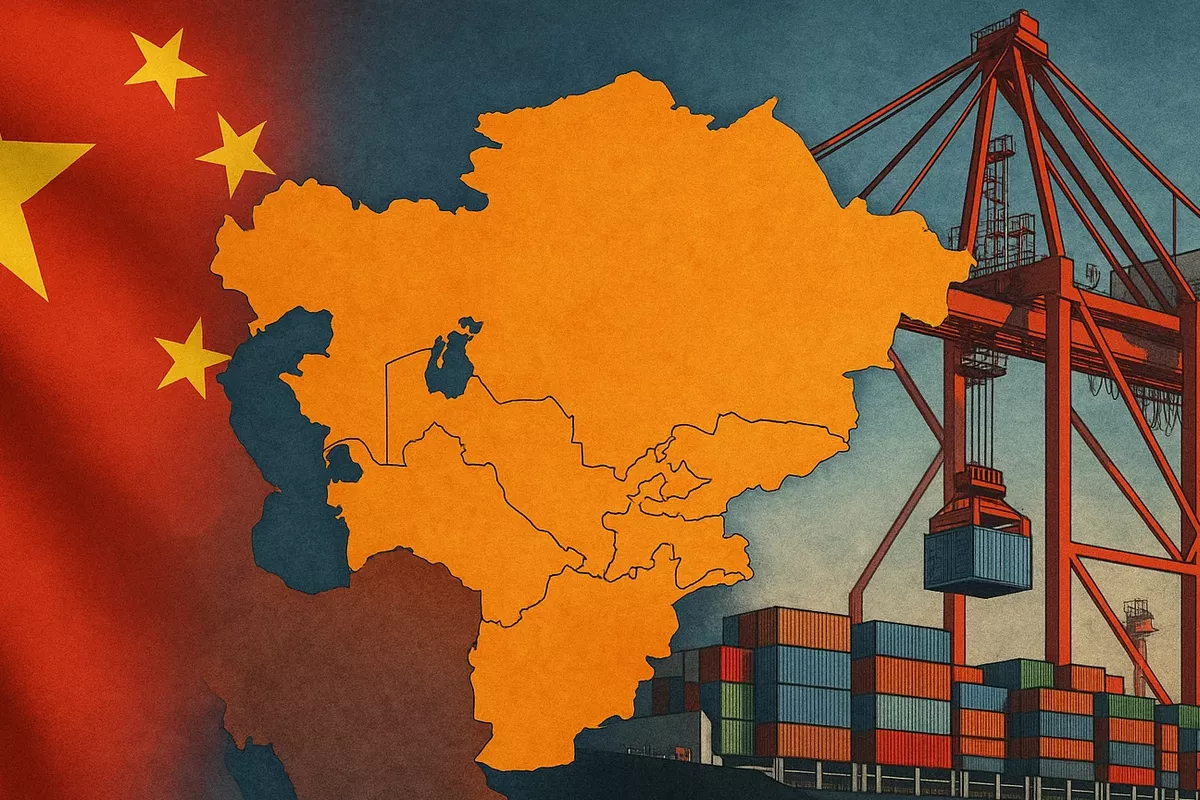
China’s Belt and Road Initiative (BRI) is often discussed in the vocabulary of spectacle-megaports, transcontinental railways, pipelines, and industrial zones that visibly announce Beijing’s arrival. Yet in Central Asia and the South Caucasus, China’s most consequential advance has unfolded with far less drama.
By 2025, Beijing’s influence in these regions had become embedded not simply in concrete and steel, but in systems: trade patterns, financing structures, logistics management, technical standards, digital customs platforms, and institutionalized diplomatic routines.
This form of expansion is “quiet” by design. It does not rely on coercion, military presence, or overt political conditionality. Instead, it reshapes the environment in which governments make decisions, narrowing future policy options while preserving the appearance of sovereign choice. For states located at the crossroads of Eurasia-historically shaped by imperial competition-this presents both opportunity and risk. Connectivity brings growth, but dependence brings constraint.
By 2025, China’s role in Central Asia and the Caucasus had reached a point of maturity. The question was no longer whether China would expand its presence, but how deeply that presence would structure the region’s political economy in the decade ahead.
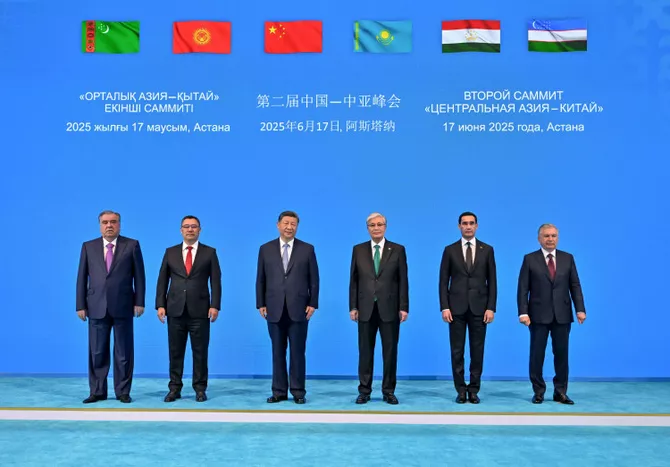
Photo: Akorda
2025 as an Inflection Point: Institutionalizing China’s Regional Role
The Second China-Central Asia Summit, held in Astana in June 2025, marked a decisive shift in how Beijing engages the region. What began as a relatively novel diplomatic format in 2023 became institutionalized, signaling continuity rather than experimentation. Regular summits, joint declarations, and sectoral cooperation mechanisms normalized China’s role as a permanent convening power.
This institutionalization matters. Historically, Central Asian states managed great-power engagement primarily through bilateral channels, preserving maneuverability by avoiding fixed structures. The new multilateral format alters that balance. While it reduces asymmetries among the Central Asian participants, it also embeds China at the center of a standing platform whose agenda-setting power rests largely with Beijing.
For regional governments, the appeal is obvious. China offers scale, speed, and financing capacity unmatched by other external actors. Infrastructure projects that might take years to negotiate with Western partners can move quickly under Chinese frameworks. Yet institutionalization also creates a “default setting”: Chinese involvement becomes the easiest, fastest, and most politically convenient option for major development initiatives.
Over time, this default setting shapes bureaucratic habits and policy reflexes. Officials begin to plan with Chinese financing in mind, design projects around Chinese technical standards, and anticipate Chinese participation as normal rather than exceptional.
Trade Expansion and the Logic of Asymmetry
Trade statistics from 2025 explain why regional leaders continue to embrace this relationship. China’s trade with the five Central Asian states surpassed the $100 billion threshold, a symbolic milestone reflecting structural integration rather than short-term fluctuation. Kazakhstan alone accounted for a substantial share, with bilateral trade exceeding $30 billion well before the end of the year.
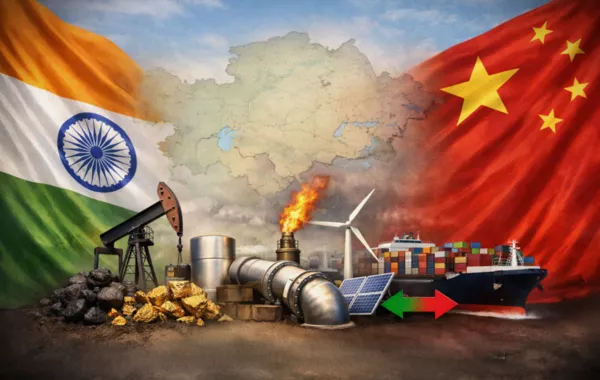
Yet the significance lies not only in volume, but in composition. Central Asia’s exports to China remain heavily concentrated in hydrocarbons, minerals, and raw materials. China’s exports to the region, by contrast, consist of machinery, electronics, industrial equipment, construction materials, and increasingly higher-value manufactured goods.
This asymmetry creates dependency dynamics. Commodity exporters are exposed to price volatility and limited diversification, while import dependence on Chinese industrial goods reinforces supply-chain reliance. When trade imbalances intersect with Chinese-built logistics networks and Chinese-financed infrastructure, economic dependence becomes multidimensional.
The result is bargaining asymmetry. In moments of fiscal stress, trade disruption, or political instability, China’s position as a dominant market and supplier enhances its leverage-often without the need for explicit pressure.

Photo: VCG
Railways as Strategy: Rewiring Eurasian Connectivity
Rail infrastructure illustrates the strategic depth of China’s approach. The China-Kyrgyzstan-Uzbekistan (CKU) railway, discussed for decades but repeatedly delayed, moved decisively toward implementation in 2025. Tunnel construction milestones and finalized financing arrangements signaled that the project had crossed from aspiration into material reality.
The political implications are substantial. First, the railway reduces reliance on northern transit routes through Russia, a priority shared by China and regional governments amid sanctions and geopolitical uncertainty. Second, it reshapes intra-regional hierarchies. Kyrgyzstan, long viewed as a geographic bottleneck, gains relevance as a transit node, while Uzbekistan consolidates its role as a regional logistics hub.
Third-and most critically-the railway locks participating states into long-term financial and technical relationships with Chinese institutions. Loan repayment schedules, maintenance contracts, rolling stock standards, and signaling systems create dependencies that extend well beyond construction.
This is not coercive expansion. It is structural integration. Once built, infrastructure constrains future choices by making alternatives costly, slow, or politically difficult.
The Middle Corridor: Influence Through Flow, Not Ownership
China’s engagement in the South Caucasus follows a similarly understated logic. Rather than acquiring strategic assets or asserting geopolitical claims, Beijing benefits from the region’s role as connective tissue between Central Asia and Europe.
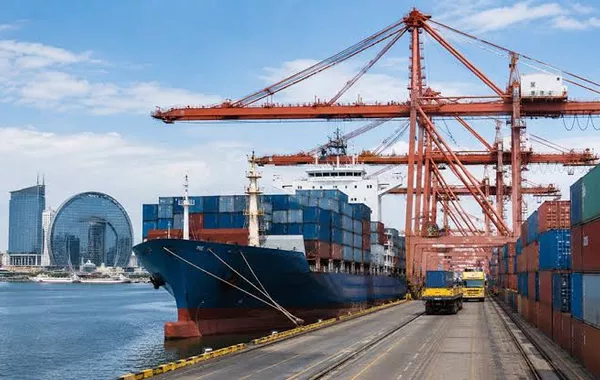
The Middle Corridor-linking China to Europe via Kazakhstan, the Caspian Sea, Azerbaijan, Georgia, and Türkiye-gained momentum in 2025 as states sought alternatives to Russian transit routes. Action plans to reduce bottlenecks, harmonize procedures, and improve coordination along the Trans-Caspian route transformed the corridor from a conceptual map line into an operational system.
China’s influence here does not depend on ownership of ports or railways. It flows from volume. As a major origin point for freight, China gains leverage through scheduling priorities, container availability, digital logistics platforms, and customs interoperability. Standards quietly follow flows, and standards shape control.
This form of influence is particularly resilient because it does not trigger immediate political backlash. It looks like commerce, not strategy-even though its long-term implications are strategic.
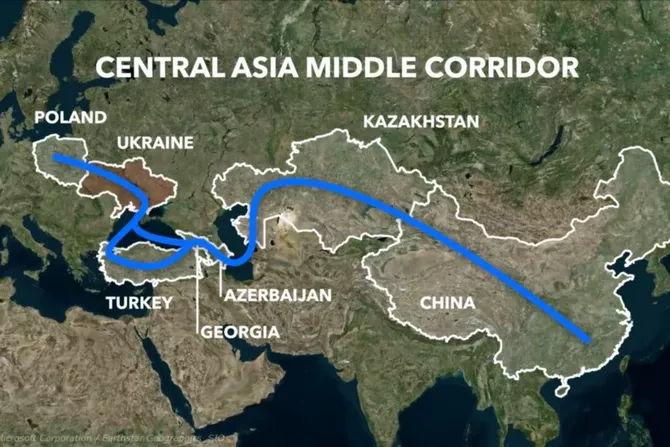
Photo: middlecorridor.com
Debt Exposure Reconsidered: From “Debt Trap” to Policy Gravity
The debate over BRI-related debt is often framed in alarmist terms, suggesting deliberate “debt traps.” In Central Asia, the reality is more nuanced and arguably more durable. The core issue is not asset seizure, but policy gravity.
In Kyrgyzstan, Chinese lenders account for a large share of external public debt. In Tajikistan, China is simultaneously a major creditor, investor, and trade partner. This concentration matters even when debt servicing remains manageable.
When a single partner occupies multiple economic roles, governments become cautious. Policy decisions-whether related to foreign alignment, regulatory changes, or infrastructure partnerships-are calibrated to avoid jeopardizing refinancing prospects or future disbursements. Strategic autonomy narrows not because sovereignty is lost, but because risk tolerance declines.
Debt anchoring also shapes domestic politics. Large infrastructure projects financed by China are often framed as symbols of development success, making governments politically invested in the continuation of the relationship. Criticism becomes easier to dismiss as anti-development or externally driven.
Infrastructure as Alignment: The Political Dimension
By 2025, infrastructure decisions increasingly functioned as signals of geopolitical orientation. Georgia’s prolonged debate over the Anaklia deep-sea port illustrated this dynamic vividly. With Western-backed alternatives stalled, Chinese-linked capital emerged as a potential solution-prompting explicit concern from Western policymakers.
For China, such situations are advantageous. Beijing does not need to force alignment; it simply needs to be present when alternatives fail. The absence of conditionality becomes a form of leverage.
European efforts to counterbalance China gained visibility in 2025, particularly through the EU-Central Asia summit and the announcement of a €12 billion connectivity package. These initiatives reflect a growing recognition that connectivity is geopolitical. Yet structural challenges remain. European financing is slower, more fragmented, and heavily conditioned on governance reforms.
For regional leaders facing domestic pressure to deliver growth and employment, speed often outweighs long-term strategic balance. China’s execution capacity thus remains a decisive advantage.
Photo: Azernews
Why China’s Expansion Is Quiet-and Why That Matters
China’s strategy in Central Asia and the Caucasus is not centered on symbolism. It is centered on interfaces:
- rail gauges, tunnels, and transshipment hubs;
- customs digitization and logistics data platforms;
- financing terms and repayment calendars;
- institutional summits that normalize Chinese centrality.
By 2025, these interfaces had thickened into durable structures. Quiet expansion works because it is difficult to oppose without appearing hostile to development. It leverages state capacity constraints, offering solutions that governments cannot easily replace.
Most importantly, it reshapes what is considered “normal.” Once Chinese standards, financing, and logistics become routine, deviation becomes costly. Political choices narrow, even as formal sovereignty remains intact.
Strategic Options for the Region: Managing, Not Resisting
The realistic response for Central Asia and the Caucasus is not rejection, but discipline.
First, debt transparency must improve. Publishing creditor composition, key loan terms, and contingent liabilities reduces elite capture and strengthens public accountability.
Second, competitive procurement should be prioritized even within Chinese-financed projects. Where possible, local content requirements and limited tenders can reduce dependency and enhance domestic capacity.
Third, corridor governance should be treated as strategic infrastructure. Shared standards are necessary, but data ownership, platform control, and operational oversight must remain diversified.
Finally, regional states should leverage renewed competition. The re-emergence of European, Turkish, Gulf, and multilateral financing creates space to bundle projects, diversify partners, and negotiate from choice rather than urgency.
Conclusion: Connectivity as Destiny-or Design
By 2025, China’s presence in Central Asia and the South Caucasus was no longer experimental. It was embedded-in trade flows, transit corridors, debt structures, and diplomatic routines. The expansion is quiet because it rarely looks like power. It looks like bridges, containers, and memoranda.
Yet quiet expansion is precisely what makes it transformative. It changes the baseline from which future decisions are made. The region’s challenge is not to deny China’s role, but to ensure that connectivity enhances resilience rather than locking in dependence.
Whether these corridors become instruments of balanced integration or channels of structural constraint will depend less on Beijing’s ambitions than on how deliberately the region shapes the architecture now solidifying beneath its feet.