Türkiye Reveals Its Most Powerful Ballistic Missile
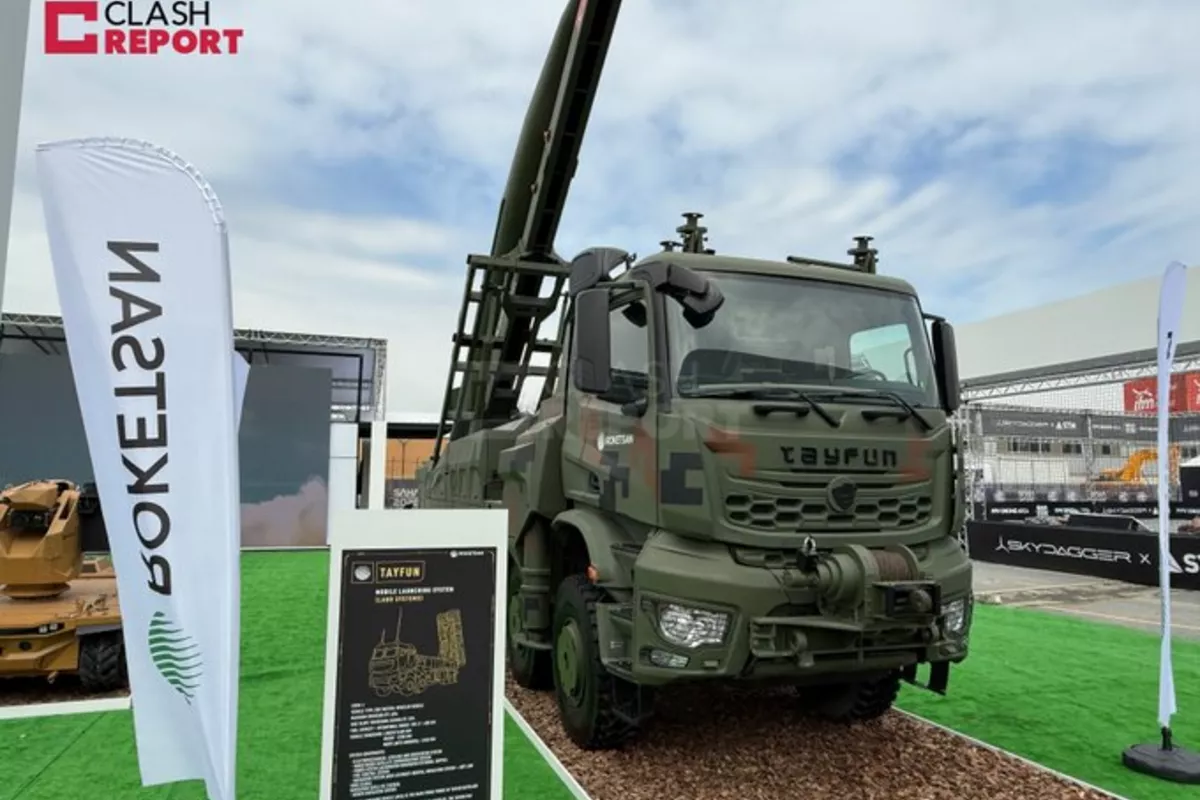
Turkey’s ROKETSAN showcased the TAYFUN Block 4 ballistic missile for the first time at SAHA 2026 in Istanbul, publicly displaying it on its 8×8 wheeled launcher.
According to Clash Report’s coverage of the SAHA 2026 exhibition, the missile measures approximately 10 meters in length, weighs approximately 7.2 tons, and achieves speeds exceeding Mach 5, placing it in the hypersonic category, The Caspian Post reports, citing Defence Blog.
ROKETSAN confirmed in its announcement that deliveries of the first versions of TAYFUN are already underway, meaning the program has progressed beyond development and into initial operational fielding while the Block 4 variant continues its own development path.
The TAYFUN family represents Turkey’s most ambitious indigenous ballistic missile program, developed by ROKETSAN as part of a broader Turkish push to build domestic strategic deterrence capabilities that do not depend on foreign suppliers or export approvals. Ballistic missiles of this class give their operators the ability to strike targets at significant range with high speed and a trajectory that is substantially more difficult to intercept than cruise missiles flying at subsonic speeds. A missile traveling at Mach 5 or above compresses the time available for air defense systems to detect, track, classify, and engage it to the point where many existing intercept systems cannot complete the engagement sequence before impact.
The 8×8 wheeled launcher configuration visible at SAHA 2026 is operationally significant beyond its display value. Road-mobile ballistic missiles are inherently more survivable than silo-based or fixed-position systems because they can reposition between launches, making them difficult to locate, track, and target before they fire or move. A launcher that can drive on public roads, set up at an unprepared position, fire, and relocate within minutes presents a targeting problem that fixed-position air and missile defense architecture struggles to solve comprehensively. Turkey’s choice of an 8×8 heavy truck as the launch platform follows the same mobility logic that has made road-mobile ballistic missiles a cornerstone of strategic deterrence programs worldwide.
The Block 4 designation signals meaningful capability advancement over earlier TAYFUN variants. In ballistic missile development, block upgrades typically address range, payload, guidance accuracy, countermeasures, or some combination of those factors. ROKETSAN has described the Block 4 as the largest and most powerful variant in the family, which at minimum indicates increased missile mass - the 7.2-ton weight and 10-meter length are at the upper end of the tactical ballistic missile category and suggest a system carrying a substantial payload over extended range. The undisclosed range figure is a standard practice for programs of this type, where the operational planning value of ambiguity about maximum reach is part of the deterrence posture.
Turkey’s ballistic missile development has proceeded in parallel with a broader expansion of its defense industrial capabilities that has attracted significant international attention over the past decade. ROKETSAN has developed a portfolio spanning short-range tactical rockets, medium-range ballistic missiles, cruise missiles, and now hypersonic-capable systems, all built on domestic Turkish engineering. The TAYFUN program in particular has been watched closely by neighboring countries and NATO allies, given that a Turkish hypersonic ballistic missile with undisclosed range creates a strike capability that overlaps with the territory of multiple regional actors.