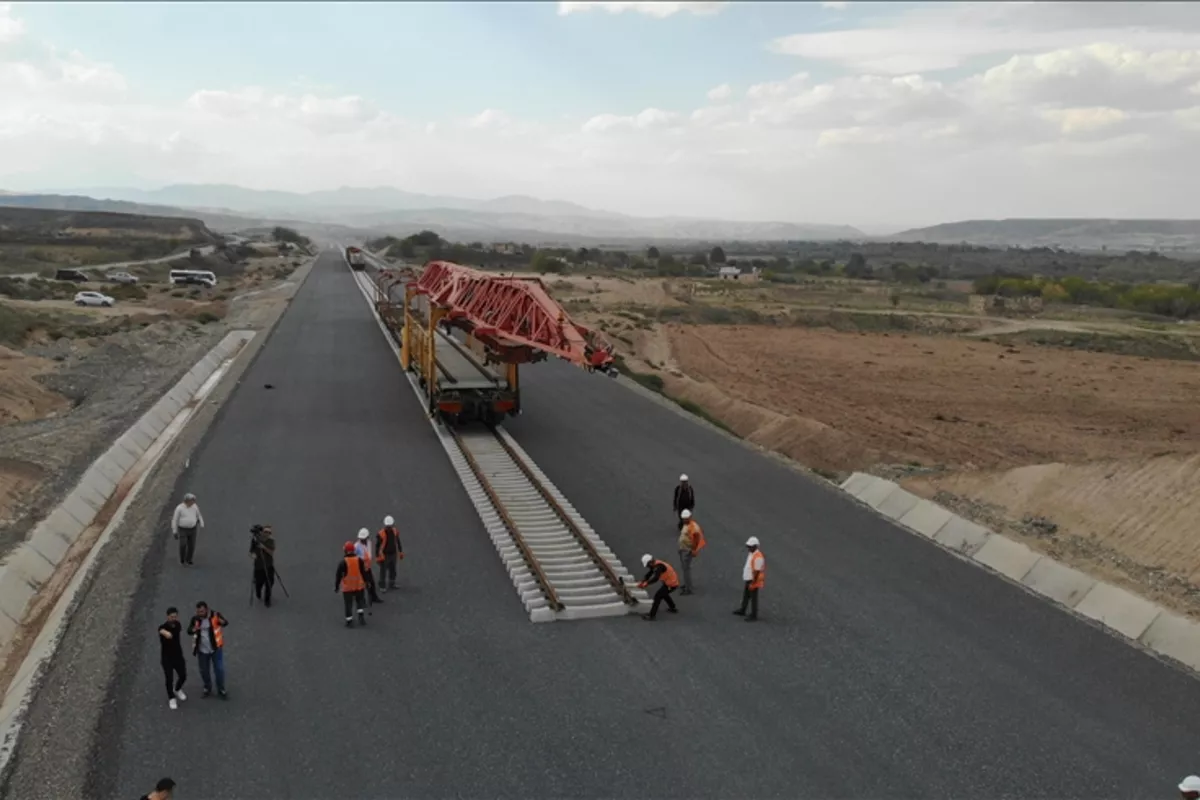
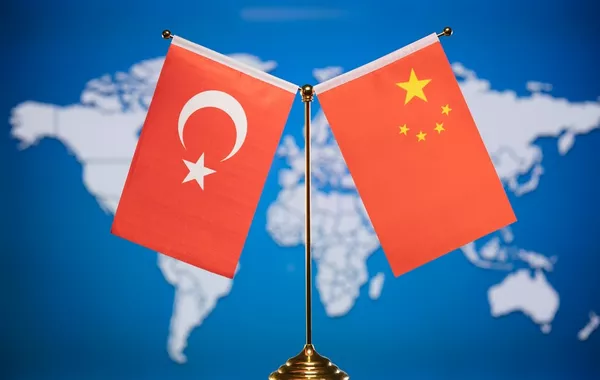
The Zangezur Corridor holds a strategically central place within Türkiye’s long-term infrastructure vision and its broader geopolitical ambition to position itself as a pivotal actor in Eurasian connectivity. Far from being a simple transport passage, the corridor functions as a structural instrument through which Ankara can expand its economic reach, consolidate influence across the South Caucasus and Central Asia, and reinforce its role as a key intermediary between Asian production centers and European consumer markets. Its importance lies not only in geography, but in the modern logic of infrastructure geopolitics, where power increasingly derives from controlling the routes, junctions, and nodes through which goods, energy, and capital circulate.
In an era defined by supply-chain vulnerabilities, geopolitical fragmentation, and competition over transit routes, infrastructure has become a strategic asset. States that control critical corridors do not merely facilitate trade; they shape the terms under which trade occurs. The Zangezur Corridor fits squarely into this paradigm. For Türkiye, it represents an opportunity to translate geographic position into durable economic and diplomatic leverage, anchoring the country more firmly at the heart of Eurasian connectivity.
From Geography to Network Power
Türkiye’s interest in the Zangezur Corridor is rooted in its location at a convergence point between three strategically significant spaces: energy-rich Central Asia, the resource-laden South Caucasus, and the high-demand markets of Europe. Geography alone, however, does not generate influence. It must be operationalized through infrastructure that allows for predictable, scalable, and resilient flows of goods, energy, and people.
This is where the concept of “nodal power” becomes relevant. In contemporary geopolitical thinking, influence is increasingly exercised not through territorial control, but through control over key nodes within transnational networks-rail hubs, ports, pipelines, border crossings, and logistics terminals. States that host or manage these nodes gain the ability to enable, slow, redirect, or condition flows. In a world shaped by sanctions, trade disputes, and transport disruptions, such capabilities translate into strategic leverage.
The Zangezur Corridor embodies this logic. Its significance lies not in shortening distances on a map, but in reducing fragmentation within regional transport architecture. By eliminating bottlenecks and creating continuity between existing routes, the corridor enhances Türkiye’s position as a junction rather than a peripheral transit point. The strategic objective is not merely participation in Eurasian connectivity, but influence over its most commercially viable pathways.
By ensuring that major land routes between Central Asia and Europe pass through Turkish-linked systems, Türkiye strengthens its ability to shape logistics standards, customs procedures, and broader regulatory frameworks. Over time, this influence compounds, transforming transit relevance into diplomatic and economic weight.
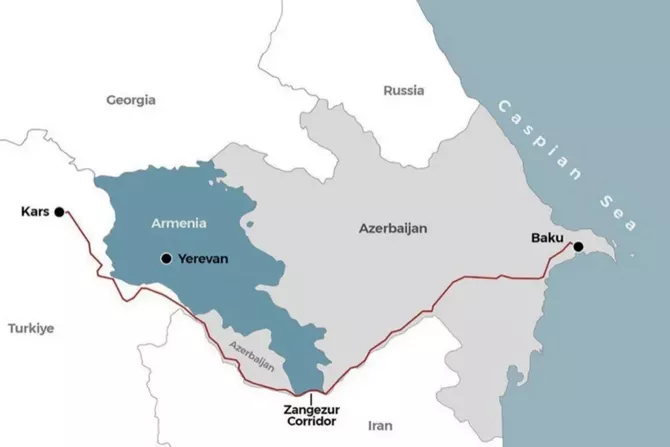
Photo: AIR Center
Integration with Existing Transport Architecture
The importance of the Zangezur Corridor is magnified by the fact that it does not stand alone. Instead, it complements a wider multimodal transport network that Türkiye has actively supported over the past decade. Central to this architecture is the Baku-Tbilisi-Kars railway, which became operational in 2017 and marked a turning point in post-Soviet regional connectivity.
The BTK railway demonstrated that a continuous rail link from the Caspian basin to Anatolia was both technically and politically feasible. It restored east-west connectivity disrupted during the geopolitical upheavals of the 1990s and laid the groundwork for what has become known as the Middle Corridor. Yet despite its success, BTK alone could not eliminate all discontinuities. Political boundaries, infrastructure gaps, and inefficient detours continued to limit seamless transit.
The Zangezur Corridor addresses these remaining structural weaknesses. By enabling a more direct and continuous land connection through the South Caucasus, it strengthens the overall coherence of the regional network. From a logistics perspective, continuity matters as much as distance. Investors and transport operators prioritize routes that minimize delays, border complications, and modal breaks. The corridor therefore enhances the commercial attractiveness of the entire system.
For Türkiye, the strategic payoff emerges from integration. When the Zangezur route is combined with BTK and prospective rail links connecting Anatolia to Nakhchivan, the result is a shorter, more efficient pathway linking Central Asian production centers to Turkish logistics hubs. This allows Türkiye to capture greater value-not only as a transit state, but as a location for storage, processing, consolidation, and redistribution of goods.
Reconfiguring Regional Economic Geography
Transport corridors are not passive conduits; they actively reshape economic landscapes. By reducing transit times and costs, they alter trade patterns, shift investment flows, and create new centers of economic gravity. In this sense, the Zangezur Corridor functions as a “map-changer” with the potential to reconfigure regional economic geography in ways that favor Türkiye.
When connectivity improves, proximity changes. Markets that were once distant become commercially viable, and locations that serve as junctions attract logistics, manufacturing, and service industries. Integrated into existing rail and road networks, the corridor supports the emergence of Turkish-linked logistics hubs capable of serving multiple regions simultaneously-Europe, the Balkans, the Eastern Mediterranean, and potentially the Middle East.
Crucially, Türkiye’s influence does not depend on owning every segment of the corridor. Power accrues from being the point where routes converge, where cargo is aggregated, and where value-added services are provided. Control over scheduling, standards, and customs procedures allows Türkiye to shape the operational logic of the corridor even without formal ownership.
Over time, such influence becomes self-reinforcing. As trade volumes increase, investment follows. As investment deepens, routes become more entrenched. This dynamic helps transform Türkiye from a perceived periphery of global trade into a central Eurasian hub with lasting strategic relevance.
Infrastructure Diplomacy and Strategic Autonomy
The Zangezur Corridor also exemplifies the use of infrastructure as a foreign policy instrument. Connectivity projects serve both economic and geopolitical objectives, enabling Türkiye to strengthen relationships while expanding its strategic footprint.
First, infrastructure diplomacy enhances Ankara’s bargaining power with partners in the South Caucasus and Central Asia. A country that provides indispensable access to markets becomes difficult to bypass. This status supports deeper trade ties, institutional cooperation, and long-term alignment around shared economic interests.
Second, connectivity projects allow Türkiye to project an image of constructive power. Rather than being defined solely by security competition, Ankara can present itself as a driver of regional development and interdependence. This narrative is particularly valuable in a fragmented international environment, where states seek partners that offer tangible economic benefits rather than ideological alignment alone.
Third, the corridor aligns with Türkiye’s broader pursuit of strategic autonomy. In an increasingly multipolar world, reliance on a single route or partner carries risk. By strengthening overland connectivity and diversifying transport options, Türkiye increases its room for maneuver. The ability to engage simultaneously with Europe, Central Asia, and neighboring regions without excessive dependence on any one actor is a hallmark of strategic autonomy.

Photo: Shutterstock
Economic and Macroeconomic Dimensions
The corridor’s strategic value is reinforced by its economic implications. Transit revenues, logistics services, and expanded trade flows generate tangible financial benefits. More importantly, they contribute to a broader ecosystem of value-added activities, including warehousing, insurance, financing, and maintenance.
Improved connectivity also strengthens Türkiye’s trade links with Central Asia, lowering transaction costs and increasing predictability. Over time, this deepens economic interdependence and supports the expansion of Turkish firms across the region.
From a macroeconomic perspective, the corridor takes on added significance in light of Türkiye’s structural challenges, including persistent current account deficits. Infrastructure-based hub status can support foreign exchange generation, improve export competitiveness, and attract foreign direct investment into logistics and manufacturing. While no single project can resolve macroeconomic imbalances, corridors such as Zangezur function as long-term levers that support resilience and growth.
Conclusion: Converting Connectivity into Influence
The strategic importance of the Zangezur Corridor for Türkiye lies in its capacity to convert geography into leverage. By strengthening nodal power, integrating with existing transport networks, and reconfiguring regional economic geography, the corridor advances Ankara’s ambition to become a central Eurasian hub.
Beyond logistics, it supports infrastructure diplomacy, economic competitiveness, and strategic autonomy in a multipolar environment. In the politics of connectivity, shaping routes means shaping outcomes. The Zangezur Corridor is therefore not simply a transport project, but a mechanism through which Türkiye can influence the future structure of Eurasian trade and power relations.