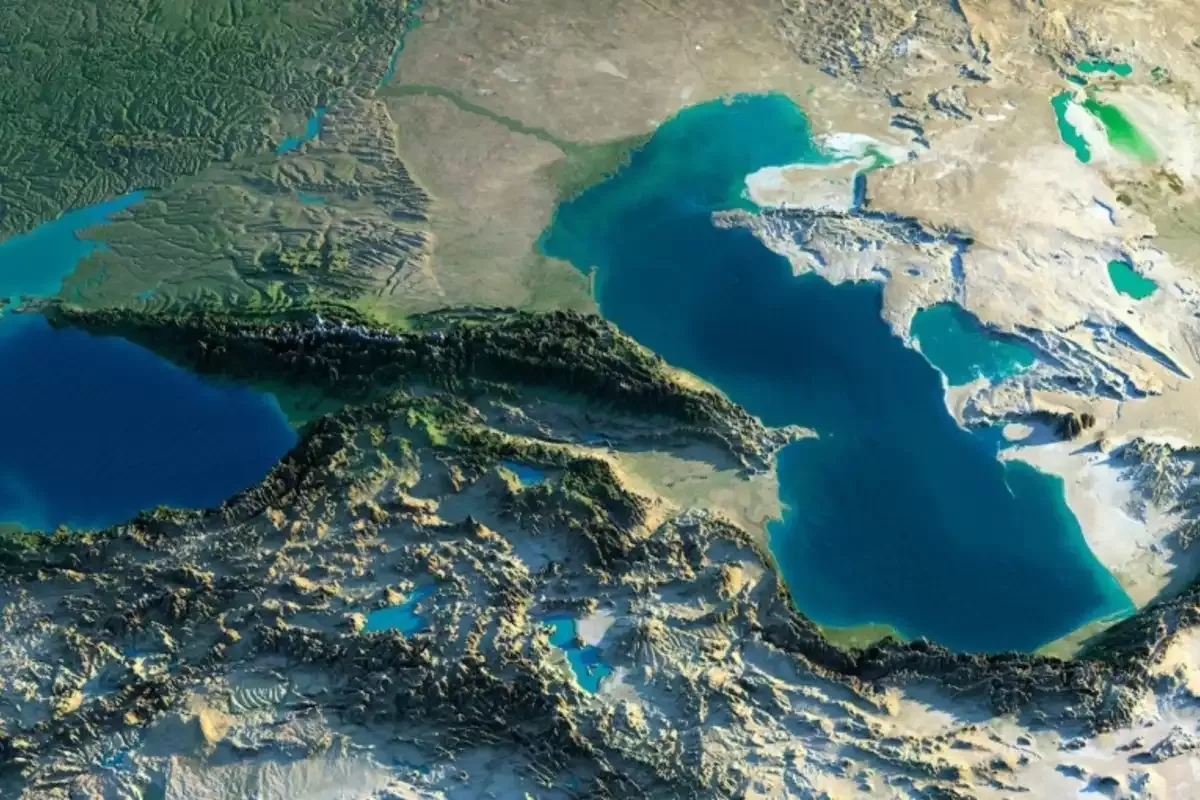
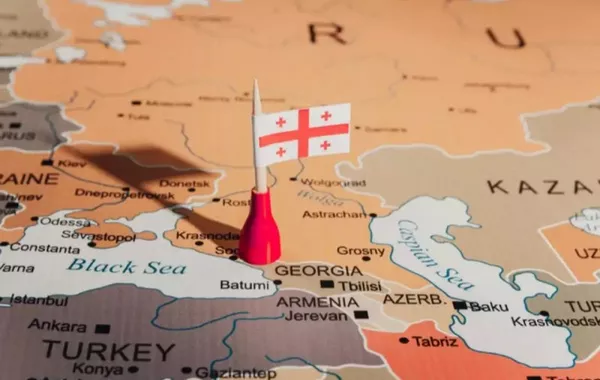
The Caspian Sea, long seen as a stable natural, economic and transport resource for the region, is changing rapidly. Its falling water level is no longer a topic only for scientists and environmentalists. Today, it has become an issue of national security, logistics, energy, fisheries, port infrastructure and the future of coastal cities. The problem is especially acute for Azerbaijan and Kazakhstan - two countries for which the Caspian is not just a sea, but a crucial element of economic development, international trade and geopolitical positioning.
The decline in the Caspian Sea level has been observed for many years, but in recent years the process has become particularly visible. For Azerbaijan, it poses risks to the Absheron coastline, maritime infrastructure, port logistics and fish stocks. For Kazakhstan, the situation is even more dramatic because the northern part of the Caspian is shallow. There, even a relatively small drop in water level can push the sea far away from the shore.
In Azerbaijan, the shallowing of the Caspian is directly linked to the future of Baku, the Port of Alat, maritime transport, coastal tourism areas and offshore energy infrastructure. As the sea retreats, the coastline changes, port operations become more complicated, dredging costs rise, and coastal infrastructure has to adapt to new conditions. Azerbaijani officials have repeatedly warned that the situation is a serious concern.
In 2023, Azerbaijan’s Minister of Ecology and Natural Resources Mukhtar Babayev said that over the previous 10 years, the Caspian Sea level had fallen by 114 centimeters (source: AZERTAC).
For Kazakhstan, the retreat of the Caspian is not only an environmental problem, but also a social one. This is particularly true for the Mangystau and Atyrau regions, where the sea has historically supported economic activity, fisheries, transport and water supply. Kazakhstan’s section of the Caspian is especially vulnerable because the northern part of the sea is shallow. Areas that were once under water are now turning into exposed seabed, salt flats and dry coastal zones. This is reshaping the landscape, worsening conditions for fish and the Caspian seal, and creating new risks for local communities.
Kazakh environmentalists describe the situation in stark terms. Kirill Osin, head of the NGO Eco Mangistau, believes that Aktau may be among the first cities to be seriously affected, since the sea is a key source of water after desalination. According to him, the falling level of the Caspian is already creating problems for water intake and the desalination process. In winter, low water levels and insufficient dredging caused difficulties with the water intake canal, while in summer the higher temperature of intake water also affects the system’s operation (source: VPO Analytics / Eco Mangistau).
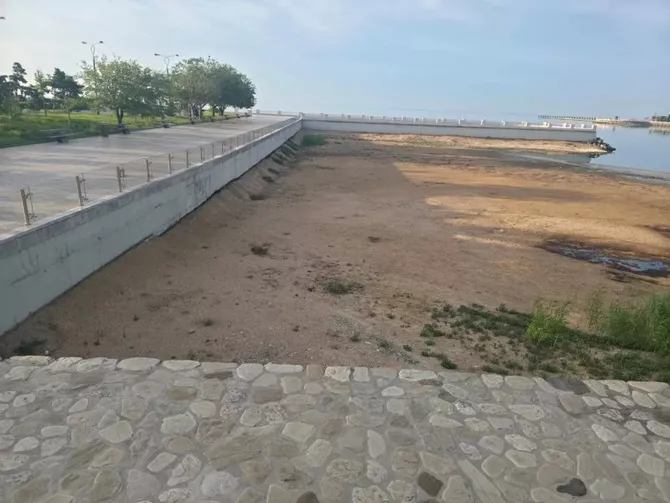
Photo: News.Az
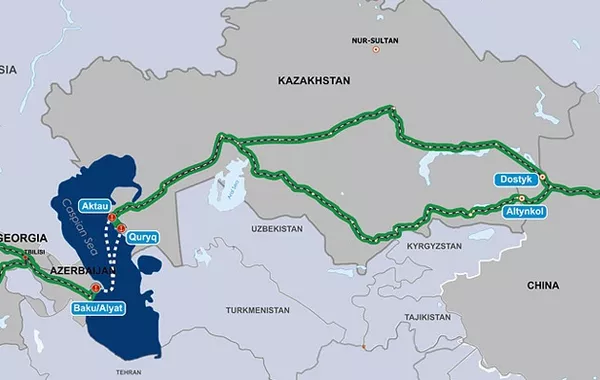
Osin also stresses that restoring the Caspian to its previous level will be extremely difficult. In his view, the sea has its own natural cycles, but the current situation is being worsened by climate change, declining river flow and human economic activity. For Kazakhstan, this is particularly dangerous because the sea’s decline directly affects the ports of Aktau and Kuryk, which play a key role in the development of the Trans-Caspian International Transport Route. If the water level continues to fall, vessel movement may become more difficult, port maintenance costs may increase, and the resilience of logistics routes may weaken.
Kazakh environmentalist Vadim Ni, founder of the Save The Caspian Sea movement, is even more direct. He says the Caspian is “losing its life” because of shallowing, pollution, and the decline of fish and Caspian seal populations. He notes that the Caspian receives around 80% of its water from the Volga River, while lower rainfall caused by climate change and the construction of dams along the river prevent water from reaching the sea in previous volumes. In his view, this is one of the main reasons for the falling water level (source: Anadolu Agency).
This position is important because it shows that the problem goes far beyond one country. Kazakhstan and Azerbaijan can adapt their ports, strengthen coastal infrastructure and improve environmental monitoring, but they do not control the Caspian’s main source of water - the Volga. That is why the issue of the sea’s decline inevitably becomes a matter of regional diplomacy involving Russia, Iran, Turkmenistan and the other Caspian littoral states.
Kazakh environmentalists also warn about the need to learn from the negative experience of the Aral Sea. Of course, the Caspian and the Aral are different water systems, and they should not be compared mechanically. But some of the risks are similar: shrinking water surface, ecosystem degradation, coastline retreat, worsening living conditions for coastal communities, and growing risks linked to dust and salt. That is why Kazakh specialists argue that the region should not merely observe the process, but build a long-term adaptation strategy.
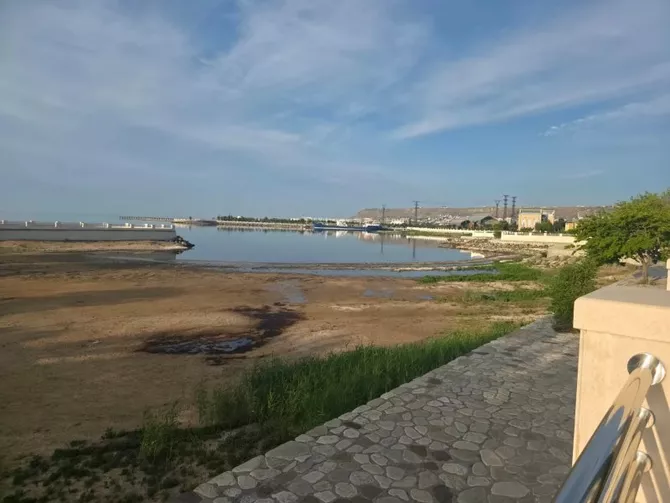
Photo: News.Az
In Azerbaijan, experts also acknowledge that the falling Caspian Sea level is already affecting both the environment and the economy. Environmentalist Rovshan Abbasov says the reduction in the sea level is seriously affecting fish stocks. According to him, this may lead to the shrinking of the Caspian’s unique flora and fauna and even the disappearance of some species. He is especially concerned about sturgeon and black caviar production, as the Caspian once accounted for a major share of the world’s supply of this valuable product (source: Day.Az / Milli.Az).
Abbasov also argues that the problem is not limited to the falling level of the sea itself. He points to a wider set of factors: declining water levels in rivers, climate change, river pollution and excessive pressure on water resources. According to him, lower river flows, the shallowing of the Caspian and pollution, including from neighboring countries, are worsening conditions for fish spawning and causing serious damage to fisheries (source: Media.Az).
In another comment, Abbasov noted that the level of the Caspian Sea has been gradually declining since 1995. He linked this to reduced water levels in the rivers flowing into the sea, especially the Kura and the Volga, as well as growing demand for freshwater in the Caspian region. According to him, a large share of agricultural production in Azerbaijan requires irrigation, and as a result less river water reaches the sea, affecting both the Caspian’s level and fish stocks (source: Baku.ws / Oxu.Az).
Thus, Azerbaijani environmentalists view the Caspian’s decline not as an isolated phenomenon, but as part of a broader water crisis. The issue involves climate, rivers, agriculture, pollution, urbanization and water management. This is especially important for Azerbaijan, where water security is already becoming one of the key priorities of environmental policy.
Professor Nizami Mammadov believes that fluctuations in the Caspian Sea level should be treated as one of the region’s fundamental environmental challenges. He notes that Azerbaijan is facing not only the shallowing of the sea, but also transboundary pollution of the Kura and Araz rivers, declining biodiversity, soil salinization and desertification. In his view, Azerbaijan could propose the creation of an international institute that would study the fundamental problems of the Caspian, conduct scientific forecasting and develop solutions for the littoral states (source: AZERTAC).
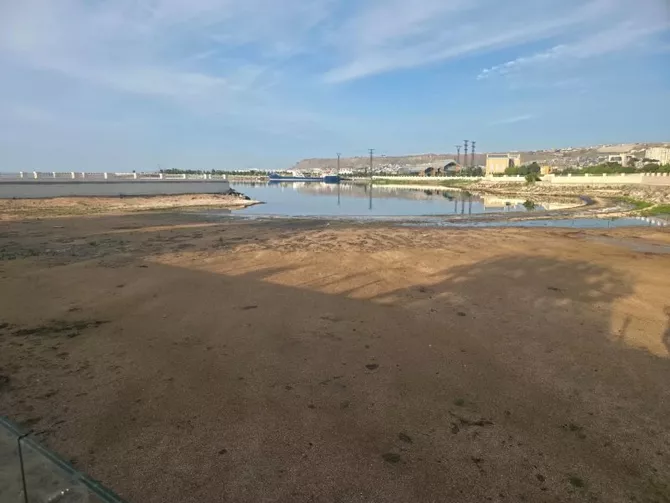
Photo: News.Az
This proposal looks particularly relevant because each country currently records the consequences of the Caspian’s decline in its own sector, while the nature of the problem requires a common scientific center and a unified monitoring system. Without coordinated data, long-term forecasts and cooperation between the countries, it will be impossible to understand how quickly the water level may continue to fall and which adaptation measures are most urgent.
At the official level, Azerbaijan also emphasizes a collective approach. Mukhtar Babayev, Azerbaijan’s Presidential Representative on Climate Issues and COP29 President, said in Astana that the decline in the Caspian Sea level is a common challenge requiring collective solutions. He stressed that the problem affects not only the environment, but also coastal infrastructure, economic activity and the well-being of people living by the sea (source: CBC TV Azerbaijan / Trend).
Azerbaijan's Deputy Minister of Ecology and Natural Resources Umayra Taghiyeva earlier said that since 2018 the Caspian Sea level had dropped by 69 centimeters, and since 2013 by 114 centimeters. She noted that the issue concerns all Caspian states and that Azerbaijan had already initiated international discussions on the matter (source: Haqqin.az).
The main reason for concern is that the Caspian’s decline affects several areas at once. First, it is a blow to the ecosystem. Shallow-water zones are shrinking, spawning conditions are changing, the habitat of the Caspian seal is deteriorating, and pressure on coastal wetlands is increasing. Second, it is a blow to the economy. Ports, shipping, fisheries, energy, tourism and water supply are becoming more vulnerable. Third, it is a social risk: people living in coastal areas are facing changes in their familiar environment.
For Azerbaijan, the most sensitive areas are the Absheron coast, the Baku metropolitan area, the Port of Alat, maritime logistics, fish stocks and coastal environmental security. If the Caspian continues to retreat, Azerbaijan will have to invest more in adapting port infrastructure, protecting coastal areas, monitoring pollution and preserving biodiversity.
For Kazakhstan, the main risks are linked to the Mangystau and Atyrau regions, the ports of Aktau and Kuryk, water supply for Aktau, fisheries, oil and gas infrastructure and the condition of northern Caspian ecosystems. Unlike deeper parts of the sea, the northern Caspian reacts especially sharply to falling water levels. Therefore, Kazakhstan is already seeing not just a decline in depth, but the actual retreat of the sea from the shore.
Experts from both countries agree on the core point: the Caspian can no longer be treated as a stable natural resource. It is a dynamic and vulnerable system shaped by climate, rivers, economic activity and regional policy. Azerbaijani specialists tend to focus on scientific monitoring, protection of fish resources, an international research institute and collective solutions. Kazakh environmentalists more often emphasize the visible consequences already unfolding: retreating water, risks for Aktau, port problems, and worsening conditions for fish and seals.
The shallowing of the Caspian is becoming a test for the entire region. If the littoral states limit themselves to statements, the problem will only deepen. But if a real coordination system is created, including joint monitoring, data exchange, environmental programs, port adaptation and a serious dialogue on river flow, the region may still have a chance to soften the consequences.
The Caspian is not retreating in a single day, and that is precisely why the danger is easy to underestimate. The sea is moving back gradually, centimeter by centimeter, but the consequences may be enormous. For Azerbaijan and Kazakhstan, this is no longer a question of the distant future. It is a challenge of the present - one that will shape the economy, ecology, transport corridors and quality of life for millions of people living along the shores of the Caspian.
By Murad Samedov